Results by title
2 books match the query 'Altman, Robert'
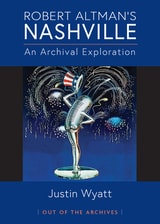
Robert Altman's Nashville
An Archival ExplorationJustin Wyatt
University of Michigan Press, 2026
Nashville (1975) is a beguiling work of art. It illustrates director Robert Altman’s ability to blend small, quotidian moments; large scenes of spectacle; and insights into American life that are both disturbing and sharply observed. As a snapshot of American society firmly rooted in a specific time and place, the film presents a compelling landscape of American dreams, failures, and lies. One of the most influential works in New Hollywood, Nashville was added to the National Film Registry in 1992 and has been on the BFI 100 Greatest Films list voted by critics and directors.
This book explores Robert Altman’s classic film from a variety of critical perspectives inspired by the archival materials from the Altman archive in the Screen Arts Mavericks and Makers collection at the University of Michigan Special Collections Research Center. Each chapter is centered around materials on Nashville from the Altman archive: stills, contact sheets, advertising artwork (used and unused), Jean Pagliuso photo shoots, Joan Tewkesbury script drafts, contracts, reviews, internal accounting memos, and the Altman scrapbooks. (Each of his films has a scrapbook of reviews, interviews, and notes from fans.) Using these sources as a starting point, the book seeks to explain the relevance and importance of Nashville after more than half a century.
This book explores Robert Altman’s classic film from a variety of critical perspectives inspired by the archival materials from the Altman archive in the Screen Arts Mavericks and Makers collection at the University of Michigan Special Collections Research Center. Each chapter is centered around materials on Nashville from the Altman archive: stills, contact sheets, advertising artwork (used and unused), Jean Pagliuso photo shoots, Joan Tewkesbury script drafts, contracts, reviews, internal accounting memos, and the Altman scrapbooks. (Each of his films has a scrapbook of reviews, interviews, and notes from fans.) Using these sources as a starting point, the book seeks to explain the relevance and importance of Nashville after more than half a century.
[more]
Robert Altman’s Subliminal Reality
Robert T. Self
University of Minnesota Press, 2002
The most complete and compelling analysis available of Altman’s films
With his complex and unconventional films, Robert Altman often draws an impassioned response from critics but bafflement and indifference from the general public. Some audiences have dismissed his movies as insignificant, unsatisfying, and unreadable. Ironically, Altman might agree: he makes films in order to challenge filmgoers’s expectations of straightforward narratives and easily understood endings.
In Robert Altman’s Subliminal Reality, Robert T. Self sheds light on Altman’s work and provides the most comprehensive analysis of his films to date. With close readings of classics like MASH, McCabe and Mrs. Miller, and Nashville, as well as more recent films like The Player, Short Cuts, and Cookie’s Fortune, Self asserts the value of Altman’s work not only to film theory and the entertainment industry but to American culture itself. In his analysis, Self identifies Altman’s films particularly as they address issues of form, identity, and industry. He explains how Altman critiques moviemaking forms by using an open, fragmented mode of storytelling and by turning conventional Hollywood genres inside out. He examines Altman’s characterization of social and individual identity as fragile and fragmentary and his depiction of antiheroic characters debilitated by their socially constructed gender roles. Finally, Self shows how Altman challenges the entertainment industry itself, questioning its methods and motives and critiquing its role in our cultural alienation. Self frames his study of Altman’s work with a discussion of the director’s efforts to create a "subliminal reality" in his narratives—to touch audiences on an unconscious level and to recognize the unspoken, and unspeakable, dimensions in human interactions. According to Self, this striving for "subliminal reality" makes Altman’s films not only exemplary of the potential of art cinema narration but instrumental in keeping such narrative alive.[more]