Results by title
4 books match the query 'Américas'
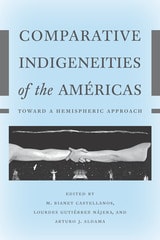
Comparative Indigeneities of the Américas
Toward a Hemispheric ApproachEdited by M. Bianet Castellanos, Lourdes Gutiérrez Nájera, and Arturo J. Aldama
University of Arizona Press, 2012
The effects of colonization on the Indigenous peoples of the Américas over the past 500 years have varied greatly. So too have the forms of resistance, resilience, and sovereignty. In the face of these differences, the contributors to this volume contend that understanding the commonalities in these Indigenous experiences will strengthen resistance to colonial forces still at play. This volume marks a critical moment in bringing together transnational and interdisciplinary scholarship to articulate new ways of pursuing critical Indigenous studies.
Comparative Indigeneities of the Américas highlights intersecting themes such as indigenísmo, mestizaje, migration, displacement, autonomy, sovereignty, borders, spirituality, and healing that have historically shaped the experiences of Native peoples across the Américas. In doing so, it promotes a broader understanding of the relationships between Native communities in the United States and Canada and those in Latin America and the Caribbean and invites a hemispheric understanding of the relationships between Native and mestiza/o peoples.
Through path-breaking approaches to transnational, multidisciplinary scholarship and theory, the chapters in this volume advance understandings of indigeneity in the Américas and lay a strong foundation for further research. This book will appeal to scholars and students in the fields of anthropology, literary and cultural studies, history, Native American and Indigenous studies, women and gender studies, Chicana/o studies, and critical ethnic studies.
Ultimately, this deeply informative and empowering book demonstrates the various ways that Indigenous and mestiza/o peoples resist state and imperial attempts to erase, repress, circumscribe, and assimilate them.
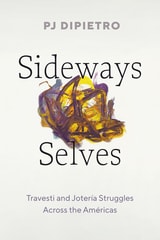
Sideways Selves
Travesti and Jotería Struggles Across the AméricasPJ DiPietro
University of Texas Press, 2025
2026 Sylvia Rivera Award in Transgender Studies, The Center for LGBTQ Studies (CLAGS), CUNY
How trans and non-binary networks engage in decoloniality across hemispheres.
A deeply informed, theoretically rich work of inquiry and critique, Sideways Selves learns from two communities of migrants as they contest their marginalization under the colonial regime of gender—colonial because, as PJ DiPietro affirms, Indigenous and Afro-diasporic conceptions of embodiment have been displaced by the European-Christian order of gender. Following gender-nonconforming Aymara, Kolla, and mixed-race exiles in Buenos Aires and K’iche’, Nahua, and Central American migrants in the San Francisco Bay Area, DiPietro takes stock of a collective, transnational effort to reimagine ideas of personhood and kinship that gender makes unthinkable.
The communities DiPietro studies create new kinds of identities, collective and genderless in nature. Their ways of thinking and doing, though radical, are motivated by old wisdom, storytelling, healing, and religion—brujería, curanderismo, Voudoun, and other practices that colonialism, capitalism, and the nation-state have unsuccessfully tried to erase. In equal measures philosophical and ethnographic, Sideways Selves witnesses and listens as these displaced people—displaced from their homes and from the moral geography of the West—show us what a just, decolonial world could actually be.
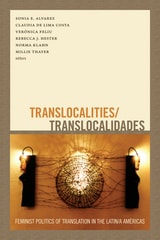
Translocalities/Translocalidades
Feminist Politics of Translation in the Latin/a AméricasSonia E. Alvarez, Claudia de Lima Costa, Verónica Feliu, Rebecca J. Hester, Norma Klahn, and Millie Thayer, eds.
Duke University Press, 2014
Contributors. Sonia E. Alvarez, Kiran Asher, Victoria (Vicky) M. Bañales, Marisa Belausteguigoitia Rius, Maylei Blackwell, Cruz C. Bueno, Pascha Bueno-Hansen, Mirangela Buggs, Teresa Carrillo, Claudia de Lima Costa, Isabel Espinal, Verónica Feliu, Macarena Gómez-Barris, Rebecca J. Hester, Norma Klahn, Agustín Lao-Montes, Suzana Maia, Márgara Millán, Adriana Piscitelli, Ana Rebeca Prada, Ester R. Shapiro, Simone Pereira Schmidt, Millie Thayer
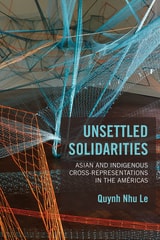
Unsettled Solidarities
Asian and Indigenous Cross-Representations in the AméricasQuynh Nhu Le
Temple University Press, 2019
Unsettled Solidarities examines contemporary Asian and Indigenous cross-representations within different settler states in the Américas. Quynh Nhu Le looks at literary works by both groups alongside public apologies, interviews, and hemispheric race theories to trace cross-community tensions and possibilities for solidarities amidst the uneven imposition of racialization and settler colonization.
Contrasting texts such as Maxine Hong Kingston’s China Men with Gerald Vizenor’s Hiroshima Bugi, and Karen Tei Yamashita’s Through the Arc of the Rain Forest with Leslie Marmon Silko’s Almanac of the Dead, among others, Le reveals how settler colonialism persists through the liberal ideological structuring or incorporation of critical and political resistance. She illuminates the tense collisions of Asian and Indigenous movements from the heroic/warrior traditions, reparations and redress, and transnational/cross-racial mobilization against global capital to mixed-race narratives.
Reading these tensions as formed through the unstable grammatical and emotional economies of liberalism, Le frames settler colonialism as a process that is invoked and yet ruptured by Asian and Indigenous peoples. In analyzing Asian/Indigenous crossings in the United States, Canada, Mexico, and Brazil, Unsettled Solidarities conveys the logics and instabilities that connect these settler empires.