Results by title
2 books match the query 'Amaya, Hector'
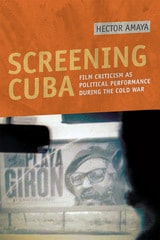
Screening Cuba
Film Criticism as Political Performance during the Cold WarHector Amaya
University of Illinois Press, 2010
Hector Amaya advances into new territory in Latin American and U.S. cinema studies in this innovative analysis of the differing critical receptions of Cuban film in Cuba and the United States during the Cold War. Synthesizing film reviews, magazine articles, and other primary documents, Screening Cuba compares Cuban and U.S. reactions to four Cuban films: Memories of Underdevelopment, Lucia, One Way or Another, and Portrait of Teresa.
In examining cultural production through the lens of the Cold War, Amaya reveals how contrasting interpretations of Cuban and U.S. critics are the result of the political cultures in which they operated. While Cuban critics viewed the films as powerful symbols of the social promises of the Cuban revolution, liberal and leftist American critics found meaning in the films as representations of anti-establishment progressive values and Cold War discourses. By contrasting the hermeneutics of Cuban and U.S. culture, criticism, and citizenship, Amaya argues that critical receptions of political films constitute a kind of civic public behavior.
[more]
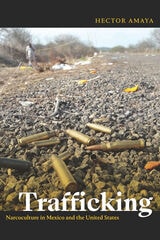
Trafficking
Narcoculture in Mexico and the United StatesHector Amaya
Duke University Press, 2020
In Trafficking Hector Amaya examines how the dramatic escalation of drug violence in Mexico in 2008 prompted new forms of participation in public culture in Mexico and the United States. He contends that, by becoming a site of national and transnational debate about the role of the state, this violence altered the modes publicness could take, transforming assumptions about freedom of expression and the rules of public participation. Amaya examines the practices of narcocorrido musicians who take advantage of digital production and distribution technologies to escape Mexican censors and to share music across the US-Mexico border, as well as anonymous bloggers whose coverage of trafficking and violence from a place of relative safety made them public heroes. These new forms of being in the public sphere, Amaya demonstrates, evolved to exceed the bounds of the state and traditional media sources, signaling the inadequacy of democratic theories of freedom and publicness to understand how violence shapes public discourse.
[more]