Results by title
2 books match the query 'Amazonas'
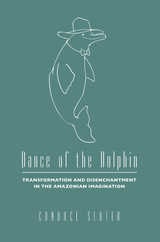
Dance of the Dolphin
Transformation and Disenchantment in the Amazonian ImaginationCandace Slater
University of Chicago Press, 1994
In folktales told throughout much of the Brazilian Amazon, dolphins take human form, attend raucous dances and festivals, seduce men and women, and carry them away to a city beneath the river. They are encantados, or Enchanted Beings, capable of provoking death or madness, but also called upon to help shamanic healers. Male dolphins—accomplished dancers who appear dressed in dapper straw hats, white suits, and with shiny black shoes—reportedly father numerous children. The females are said to lure away solitary fishermen. Both sinister and charming, these characters resist definition and thus domination; greedy and lascivious outsiders, they are increasingly symbolic of a distinctly Amazonian culture politically, socially, economically, and environmentally under seige.
Candace Slater examines these stories in Dance of the Dolphin, both as folk narratives and as representations of culture and conflict in Amazonia. Her engaging study discusses the tales from the viewpoints of genre, performance, and gender, but centers on them as responses to the great changes sweeping the Amazon today. According to Slater, these surprisingly widespread tales reflect Amazonians' own mixed reactions to the ongoing destruction of the rainforest and the resulting transformations in the social as well as physical landscape. Offering an informed view of Brazilian culture, this book crosses the boundaries of folklore, literature, anthropology, and Latin American studies. It is one of the very few studies to offer an overview of the changes taking place in Amazonia through the eyes of ordinary people.
"This book is a rich collection of stories about the transformation of dolphins in the city of enchantment. . . . The joy in this book is not just its vibrant analysis and careful relating of tradition and lore, but also its uncanny accurateness in capturing the very essence of Amazonia."-Darrell Posey, Journal of Latin American Studies
"Slater's fluid prose reads like a novel for those interested in Amazonian culture and folklore, while her integrated approach makes this a must read for those interested in innovative methodology."-Lisa Gabbert, Western Folklore
[more]
Forest Lost
Producing Green Capitalism in the Brazilian AmazonMaron E. Greenleaf
Duke University Press, 2024
Forest Lost is an ethnography of forest carbon offsets and the wider effort to make the living rainforest valuable in the Brazilian Amazon. Unlike other forest commodities, forest carbon offsets do not involve resource extraction; instead, they require keeping carbon in place through forest protection. Maron E. Greenleaf explores forest carbon offsets to understand green capitalism—the use of capitalist logics and practices to mitigate environmental damage. She traces cultural, environmental, governmental, material, and multispecies relations involved in making forest carbon valuable as well as how forest carbon’s commodification in the Amazon turned it into a source of redistributable public environmental wealth. At the same time, Greenleaf shows how making forest carbon monetarily valuable created an unexpected set of uneven, contingent, and contested social and political relations. While forest carbon in the Amazon demonstrates that green capitalism can be socially inclusive, it also shows that green capitalism can reinforce the marginalization it purportedly seeks to combat. By outlining these complex relations and tensions, Greenleaf elucidates broader efforts to create a capitalism suited to the Anthropocene and those efforts’ alluring promises and vexing failures.
[more]