Results by title

3 books match the query 'Ambassador'
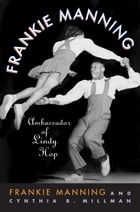
cover of Frankie Manning: Ambassador of Lindy Hop

Frankie Manning

Ambassador of Lindy Hop

Frankie Manning

Temple University Press, 2008

In the early days of swing dancing, Frankie Manning stood out for his moves and his innovative routines; he created the "air step" in the Lindy hop, a dance that took the U.S. and then the world by storm. In this fascinating autobiography, the choreographer and Tony Award winner (Black and Blue) Frankie Manning recalls how his first years of dancing as a teenager at Harlem's Savoy Ballroom led to his becoming chief choreographer and a lead dancer for Whitey's Lindy Hoppers, a group that appeared on Broadway, in Hollywood musicals, and on stages around the globe. Manning brings the Swing Era vividly back to life with his recollections of the crowded ballrooms, and of Lindy hoppers trying to outdo each other in spectacular performances. His memories of the many headliners and film stars, as well as uncelebrated dancers with whom he shared the stage, create a unique portrait of an era in which African American performers enjoyed the spotlight if not a star's prerogatives and salary.

With collaborator Cynthia Millman, Manning traces the evolution of swing dancing from its early days in Harlem through the post-World War II period, until it was eclipsed by rock 'n' roll and then disco. When swing made a comeback, Manning's 30-year hiatus ended. He has been performing, choreographing, and teaching ever since.
[more]
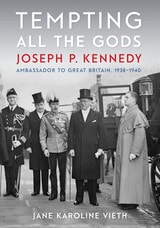
cover of Tempting All the Gods: Joseph P. Kennedy, Ambassador to Great Britain, 1938–1940

Tempting All the Gods

Joseph P. Kennedy, Ambassador to Great Britain, 1938–1940

Jane Karoline Vieth

Michigan State University Press, 2021
Tempting All the Gods is a detailed study of Joseph P. Kennedy’s diplomatic career in London. It examines Kennedy’s role as ambassador to the Court of St. James’s from 1938–1940, a crucial time in world history. It describes his attitudes toward American foreign policy before the outbreak of war and after the war began, explains why he held those views, and assesses their impact on Anglo-American relations. It also looks at the diplomatic background against which he worked, at the political philosophies and personalities of the statesmen with whom he dealt, and at his relations with them, particularly President Franklin Roosevelt and British Prime Ministers Neville Chamberlain and Winston Churchill. Here the reader will find a meticulously researched account of Kennedy’s career based on the latest evidence available, providing a current and balanced historical reassessment. Scholars will be able to study Kennedy’s diplomatic career within the broader context of international relations and also to gain a fuller understanding of his view of his own motives and policies, including an understanding of why the ambassadorship was the greatest achievement—with the poorest outcome—in the varied life of an intensely ambitious man who was dedicated foremost to family, friends, and fortune. This book will prove significant to students of Anglo-American relations and of World War II, and to the general public, with its enduring fascination with the Kennedy family.
[more]
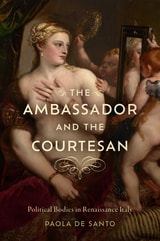
cover of The Ambassador and the Courtesan: Political Bodies in Renaissance Italy

The Ambassador and the Courtesan

Political Bodies in Renaissance Italy

Paola De Santo

University of Delaware Press, 2026

Drawing on literature, legal texts, and archival materials, The Ambassador and the Courtesan offers a comparative analysis of these two emerging roles in the early modern period and in Renaissance Italian society. While these two figures may appear unrelated, this book demonstrates their shared relation to the body politic, including the relationship of their very bodies to that metaphorical body. One imagines the early modern ambassador as traveling from one center of power to another, gathering news and disseminating it in writing, as well as negotiating in person. The courtesan, in contrast, is normally imagined employing her body in the service of entertaining elite clients in the enclosed space of the urban salon. These characterizations reinforce their very different roles in Renaissance Italian society and culture, but by placing them in dialogue, salient points of convergence emerge detailing how they were integral to the concurrent emergence of a modern subjectivity of the individual and the formation of the modern state.
[more]