Results by title

3 books match the query 'Ambiguity in literature'
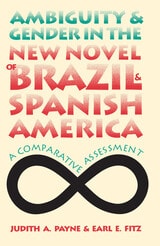
cover of Ambiguity and Gender in the New Novel of Brazil and Spanish America: A Comparative Assessment

Ambiguity and Gender in the New Novel of Brazil and Spanish America

A Comparative Assessment

Payne, Judith A.

University of Iowa Press, 1993
In this first book-length study to compare the "new novels" of both Spanish America and Brazil, the authors deftly examine the differing perceptions of ambiguity as they apply to questions of gender and the participation of females and males in the establishment of Latin American narrative models. Their daring thesis: the Brazilian new novel developed a more radical form than its better-known Spanish-speaking cousin because it had a significantly different approach to the crucial issues of ambiguity and gender and because so many of its major practitioners were women.
As a wise strategy for assessing the canonical new novels from Latin America, the coupling of ambiguity and gender enables Payne and Fitz to discuss how borders--literary, generic, and cultural--are maintained, challenged, or crossed. Their conclusions illuminate the contributions of the new novel in terms of experimental structures and narrative techniques as well as the significant roles of voice, theme, and language. Using Jungian theory and a poststructural optic, the authors also demonstrate how the Latin American new novel faces such universal subjects as myth, time, truth, and reality. Perhaps the most original aspect of their study lies in its analysis of Brazil's strong female tradition. Here, issues such as alternative visions, contrasexuality, self-consciousness, and ontological speculation gain new meaning for the future of the novel in Latin America.
With its comparative approach and its many bilingual quotations, Ambiguity and Gender in the New Novel of Brazil and Spanish America offers an engaging picture of the marked differences between the literary traditions of Portuguese-speaking and Spanish-speaking America and, thus, new insights into the distinctive mindsets of these linguistic cultures.
[more]
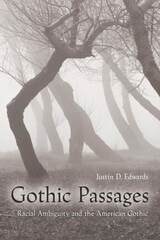
cover of Gothic Passages: Racial Ambiguity and the American Gothic

Gothic Passages

Racial Ambiguity and the American Gothic

Justin D. Edwards

University of Iowa Press, 2003

This groundbreaking study analyzes the development of American gothic literature alongside nineteenth-century discourses of passing and racial ambiguity.

By bringing together these areas of analysis, Justin Edwards considers the following questions. How are the categories of “race” and the rhetoric of racial difference tied to the language of gothicism? What can these discursive ties tell us about a range of social boundaries—gender, sexuality, class, race, etc.—during the nineteenth century? What can the construction and destabilization of these social boundaries tell us about the development of the U.S. gothic?

The sources used to address these questions are diverse, often literary and historical, fluidly moving between “representation” and “reality.” Works of gothic literature by Edgar Allan Poe, Herman Melville, Frances Harper, and Charles Chesnutt, among others, are placed in the contexts of nineteenth-century racial “science” and contemporary discourses about the formation of identity. Edwards then examines how nineteenth-century writers gothicized biracial and passing figures in order to frame them within the rubric of a “demonization of difference.” By charting such depictions in literature and popular science, he focuses on an obsession in antebellum and postbellum America over the threat of collapsing racial identities—threats that resonated strongly with fears of the transgression of the boundaries of sexuality and the social anxiety concerning the instabilities of gender, class, ethnicity, and nationality.

Gothic Passages not only builds upon the work of Americanists who uncover an underlying racial element in U.S. gothic literature but also sheds new light on the pervasiveness of gothic discourse in nineteenth-century representations of passing from both sides of the color line. This fascinating book will be of interest to scholars of American literature, cultural studies, and African American studies.
[more]
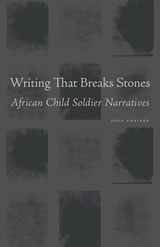
cover of Writing That Breaks Stones: African Child Soldier Narratives

Writing That Breaks Stones

African Child Soldier Narratives

Joya Uraizee

Michigan State University Press, 2020

Writing That Breaks Stones: African Child Soldier Narratives is a critical examination of six memoirs and six novels written by and about young adults from Africa who were once child soldiers. It analyzes not only how such narratives document the human rights violations experienced by these former child soldiers but also how they connect and disconnect from their readers in the global public sphere. It draws on existing literary scholarship about novels and memoirs as well as on the fieldwork conducted by social scientists about African children in combat situations. Writing That Breaks Stones groups the twelve narratives into categories and analyzes each segment, comparing individually written memoirs with those written collaboratively, and novels whose narratives are fragmented with those that depict surreal landscapes of misery. It concludes that the memoirs focus on a lone individual’s struggles in a hostile environment, and use repetition, logical contradictions, narrative breaks, and reversals of binaries in order to tell their stories. By contrast, the novels use narrative ambiguity, circularity, fragmentation, and notions of dystopia in ways that call attention to the child soldiers’ communities and environments. All twelve narratives depict the child soldier’s agency and culpability somewhat ambiguously, effectively reflecting the ethical dilemmas of African children in combat.
[more]