Results by title
6 books match the query 'American Bottom'
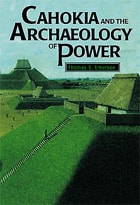
Cahokia and the Archaeology of Power
Thomas E. Emerson
University of Alabama Press, 1997
Examines the authority a ruling elite exercised over the surrounding countryside through a complex of social, political, and religious symbolism
This study uses the theoretical concepts of agency, power, and ideology to explore the development of cultural complexity within the hierarchically organized Cahokia Middle Mississippian society of the American Bottom from the 11th to the 13th centuries. By scrutinizing the available archaeological settlement and symbolic evidence, Emerson demonstrates that many sites previously identified as farmsteads were actually nodal centers with specialized political, religious, and economic functions integrated into a centralized administrative organization. These centers consolidated the symbolism of such 'artifacts of power' as figurines, ritual vessels, and sacred plants into a rural cult that marked the expropriation of the cosmos as part of the increasing power of the Cahokian rulers.
During the height of Cahokian centralized power, it is argued, the elites had convinced their subjects that they ruled both the physical and the spiritual worlds. Emerson concludes that Cahokian complexity differs significantly in degree and form from previously studied Eastern Woodlands chiefdoms and opens new discussion about the role of rural support for the Cahokian ceremonial center.

Cahokia and the Hinterlands
Middle Mississippian Cultures of the MidwestEdited by Thomas E. Emerson and R. Barry Lewis
University of Illinois Press, 1991
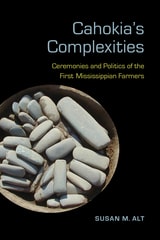
Cahokia's Complexities
Ceremonies and Politics of the First Mississippian FarmersSusan M. Alt
University of Alabama Press, 2018
The reasons for the rise and fall of early cities and ceremonial centers around the world have been sought for centuries. In the United States, Cahokia has been the focus of intense archaeological work to explain its mysteries. Cahokia was the first and exponentially the largest of the Mississippian centers that appeared across the Midwest and Southeast after AD 1000. Located near present-day East St. Louis, Illinois, the central complex of Cahokia spanned more than 12 square kilometers and encompassed more than 120 earthen mounds.
As one of the foremost experts on Cahokia, Susan M. Alt addresses long-standing considerations of eastern Woodlands archaeology—the beginnings, character, and ending of Mississippian culture (AD 1050–1600)—from a novel theoretical and empirical vantage point. Through this case study on farmers’ immigration and resettling, Alt’s narrative reanalyzes the relationship between administration and diversity, incorporating critical new discoveries and archaeological patterns from outside of Cahokia.
Alt examines the cultural landscape of the Cahokia flood plain and the layout of one extraordinary upland site, Grossman, as an administrative settlement where local farmers might have seen or participated in Cahokian rituals and ceremonies involving a web of ancestors, powers, and places. Alt argues that a farming district outside the center provides definitive evidences of the attempted centralized administration of a rural hinterland.
Cahokia, the Great Native American Metropolis
Biloine Whiting Young and Melvin L. Fowler
University of Illinois Press, 2000
Climate and Culture Change in North America AD 900–1600
By William C. Foster
University of Texas Press, 2012
Climate change is today’s news, but it isn’t a new phenomenon. Centuries-long cycles of heating and cooling are well documented for Europe and the North Atlantic. These variations in climate, including the Medieval Warm Period (MWP), AD 900 to 1300, and the early centuries of the Little Ice Age (LIA), AD 1300 to 1600, had a substantial impact on the cultural history of Europe. In this pathfinding volume, William C. Foster marshals extensive evidence that the heating and cooling of the MWP and LIA also occurred in North America and significantly affected the cultural history of Native peoples of the American Southwest, Southern Plains, and Southeast.
Correlating climate change data with studies of archaeological sites across the Southwest, Southern Plains, and Southeast, Foster presents the first comprehensive overview of how Native American societies responded to climate variations over seven centuries. He describes how, as in Europe, the MWP ushered in a cultural renaissance, during which population levels surged and Native peoples substantially intensified agriculture, constructed monumental architecture, and produced sophisticated works of art. Foster follows the rise of three dominant cultural centers—Chaco Canyon in New Mexico, Cahokia on the middle Mississippi River, and Casas Grandes in northwestern Chihuahua, Mexico—that reached population levels comparable to those of London and Paris. Then he shows how the LIA reversed the gains of the MWP as population levels and agricultural production sharply declined; Chaco Canyon, Cahokia, and Casas Grandes collapsed; and dozens of smaller villages also collapsed or became fortresses.
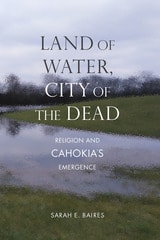
Land of Water, City of the Dead
Religion and Cahokia's EmergenceSarah E. Baires
University of Alabama Press, 2017
Explores the embodiment of religion in the Cahokia land and how places create, make meaningful, and transform practices and beliefs
Cahokia, the largest city of the Mississippian mound cultures, lies outside present-day East St. Louis. Land of Water, City of the Dead reconceptualizes Cahokia’s emergence and expansion (ca. 1050–1200), focusing on understanding a newly imagined religion and complexity through a non-Western lens. Sarah E. Baires argues that this system of beliefs was a dynamic, lived component, based on a broader ontology, with roots in other mound societies. This religion was realized through novel mortuary practices and burial mounds as well as through the careful planning and development of this early city’s urban landscape.
Baires analyzes the organization and alignment of the precinct of downtown Cahokia with a specific focus on the newly discovered and excavated Rattlesnake Causeway and the ridge-top mortuary mounds located along the site axes. Land of Water, City of the Dead also presents new data from the 1954 excavations of the ridge-top mortuary Wilson Mound and a complete analysis of the associated human remains. Through this skeletal analysis, Baires discusses the ways that Cahokians processed and buried their ancestors, identifying unique mortuary practices that include the intentional dismemberment of human bodies and burial with marine shell beads and other materials.