Results by title
5 books match the query 'American Bottom (Ill.)'
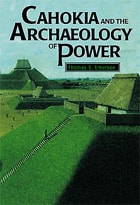
Cahokia and the Archaeology of Power
Thomas E. Emerson
University of Alabama Press, 1997
Examines the authority a ruling elite exercised over the surrounding countryside through a complex of social, political, and religious symbolism
This study uses the theoretical concepts of agency, power, and ideology to explore the development of cultural complexity within the hierarchically organized Cahokia Middle Mississippian society of the American Bottom from the 11th to the 13th centuries. By scrutinizing the available archaeological settlement and symbolic evidence, Emerson demonstrates that many sites previously identified as farmsteads were actually nodal centers with specialized political, religious, and economic functions integrated into a centralized administrative organization. These centers consolidated the symbolism of such 'artifacts of power' as figurines, ritual vessels, and sacred plants into a rural cult that marked the expropriation of the cosmos as part of the increasing power of the Cahokian rulers.
During the height of Cahokian centralized power, it is argued, the elites had convinced their subjects that they ruled both the physical and the spiritual worlds. Emerson concludes that Cahokian complexity differs significantly in degree and form from previously studied Eastern Woodlands chiefdoms and opens new discussion about the role of rural support for the Cahokian ceremonial center.

Cahokia and the Hinterlands
Middle Mississippian Cultures of the MidwestEdited by Thomas E. Emerson and R. Barry Lewis
University of Illinois Press, 1991
Cahokia, the Great Native American Metropolis
Biloine Whiting Young and Melvin L. Fowler
University of Illinois Press, 2000
Land of Water, City of the Dead
Religion and Cahokia's EmergenceSarah E. Baires
University of Alabama Press, 2017
Explores the embodiment of religion in the Cahokia land and how places create, make meaningful, and transform practices and beliefs
Cahokia, the largest city of the Mississippian mound cultures, lies outside present-day East St. Louis. Land of Water, City of the Dead reconceptualizes Cahokia’s emergence and expansion (ca. 1050–1200), focusing on understanding a newly imagined religion and complexity through a non-Western lens. Sarah E. Baires argues that this system of beliefs was a dynamic, lived component, based on a broader ontology, with roots in other mound societies. This religion was realized through novel mortuary practices and burial mounds as well as through the careful planning and development of this early city’s urban landscape.
Baires analyzes the organization and alignment of the precinct of downtown Cahokia with a specific focus on the newly discovered and excavated Rattlesnake Causeway and the ridge-top mortuary mounds located along the site axes. Land of Water, City of the Dead also presents new data from the 1954 excavations of the ridge-top mortuary Wilson Mound and a complete analysis of the associated human remains. Through this skeletal analysis, Baires discusses the ways that Cahokians processed and buried their ancestors, identifying unique mortuary practices that include the intentional dismemberment of human bodies and burial with marine shell beads and other materials.
Temples for Cahokia Lords
Preston Holder's 1955–1956 Excavations of Kunnemann MoundTimothy R. Pauketat with contributions by John R. Bozell, Sandra L. Dunavan, and a foreword by John O'Shea
University of Michigan Press, 1993