Results by title

11 books match the query 'American Century'
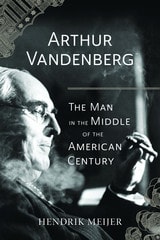
cover of Arthur Vandenberg: The Man in the Middle of the American Century

Arthur Vandenberg

The Man in the Middle of the American Century

Hendrik Meijer

University of Chicago Press, 2017

The idea that a Senator—Republican or Democrat—would put the greater good of the country ahead of party seems nearly impossible to imagine in our current climate of gridlock and divisiveness. But this hasn’t always been the case. Arthur H. Vandenberg (1884–1951), Republican from Grand Rapids, Michigan, was the model of a consensus builder, and the coalitions he spearheaded continue to form the foundation of American foreign and domestic policy today. Edward R. Murrow called him “the central pivot of the entire era,” yet, despite his significance, Vandenberg has never received the full public attention he is due—until now. With this authoritative biography, Hendrik Meijer reveals how Vandenberg built and nurtured the bipartisan consensus that created the American Century.
           
Originally the editor and publisher of the Grand Rapids Herald, Vandenberg was appointed and later elected to the Senate in 1928, where he became an outspoken opponent of the New Deal and a leader among the isolationists who resisted FDR’s efforts to aid European allies at the onset of World War II. But Vandenberg soon recognized the need for unity at the dawn of a new world order; and as a Republican leader, he worked closely with Democratic administrations to build the strong bipartisan consensus that established the Marshall Plan, the United Nations, and NATO. Vandenberg, as Meijer reveals, was instrumental in organizing Congressional support for these monumental twentieth-century foreign policy decisions.

Vandenberg’s life and career offer powerful lessons for today, and Meijer has given us a story that suggests an antidote to our current democratic challenges. After reading this poignant biography, many will ask: Where is the Vandenberg of today?
 
[more]
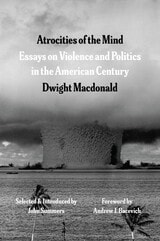
cover of Atrocities of the Mind: Essays on Violence and Politics in the American Century

Atrocities of the Mind

Essays on Violence and Politics in the American Century

Dwight Macdonald

University of Chicago Press, 2026

An essential collection of Dwight Macdonald’s prophetic essays on politics, art, and violence in twentieth-century America.

What does extreme violence do to human values? Does the concept of collective guilt make sense in assessing responsibility for genocide? Has modern mechanized society forever destroyed the possibility of peaceful resistance through art and civil disobedience? Atrocities of the Mind presents anew Dwight Macdonald, one of America’s foremost literary journalists and political activists, grappling with the hard questions of his time—and ours.  
 
In this collection, Macdonald writes about major events—the Holocaust, the atomic bombing of Hiroshima, Gandhi’s assassination, the Vietnam War, and social phenomena such as mass shootings, campus protests, and police brutality—with clear-sighted and buoyant prose. He writes incisively about the cinema of Alfred Hitchcock and Roman Polanski, praises Dorothy Day’s pacifism, and reports circulating an antiwar petition in the White House Rose Garden. And not without effect: his essay “Our Invisible Poor” is said to have spurred the Johnson administration’s War on Poverty. 
 
Norman Mailer memorably called Macdonald “a man with whom one might seldom agree but could never disrespect because he always told the truth as he saw the truth—a man therefore of the most incorruptible integrity.” In our America, reeling from political violence, Macdonald’s truth-telling reminds us how we got here and who we might still become.
[more]
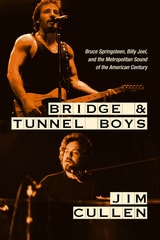
cover of Bridge and Tunnel Boys: Bruce Springsteen, Billy Joel, and the Metropolitan Sound of the American Century

Bridge and Tunnel Boys

Bruce Springsteen, Billy Joel, and the Metropolitan Sound of the American Century

Jim Cullen

Rutgers University Press, 2024

Born four months apart, Bruce Springsteen and Billy Joel both released their debut albums in the early 1970s, quickly becoming two of the most successful rock stars of their generation. While their critical receptions have been very different, surprising parallels emerge when we look at the arcs of their careers and the musical influences that have inspired them.

Bridge and Tunnel Boys compares the life and work of Long Islander Joel and Asbury Park, New Jersey, native Springsteen, considering how each man forged a distinctive sound that derived from his unique position on the periphery of the Big Apple. Locating their music within a longer tradition of the New York metropolitan sound, dating back to the early 1900s, cultural historian Jim Cullen explores how each man drew from the city’s diverse racial and ethnic influences. His study explains how, despite frequently releasing songs that questioned the American dream, Springsteen and Joel were able to appeal to wide audiences during both the national uncertainty of the 1970s and the triumphalism of the Reagan era. By placing these two New York–area icons in a new context, Bridge and Tunnel Boys allows us to hear their most beloved songs with new appreciation.  
 
[more]
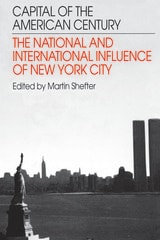
cover of Capital of the American Century: The National and International Influence of New York City

Capital of the American Century

The National and International Influence of New York City

Martin Shefter

Russell Sage Foundation, 1993
Capital of the American Century investigates the remarkable influence that New York City has exercised over the economy, politics, and culture of the nation throughout much of the twentieth century. New York's power base of corporations, banks, law firms, labor unions, artists and intellectuals has played a critical role in shaping areas as varied as American popular culture, the nation's political doctrines, and the international capitalist economy. If the city has lost its unique prominence in recent decades, the decline has been largely—and ironically—a result of the successful dispersion of its cosmopolitan values. The original essays in Capital of the American Century offer objective and intriguing analyses of New York City as a source of innovation in many domains of American life. Postwar liberalism and modernism were advanced by a Jewish and WASP coalition centered in New York's charitable foundations, communications media, and political organizations, while Wall Street lawyers and bankers played a central role in fashioning national security policies. New York's preeminence as a cultural capital was embodied in literary and social criticism by the "New York intellectuals," in the fine arts by the school of Abstract Expressionism, and in popular culture by Broadway musicals. American business was dominated by New York, where the nation's major banks and financial markets and its largest corporations were headquartered. In exploring New York's influence, the contributors also assess the larger social and economic conditions that made it possible for a single city to exert such power. New York's decline in recent decades stems not only from its own fiscal crisis, but also from the increased diffusion of industrial, cultural, and political hubs throughout the nation. Yet the city has taken on vital new roles that, on the eve of the twenty-first century, reflect an increasingly global era: it is the center of U.S. foreign trade and the international art market: The New York Times and The Wall Street Journal have emerged as international newspapers; and the city retains a crucial influence in information-intensive sectors such as corporate law, accounting, management consulting, and advertising. Capital of the American Century provides a fresh link between the study of cities and the analysis of national and international affairs. It is a book that enriches our historical sense of contemporary urban issues and our understanding of modern culture, economy, and politics.
[more]
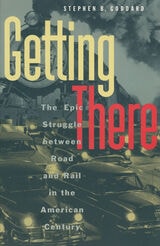
cover of Getting There: The Epic Struggle between Road and Rail in the American Century

Getting There

The Epic Struggle between Road and Rail in the American Century

Stephen B. Goddard

University of Chicago Press, 1996

"A readable and concise overview of how U.S. transportation came to its present pass. . . . Goddard is at his best when recounting the complex and interesting history of what has come to be called 'the highway lobby.'. . . An excellent book for the general reader with an interest in getting around."—Larry Fish, Philadelphia Inquirer

"This is a riveting story: of mighty railroads hamstrung almost overnight by government bureaucrats; of road interests led by General Motors Corp. conspiring in city after city to destroy efficient trolley systems . . . and of freeways that are far from free."—Bill Laitner, Detroit Free Press

"The combination of forces and fates that turned America into a giant parking lot from sea to shining sea is the subject of Stephen B. Goddard's lively pop history. . . . As Mr. Goddard ably points out, road-building and the creation of car-dependent suburbs have become ends in themselves."—James Howard Kunstler, Wall Street Journal

"The strength of Goddard's book is that he understands the complexities of manipulating public opinion to influence legislatures."—David Young, Chicago Tribune

"[Goddard's] book is a deft and easily read history of how transportation has shaped the nation and its economy, and ultimately, how a federation of truck and car interests drastically tilted national policies. . . . For many reasons this is an exceptionally important work."—Jim Dwyer, New York Newsday
[more]
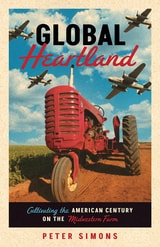
cover of Global Heartland: Cultivating the American Century on the Midwestern Farm

Global Heartland

Cultivating the American Century on the Midwestern Farm

Peter Simons

University of Minnesota Press, 2025

Highlighting the critical role of midwestern farmers in the creation of the American Century

Though often left out of the story of the making of the American Century, the farmers of the Midwest were at its center, fueling the nation’s growing power in the midtwentieth century. In Global Heartland, Peter Simons explores how, after decades of slipping to the margins of an urbanizing economy, these farmers assumed renewed strategic and cultural importance as they produced essential sustenance for overseas troops and food rations for a domestic population.

During the mid-1900s, once-isolationist midwestern farmers came to see the continental interior not as an insulated space but as an environmentally rich landscape that mandated them to accept a larger stake in global affairs. Simons traces this transformation from an older agrarian internationalism rooted in religion and ties to family abroad to illuminate the increasing influence of the U.S. agricultural community during the Cold War. Examining regional political parties, Lend-Lease programs, wartime mass media, and farmer-led relief programs, and interspersing this history with vignettes revisiting the Mercy Wheat campaign of 1947, the postwar International Farm Youth Exchange, and the Flying Farmers organization, Simons offers an enlightening consideration of midwestern farmers’ involvement in America’s international ascent.

Unique in its focus on farmers and their work rather than the more common attention to food or agricultural commodities, Global Heartland complicates and expands ideas of the farm industry’s role in American history.
[more]
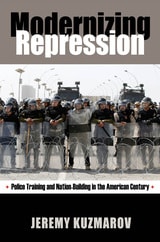
cover of Modernizing Repression: Police Training and Nation-Building in the American Century

Modernizing Repression

Police Training and Nation-Building in the American Century

Jeremy Kuzmarov

University of Massachusetts Press, 2012

As American troops became bogged down first in Iraq and then Afghanistan, a key component of U.S. strategy was to build up local police and security forces in an attempt to establish law and order. This approach, Jeremy Kuzmarov shows, is consistent with practices honed over more than a century in developing nations within the expanding orbit of the American empire. From the conquest of the Philippines and Haiti at the turn of the twentieth century through Cold War interventions and the War on Terror, police training has been valued as a cost-effective means of suppressing radical and nationalist movements, precluding the need for direct U.S. military intervention and thereby avoiding the public opposition it often arouses.

Unlike the spectacular but ephemeral pyrotechnics of the battlefield, police training programs have had lasting consequences for countries under the American imperial umbrella, fostering new elites, creating powerful tools of social control, and stifling political reform. These programs have also backfired, breeding widespread resistance, violence, and instability—telltale signs of “blowback” that has done more to undermine than advance U.S. strategic interests abroad.
[more]
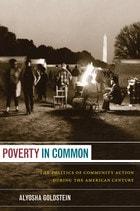
cover of Poverty in Common: The Politics of Community Action during the American Century

Poverty in Common

The Politics of Community Action during the American Century

Alyosha Goldstein

Duke University Press, 2012
After the Second World War, the idea that local community action was indispensable for the alleviation of poverty was broadly embraced by US policymakers, social scientists, international development specialists, and grassroots activists. Governmental efforts to mobilize community action in the name of democracy served as a volatile condition of possibility for poor people and dispossessed groups negotiating the tension between calls for self-help and demands for self-determination in the era of the Cold War and global decolonization. In Poverty in Common, Alyosha Goldstein suggests new ways to think about the relationship among liberalism, government, and inequality in the United States. He does so by analyzing historical dynamics including Progressive-era reform as a precursor to community development during the Cold War, the ways that the language of "underdevelopment" articulated ideas about poverty and foreignness, the use of poverty as a crucible of interest group politics, and radical groups' critical reframing of community action in anticolonial terms. During the mid-twentieth century, approaches to poverty in the United States were linked to the racialized and gendered negotiation of boundaries—between the foreign and the domestic, empire and nation, violence and order, and dependency and autonomy.
[more]
cover of Science and the American Century: Readings from "Isis"

Science and the American Century

Readings from "Isis"

Edited and with an Introduction by Sally Gregory Kohlstedt and David Kaiser

University of Chicago Press, 2013
The twentieth century was one of astonishing change in science, especially as pursued in the United States. Against a backdrop of dramatic political and economic shifts brought by world wars, intermittent depressions, sporadic and occasionally massive increases in funding, and expanding private patronage, this scientific work fundamentally reshaped everyday life. Science and the American Century offers some of the most significant contributions to the study of the history of science, technology, and medicine during the twentieth century, all drawn from the pages of the journal Isis.
 
Fourteen essays from leading scholars are grouped into three sections, each presented in roughly chronological order. The first section charts several ways in which our knowledge of nature was cultivated, revealing how scientific practitioners and the public alike grappled with definitions of the “natural” as they absorbed and refracted global information. The essays in the second section investigate the changing attitudes and fortunes of scientists during and after World War II. The final section documents the intricate ways that science, as it advanced, became intertwined with social policies and the law.
 
This important and useful book provides a thoughtful and detailed overview for scholars and students of American history and the history of science, as well as for scientists and others who want to better understand modern science and science in America.
[more]
cover of Subversions of the American Century: Filipino Literature in Spanish and the Transpacific Transformation of the United States

Subversions of the American Century

Filipino Literature in Spanish and the Transpacific Transformation of the United States

Adam Lifshey

University of Michigan Press, 2016
Subversions of the American Century: Filipino Literature in Spanish and the Transpacific Transformation of the United States argues that the moment the United States became an overseas colonial power in 1898, American national identity was redefined across a global matrix. The Philippines, which the United States seized at that point from Spain and local revolutionaries, is therefore the birthplace of a new kind of America, one with a planetary reach that was, most profoundly, accompanied by resistance to that reach by local peoples.

Post-1898 Filipino literature in Spanish testifies crucially to this foregrounding fact of American global power, for it is the language of that tradition that speaks directly to the reality of one empire having wrested land from another. Yet this literature is invisible in American Studies programs, Asian Studies programs, Spanish and English departments, and everywhere else. Subversions of the American Century will change that. After Subversions, students and scholars in various American Studies disciplines as well as Asian, Spanish, and Comparative Literature fields will find it necessary to revisit and revamp the basic parameters by which they approach their subjects.

[more]
cover of Why the American Century?

Why the American Century?

Olivier Zunz

University of Chicago Press, 1998

Reinterpreting our country's rise to world power, Olivier Zunz shows how American elites appropriated the twentieth century. Policymakers, corporate managers, engineers, scientists, and social scientists promoted a social contract of abundance and a controversial theory of pluralism. Their efforts created a model of middle class behavior for America and for the rest of the world.

"It should certainly be the task of historians to explain the nation's triumphs as effectively as they have explained its failures, and Zunz in this intelligent, learned and ambitious book suggests a valuable new model for doing so."—Alan Brinkley, Times Literary Supplement

"Zunz is evenhanded in his judgments. . . . His thesis is both imaginative and well grounded in the appropriate sources."—David M. Oshinsky, New York Times Book Review

"Zunz is an innovative and perceptive social critic. He crosses disciplinary boundaries with ease and felicity, and is particularly adept at illustrating large themes with unusual but telling details."—Kent Blaser, American Studies

"An eye-opening introduction to the shaping of modern America."—Foreign Affairs
[more]