Results by title
3 books match the query 'American Communism'
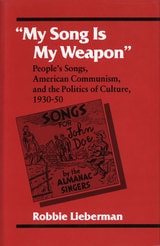
"My Song Is My Weapon"
People's Songs, American Communism, and the Politics of Culture, 1930-50Robbie Lieberman
University of Illinois Press, 1989
A revealing exploration of the origins and development of People's Songs, Inc., "My Song Is My Weapon won the ASCAP-Deems Taylor Award. Robbie Lieberman brings to life the hootenannies, concerts, and rallies of the time, paying special attention to the politics of culture of the Old Left. Her analysis of the communist movement culture, coupled with interviews with former members of People's Songs, sheds new light on Cold War America, the American Communist movement, and the experience of left-wing cultural workers.
[more]
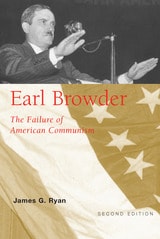
Earl Browder
The Failure of American CommunismJames G. Ryan
University of Alabama Press, 2005
Examines the political history of a 20th-century Communist part leader in the US
Earl Browder, the preeminent 20th-century Communist party leader in the United States, steered the CPUSA through the critical years of the Great Depression and World War II. A Kansas native and veteran of numerous radical movements, he was peculiarly fitted by circumstance and temperament to head the cause during its heyday.
Serving as a bridge between American Communism’s secret and public worlds, Browder did more than anyone to attempt to explain the Soviet Union’s shifting policies to the American people in a way that would serve the interests of the CPUSA. A proud and loyal follower of Joseph Stalin, Browder nevertheless sought to move the party into the U.S. political mainstream. He used his knowledge of domestic politics to persuade the Communist International to modify Popular Front (1935-1939) tactics for the United States.
Despite his rise in the hierarchy, he possessed an independent streak that ultimately proved his undoing. Imprisonment as he neared age 50 left permanent psychological damage. After being released with the approval of President Franklin D. Roosevelt, Browder lost his perspective and began entertaining delusions of grandeur about his status in American politics and in the world Communist movement. Still, he could never quite bring legitimacy to the CPUSA because he lacked the vision and moral courage to separate himself totally from the Soviet Union. Ryan concludes that Browder was not so much insincere as deluded. His failure contributed to the demise of the popularity of the Communist party in the United States.
In preparation for this book, the author consulted the Browder Papers at Syracuse University and U.S. Government documents, particularly the F.B.I. files. In addition, he traveled to Russia for research in the Soviet Archives when recently opened to Western scholars, including the records of the former Communist International and a collection of American Communist party files, 1919-1944, shipped secretly to Moscow long ago. Indeed, until 1992, the existence of the CPUSA collection was only rumored.
[more]
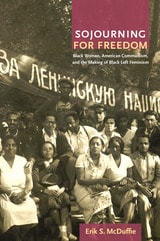
Sojourning for Freedom
Black Women, American Communism, and the Making of Black Left FeminismErik S. McDuffie
Duke University Press, 2011
Sojourning for Freedom portrays pioneering black women activists from the early twentieth century through the 1970s, focusing on their participation in the U.S. Communist Party (CPUSA) between 1919 and 1956. Erik S. McDuffie considers how women from diverse locales and backgrounds became radicalized, joined the CPUSA, and advocated a pathbreaking politics committed to black liberation, women’s rights, decolonization, economic justice, peace, and international solidarity. McDuffie explores the lives of black left feminists, including the bohemian world traveler Louise Thompson Patterson, who wrote about the “triple exploitation” of race, gender, and class; Esther Cooper Jackson, an Alabama-based civil rights activist who chronicled the experiences of black female domestic workers; and Claudia Jones, the Trinidad-born activist who emerged as one of the Communist Party’s leading theorists of black women’s exploitation. Drawing on more than forty oral histories collected from veteran black women radicals and their family members, McDuffie examines how these women negotiated race, gender, class, sexuality, and politics within the CPUSA. In Sojourning for Freedom, he depicts a community of radical black women activist intellectuals who helped to lay the foundation for a transnational modern black feminism.
[more]