Results by title
5 books match the query 'American Economy'
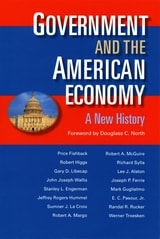
Government and the American Economy
A New HistoryPrice V. Fishback et al.
University of Chicago Press, 2007
The American economy has provided a level of well-being that has consistently ranked at or near the top of the international ladder. A key source of this success has been widespread participation in political and economic processes. In The Government and the American Economy, leading economic historians chronicle the significance of America’s open-access society and the roles played by government in its unrivaled success story.
America’s democratic experiment, the authors show, allowed individuals and interest groups to shape the structure and policies of government, which, in turn, have fostered economic success and innovation by emphasizing private property rights, the rule of law, and protections of individual freedom. In response to new demands for infrastructure, America’s federal structure hastened development by promoting the primacy of states, cities, and national governments. More recently, the economic reach of American government expanded dramatically as the populace accepted stronger limits on its economic freedoms in exchange for the increased security provided by regulation, an expanded welfare state, and a stronger national defense.
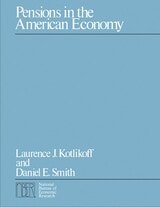
Pensions in the American Economy
Laurence J. Kotlikoff and Daniel E. Smith
University of Chicago Press, 1984
The picture that emerges of the "typical" plan and its significant variations is crucial to all those with a financial stake in pensions. The reader can compare pension vesting, retirement, and benefit provisions by plan type, plan size, industry, union status, and many more characteristics. With this information, workers can evaluate just how generous their employer is; job applicants can compare fringe benefits of prospective employers; personnel directors can judge their competitive edge.
The financial community will find especially interesting the analysis of the unfunded liabilities of private, state, and local pension funds. The investment decisions of private and public pension funds and their return performances are described as well.
Government officials and social scientists will find the analysis of pension coverage, the receipt of pension income by the elderly, cost-of-living adjustments, and disability insurance of special importance in evaluating the proper degree of public intervention in the area of old age income support.
Pensions in the American Economy is comprehensive and easy to use. Every reader, from small-business owners and civil servants to pension fund specialists, will find in it essential information about this increasingly important part of labor compensation and retirement finances.
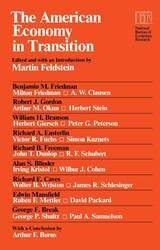
The American Economy in Transition
Edited by Martin Feldstein
University of Chicago Press, 1980
This unusual volume marks the sixtieth anniversary of the National Bureau of Economic Research. In contrast to the technical and specialized character of most NBER studies, the current book is designed to provide the general reader with a broad and critical overview of the American economy. The result is a volume of essays that range from monetary policy to productivity development, from population change to international trade.
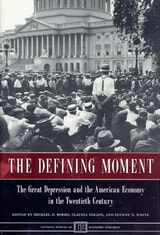
The Defining Moment
The Great Depression and the American Economy in the Twentieth CenturyEdited by Michael D. Bordo, Claudia Goldin, and Eugene N. White
University of Chicago Press, 1997
The essays consider whether New Deal-style legislation continues to operate today as originally envisioned, whether it altered government and the economy as substantially as did policies inaugurated during World War II, the 1950s, and the 1960s, and whether the legislation had important precedents before the Depression, specifically during World War I. Some chapters find that, surprisingly, in certain areas such as labor organization, the 1930s responses to the Depression contributed less to lasting change in the economy than a traditional view of the time would suggest. On the whole, however, these essays offer testimony to the Depression's legacy as a "defining moment." The large role of today's government and its methods of intervention—from the pursuit of a more active monetary policy to the maintenance and extension of a wide range of insurance for labor and business—derive from the crisis years of the 1930s.
Wrecked
The Edmund Fitzgerald and the Sinking of the American EconomyThomas M Nelson
Michigan State University Press, 2025