Results by title
5 books match the query 'American Empire'
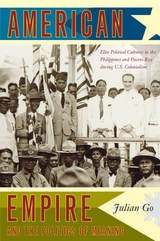
American Empire and the Politics of Meaning
Elite Political Cultures in the Philippines and Puerto Rico during U.S. ColonialismJulian Go
Duke University Press, 2007
American Empire and the Politics of Meaning is an examination of how these efforts to provide the elite of Puerto Rico and the Philippines a practical education in self-government played out on the ground in the early years of American colonial rule, from 1898 until 1912. It is the first systematic comparative analysis of these early exercises in American imperial power. The sociologist Julian Go unravels how American authorities used “culture” as both a tool and a target of rule, and how the Puerto Rican and Philippine elite received, creatively engaged, and sometimes silently subverted the Americans’ ostensibly benign intentions. Rather than finding that the attempt to transplant American-style democracy led to incommensurable “culture clashes,” Go assesses complex processes of cultural accommodation and transformation. By combining rich historical detail with broader theories of meaning, culture, and colonialism, he provides an innovative study of the hidden intersections of political power and cultural meaning-making in America’s earliest overseas empire.
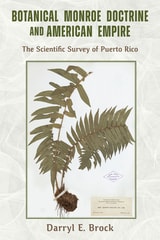
Botanical Monroe Doctrine and American Empire
The Scientific Survey of Puerto RicoDarryl E. Brock
University of Alabama Press, 2026
Explores how a US-led natural history survey of Puerto Rico served American Empire while yet catalyzing Boricua cultural nationalism
In Botanical Monroe Doctrine and American Empire, Darryl E. Brock examines the history, influence, and legacy of an ambitious effort to conduct a “physical and natural history survey of Porto [Puerto] Rico.” As founder of The New York Botanical Garden, Nathaniel Lord Britton advanced a botanical Monroe Doctrine that sought to counter British and European scientific influence in the Americas by establishing American authority over the naming and classification of species. Although initially aligned with imperial and “civilizing” aims, the Scientific Survey of Puerto Rico ultimately contributed to modernization, professionalization, and cultural preservation on the island. Its work in Taíno archaeology and jíbaro folklore helped lay the foundation for today’s Caguana Indigenous Ceremonial Park and reinforced currents of Boricua cultural nationalism. The survey also intersected with broader political and economic developments, influencing areas from bilingual education to New Deal administration in Puerto Rico.
Sponsored by the New York Academy of Sciences, the survey was conducted by The New York Botanical Garden in partnership with the American Museum of Natural History and the Yale Peabody Museum, with the final report issued in 1970. Puerto Rican scientists and intellectuals, including mycologist and future University of Puerto Rico chancellor Carlos Chardón, actively contributed to the project. Expanding to the Virgin Islands, the survey encompassed nearly two dozen expeditions, collected more than 10,000 plant specimens, and identified thirty-eight new species. Its nineteen published volumes remain among the most comprehensive multidisciplinary scientific studies of any tropical region. Brock’s groundbreaking work is essential reading for those interested in the history of science, Puerto Rico, and American empire.
Domestications
American Empire, Literary Culture, and the Postcolonial LensHosam Aboul-Ela
Northwestern University Press, 2018
Domestications traces a genealogy of American global engagement with the Global South since World War II. Hosam Aboul-Ela reads American writers contrapuntally against intellectuals from the Global South in their common—yet ideologically divergent—concerns with hegemony, world domination, and uneven development. Using Edward Said’s Culture and Imperialism as a model, Aboul-Ela explores the nature of U.S. imperialism’s relationship to literary culture through an exploration of five key terms from the postcolonial bibliography: novel, idea, perspective, gender, and space.
Within this framework the book examines juxtapositions including that of Paul Bowles’s Morocco with North African intellectuals’ critique of Orientalism, the global treatment of Vietnamese liberation movements with the American narrative of personal trauma in the novels of Tim O’Brien and Hollywood film, and the war on terror’s philosophical idealism with Korean and post-Arab nationalist materialist archival fiction.
Domestications departs from other recent studies of world literature in its emphases not only on U.S. imperialism but also on intellectuals working in the Global South and writing in languages other than English and French. Although rooted in comparative literature, its readings address issues of key concern to scholars in American studies, postcolonial studies, literary theory, and Middle Eastern studies.
Judicial Territory
Law, Capital, and the Expansion of American EmpireShaina Potts
Duke University Press, 2024
Poems of the American Empire
The Lyric Form in the Long Twentieth CenturyJen Hedler Phillis
University of Iowa Press, 2019
Poems of the American Empire argues that careful attention to a particular strain of twentieth-century lyric poetry yields a counter-history of American global power. The period that Phillis covers—from Ezra Pound’s A Draft of XXX Cantos in 1930 to Cathy Park Hong’s Engine Empire in 2012—roughly matches what some consider the ascent and decline of the American empire. The diverse poems that appear in this book are united by their use of epic forms in the lyric poem, a combination that violates a fundamental framework of both genres’ relationship to time.
This book makes a groundbreaking intervention by insisting that lyric time is key to understanding the genre. These poems demonstrate the lyric form’s ability to represent the totality of history, making American imperial power visible in its fullness. Neither strictly an empty celebration of American exceptionalism nor a catalog of atrocities, Poems of the American Empire allows us to see both.