Results by title
6 books match the query 'American Higher Education'
A Perfect Mess
The Unlikely Ascendancy of American Higher EducationDavid F. Labaree
University of Chicago Press, 2017
And the best it is: today America’s universities and colleges produce the most scholarship, earn the most Nobel prizes, hold the largest endowments, and attract the most esteemed students and scholars from around the world. But this was not an inevitability. Weakly funded by the state, American schools in their early years had to rely on student tuition and alumni donations in order to survive. This gave them tremendous autonomy to seek out sources of financial support and pursue unconventional opportunities to ensure their success. As Labaree shows, by striving as much as possible to meet social needs and fulfill individual ambitions, they developed a broad base of political and financial support that, grounded by large undergraduate programs, allowed for the most cutting-edge research and advanced graduate study ever conducted. As a result, American higher education eventually managed to combine a unique mix of the populist, the practical, and the elite in a single complex system.
The answers to today’s problems in higher education are not easy, but as this book shows, they shouldn’t be: no single person or institution can determine higher education’s future. It is something that faculty, administrators, and students—adapting to society’s needs—will determine together, just as they have always done.
A Perfect Mess
The Unlikely Ascendancy of American Higher EducationDavid F. Labaree
University of Chicago Press, 2017
Read the news about America’s colleges and universities—rising student debt, affirmative action debates, and conflicts between faculty and administrators—and it’s clear that higher education in this country is a total mess. But as David F. Labaree reminds us in this book, it’s always been that way. And that’s exactly why it has become the most successful and sought-after source of learning in the world. Detailing American higher education’s unusual struggle for survival in a free market that never guaranteed its place in society—a fact that seemed to doom it in its early days in the nineteenth century—he tells a lively story of the entrepreneurial spirit that drove American higher education to become the best.
And the best it is: today America’s universities and colleges produce the most scholarship, earn the most Nobel prizes, hold the largest endowments, and attract the most esteemed students and scholars from around the world. But this was not an inevitability. Weakly funded by the state, American schools in their early years had to rely on student tuition and alumni donations in order to survive. This gave them tremendous autonomy to seek out sources of financial support and pursue unconventional opportunities to ensure their success. As Labaree shows, by striving as much as possible to meet social needs and fulfill individual ambitions, they developed a broad base of political and financial support that, grounded by large undergraduate programs, allowed for the most cutting-edge research and advanced graduate study ever conducted. As a result, American higher education eventually managed to combine a unique mix of the populist, the practical, and the elite in a single complex system.
The answers to today’s problems in higher education are not easy, but as this book shows, they shouldn’t be: no single person or institution can determine higher education’s future. It is something that faculty, administrators, and students—adapting to society’s needs—will determine together, just as they have always done.
Activist Rhetorics and American Higher Education, 1885-1937
Susan Kates
Southern Illinois University Press, 2000
In this study of the history of rhetoric education, Susan Kates focuses on the writing and speaking instruction developed at three academic institutions founded to serve three groups of students most often excluded from traditional institutions of higher education in late-nineteenth-and early-twentieth-century America: white middle-class women, African Americans, and members of the working class.
Kates provides a detailed look at the work of those students and teachers ostracized from rhetorical study at traditional colleges and universities. She explores the pedagogies of educators Mary Augusta Jordan of Smith College in Northhampton, Massachusetts; Hallie Quinn Brown of Wilberforce University in Wilberforce, Ohio; and Josephine Colby, Helen Norton, and Louise Budenz of Brookwood Labor College in Katonah, New York.
These teachers sought to enact forms of writing and speaking instruction incorporating social and political concerns in the very essence of their pedagogies. They designed rhetoric courses characterized by three important pedagogical features: a profound respect for and awareness of the relationship between language and identity and a desire to integrate this awareness into the curriculum; politicized writing and speaking assignments designed to help students interrogate their marginalized standing within the larger culture in terms of their gender, race, or social class; and an emphasis on service and social responsibility.
An Accidental Triumph
The Improbable History of American Higher EducationSol Gittleman
Vesto Books, 2023
"Hardly a day passes without reference to some scandal, fraud, intellectual or moral failure, or other ill associated with American academic institutions,” writes Sol Gittleman in his bracing new book, An Accidental Triumph. “If American higher education is such a failure, why are students and scholars from all over the world still so eager to secure a place in one of these institutions? Is American higher education a disaster or the envy of the world?”
Gittleman confronts this contradiction in this dynamic mix of history, analysis, and personal reflection. An Accidental Triumph tells the engaging story of how American higher education evolved from a patchwork of seminaries in the early nineteenth century into the world’s leader in research by the middle of the twentieth. Gittleman links this fascinating story to his own fifty-year academic career, which coincided with an explosive rise in enrollment, spurred by the GI Bill, and an unparalleled postwar boom in faculty hiring, prompted by massive new federal support for academic research from organizations such as the National Science Foundation.
Writing with authority, frankness, and unfailing wry good humor, Gittleman surveys the triumphs, tragedies, and tensions of the history of American higher education. Despite the relentless criticism, Gittleman finds good reason to remain optimistic about the future of teaching and research at the college and university level in the United States.
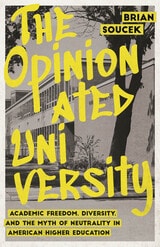
The Opinionated University
Academic Freedom, Diversity, and the Myth of Neutrality in American Higher EducationBrian Soucek
University of Chicago Press, 2026
Can a university ever truly be neutral in today’s social and political climate? Pushing against the tide of universities increasingly pledging to stay neutral about contentious issues, law professor Brian Soucek argues that their promises are doomed to fail—universities can’t help being opinionated.
In The Opinionated University, Soucek shows that neutrality is a myth by taking a deep dive into several prominent campus controversies of the day, including diversity, equity, and inclusion (DEI) efforts and restrictions on campus speech and protest. Each issue requires universities to choose a side in what they do, if not also in what they say. In everything from curricular and admissions decisions to their response to outside rankings and their evaluation of faculty, universities express the values at the heart of their mission. Soucek argues that those pushing for neutrality are only preventing universities from standing up for their values, whether in today’s current moment of crisis or in periods of political calm.
Both timely and deeply engaging, The Opinionated University calls on universities to dispense with neutrality as a governing principle and focus instead on what their mission should be, and who should determine it.

Trends in American Higher Education
Joseph Ben-David
University of Chicago Press, 1981