Results by title
4 books match the query 'American Legislatures'
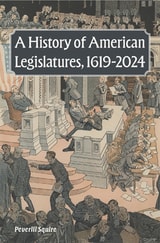
A History of American Legislatures, 1619-2024
Peverill Squire
University of Missouri Press, 2026
What might the members of the first Virginia assembly think if they could visit today’s Virginia House of Delegates? The air-conditioning and diversity of the current membership surely would surprise them, but would the legislative process itself strike them as odd?
In his latest work, Peverill Squire demonstrates that the way the modern legislature goes about its work would seem familiar to visitors from the past. Squire traces a nearly uninterrupted path from that first assembly in Virginia in 1619 to the contemporary Virginia General Assembly, and to the U.S. Congress and the other forty-nine state legislatures.
Each chapter examines discrete topics rather than historical eras, distinguishing the book from other studies of American legislatures. Topics covered include the fundamentals of legislative structure and operation, how qualification standards for legislative service became more inclusive, and how legislative professionalization unfolded at both congressional and state levels.
Though covering more than 400 years, Squire manages to present a comprehensive and accessible history of American legislatures that both scholars and students will find valuable.
Indecision in American Legislatures
Jeffrey J. Harden and Justin H. Kirkland
University of Michigan Press, 2018
Lawmaking provides many opportunities for proposals to be altered, amended, tabled, or stopped completely. The ideal legislator should assess evidence, update his or her beliefs with new information, and sometimes be willing to change course. In practice, however, lawmakers face criticism from the media, the public, and their colleagues for “flip-flopping.” Legislators may also only appear to change positions in some cases as a means of voting strategically.
This book presents a systematic examination of legislative indecision in American politics. This might occur via “waffling”—where a legislator cosponsors a bill, then votes against it at roll call. Or it might occur when a legislator votes one way on a bill, then switches her vote to the other side. In Indecision in American Legislatures, Jeffrey J. Harden and Justin H. Kirkland develop a theoretical framework to explain indecision itself, as well as the public’s attitudes toward indecision. They test their expectations with data sources from American state legislatures, the U.S. Congress, and survey questions administered to American citizens. Understanding legislative indecision from both the legislator and citizen perspectives is important for discussions about the quality of representation in American politics.
The Evolution of American Legislatures
Colonies, Territories, and States, 1619-2009Peverill Squire
University of Michigan Press, 2014
The institutional development of American legislatures, beginning with the first colonial assembly of 1619, has been marked by continuity as well as change. Peverill Squire draws upon a wealth of primary sources to document this institutional history. Beginning with the ways in which colonial assemblies followed the precedents of British institutions, Squire traces the fundamental ways they evolved to become distinct. He next charts the formation of the first state legislatures and the Constitutional Congress, describes the creation of territorial and new state legislatures, and examines the institutionalization of state legislatures in the nineteenth century and their professionalization since 1900.
With his conclusion, Squire discusses the historical trajectory of American legislatures and suggests how they might further develop over the coming decades. While Squire's approach will appeal to historians, his focus on the evolution of rules, procedures, and standing committee systems, as well as member salaries, legislative sessions, staff, and facilities, will be valuable to political scientists and legislative scholars.
The Right of Instruction and Representation in American Legislatures, 1778 to 1900
Peverill Squire
University of Michigan Press, 2021