Results by title
2 books match the query 'American Literary Realism'
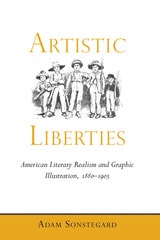
Artistic Liberties
American Literary Realism and Graphic Illustration, 1880-1905Adam Sonstegard
University of Alabama Press, 2013
A landmark study of the illustrations that originally accompanied now-classic works of American literary realism
Though today we commonly read major works of nineteenth-century American literature in unillustrated paperbacks or anthologies, many of them first appeared as magazine serials, accompanied by ample illustrations that sometimes made their way into the serials’ first printings as books. The graphic artists creating these illustrations often visually addressed questions that the authors had left for the reader to interpret, such as the complexions of racially ambiguous characters in Uncle Tom’s Cabin. The artists created illustrations that depicted what outsiders saw in Huck and Jim in Adventures of Huckleberry Finn, rather than what Huck and Jim learned to see in one another. These artists even worked against the texts on occasion—for instance, when the illustrators reinforced the same racial stereotypes that writers such as Paul Laurence Dunbar had intended to subvert in their works.
Authors of American realism commonly submitted their writing to editors who allowed them little control over the aesthetic appearance of their work. In his groundbreaking Artistic Liberties, Adam Sonstegard studies the illustrations from these works in detail and finds that the editors employed illustrators who were often unfamiliar with the authors’ intentions and who themselves selected the literary material they wished to illustrate, thereby taking artistic liberties through the tableaux they created.
Sonstegard examines the key role that the appointed artists played in visually shaping narratives—among them Mark Twain’s Pudd’nhead Wilson, Stephen Crane’s The Monster, and Edith Wharton’s The House of Mirth—as audiences tended to accept their illustrations as guidelines for understanding the texts. In viewing these works as originally published, received, and interpreted, Sonstegard offers a deeper knowledge not only of the works, but also of the realities surrounding publication during this formative period in American literature.
[more]
Utopia and Cosmopolis
Globalization in the Era of American Literary RealismThomas Peyser
Duke University Press, 1998
When did Americans first believe they were at the center of a truly global culture? How did they envision that culture and how much do recent attitudes toward globalization owe to their often utopian dreams? In Utopia and Cosmopolis Thomas Peyser asks these and other questions, offers a reevaluation of American literature and culture at the dawn of the twentieth century, and provides a new context for understanding contemporary debates about America’s relation to the rest of the world.
Applying current theoretical work on globalization to the writing of authors as diverse as Edward Bellamy, Charlotte Perkins Gilman, William Dean Howells, and Henry James, Peyser reveals the ways in which turn-of-the-century American writers struggled to understand the future in a newly emerging global community. Because the pressures of globalization at once fostered the formation of an American national culture and made national culture less viable as a source of identity, authors grappled to find a form of fiction that could accommodate the contradictions of their condition. Utopia and Cosmopolis unites utopian and realist narratives in subtle, startling ways through an examination of these writers’ aspirations and anxieties. Whether exploring the first vision of a world brought together by the power of consumer culture, or showing how different cultures could be managed when reconceived as specimens in a museum, this book steadily extends the horizons within which late nineteenth- and early twentieth-century American literature and culture can be understood.
Ranging widely over history, politics, philosophy, and literature, Utopia and Cosmopolis is an important contribution to debates about utopian thought, globalization, and American literature.
[more]