Results by title
3 books match the query 'American Metropolis'
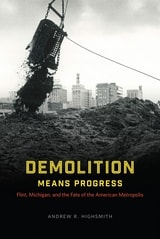
Demolition Means Progress
Flint, Michigan, and the Fate of the American MetropolisAndrew R. Highsmith
University of Chicago Press, 2015
In one of the most comprehensive works yet written on the history of inequality and metropolitan development in modern America, Andrew R. Highsmith uses the case of Flint to explain how the perennial quest for urban renewal—even more than white flight, corporate abandonment, and other forces—contributed to mass suburbanization, racial and economic division, deindustrialization, and political fragmentation. Challenging much of the conventional wisdom about structural inequality and the roots of the nation’s “urban crisis,” Demolition Means Progress shows in vivid detail how public policies and programs designed to revitalize the Flint area ultimately led to the hardening of social divisions.

Justice and the American Metropolis
Clarissa Rile Hayward
University of Minnesota Press, 2011
Today’s American cities and suburbs are the sites of “thick injustice”—unjust power relations that are deeply and densely concentrated as well as opaque and seemingly intractable. Thick injustice is hard to see, to assign responsibility for, and to change.
Identifying these often invisible and intransigent problems, this volume addresses foundational questions about what justice requires in the contemporary metropolis. Essays focus on inequality within and among cities and suburbs; articulate principles for planning, redevelopment, and urban political leadership; and analyze the connection between metropolitan justice and institutional design. In a world that is progressively more urbanized, and yet no clearer on issues of fairness and equality, this book points the way to a metropolis in which social justice figures prominently in any definition of success.
Contributors: Susan S. Fainstein, Harvard U; Richard Thompson Ford, Stanford U; Gerald Frug, Harvard U; Loren King, Wilfrid Laurier U; Margaret Kohn, U of Toronto; Stephen Macedo, Princeton U; Douglas W. Rae, Yale U; Clarence N. Stone, George Washington U; Margaret Weir, U of California, Berkeley; Thad Williamson, U of Richmond.
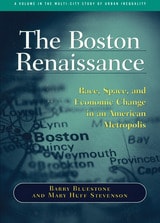
The Boston Renaissance
Race, Space, and Economic Change in an American MetropolisBarry Bluestone
Russell Sage Foundation, 2000