Results by title
6 books match the query 'American Midwest'

Hatred at Home
al-Qaida on Trial in the American MidwestAndrew Welsh-Huggins
Ohio University Press, 2011
One day in 2002, three friends—a Somali immigrant, a Pakistan–born U.S. citizen, and a hometown African American—met in a Columbus, Ohio coffee shop and vented over civilian casualties in the war in Afghanistan. Their conversation triggered an investigation that would become one of the most unusual and far–reaching government probes into terrorism since the 9/11 attacks.
Over several years, prosecutors charged each man with unrelated terrorist activities in cases that embodied the Bush administration’s approach to fighting terrorism at home.
Government lawyers spoke of catastrophes averted; defense attorneys countered that none of the three had done anything but talk. The stories of these homegrown terrorists illustrate the paradox the government faces after September 11: how to fairly wage a war against alleged enemies living in our midst.
Hatred at Home is a true crime drama that will spark debate from all political corners about safety, civil liberties, free speech, and the government’s war at home.

Heartland English
Variation and Transition in the American MidwestTimothy C. Frazer
University of Alabama Press, 1993
Mapping the Diverse Voices of America's Linguistic Heartland.
Heartland English is the first book-length scholarly treatment of English spoken in the Midwest, or the northern interior of the continental United States. For generations, the American Midwest has been portrayed as the home of a single, uniform variety of "standard" American English. Heartland English: Variation and Transition in the American Midwest challenges that assumption through the first book-length scholarly examination of the rich linguistic diversity that exists across the region. Bringing together the work of leading dialectologists and language scholars, editor Timothy C. Frazer presents a groundbreaking exploration of how history, migration, settlement patterns, geography, culture, and social change have shaped the spoken language of the Midwest.
Covering communities across the northern interior of the United States, the volume reveals a complex linguistic landscape marked by regional dialect boundaries, evolving pronunciations, distinctive vocabulary, and shifting patterns of speech. Rather than viewing Midwestern English as a static or homogeneous dialect, the contributors demonstrate how linguistic variation reflects the movement of peoples, the influence of neighboring regions, and the ongoing transformation of American society.
Drawing on research in dialect geography, sociolinguistics, historical linguistics, and language variation studies, Heartland English offers valuable insights into the ways language both shapes and reflects regional identity. The collection examines how speakers perceive dialect differences, how those differences develop over time, and why the Midwest remains one of the most important regions for understanding the evolution of American English. As a landmark contribution to the study of language in North America, the book continues to serve as an essential resource for scholars investigating the relationship between language, culture, and place.
A Publication in the Centennial Series of the American Dialect Society in celebration of the beginning of its second century of research into language variation in America.
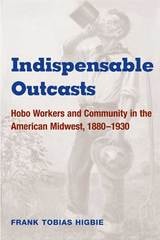
Indispensable Outcasts
Hobo Workers and Community in the American Midwest, 1880-1930Frank Tobias Higbie
University of Illinois Press, 2003
Often overlooked in labor history, the hoboes who rode the rails in search of seasonal work nevertheless secured a place in the American imagination. Frank Tobias Higbie weaves together history, anthropology, gender studies, and literary analysis to reposition these workers at the center of Progressive Era debates over class, race, manly responsibility, community, and citizenship. Combining incisive cultural criticism with labor history, Higbie illustrates how these so-called marginal figures were in fact integral to communities and to cultural conflicts over class, masculinity, and sexuality. He draws from life histories, the investigations of social reformers, and the organizing materials of the Industrial Workers of the World to present a complex portrait of hobo life, from its often violent and dangerous working conditions to its ethic of “transient mutuality” that enabled survival and resistance on the road.
Frank and compelling,Indispensable Outcasts examines hoboes within the sprawling story of American labor while meditating on writing history from the bottom up and the ways a fascination with personal narrative can color a historian's work.
The Sower and the Seer
Perspectives on the Intellectual History of the American MidwestJoseph Hogan
Wisconsin Historical Society Press, 2021
The Midwest has been characterized as a fertile seedbed for the germination of great thinkers, but a wasteland for their further growth. The Sower and the Seer reveals that representation to be false. In fact, the region has sustained many innovative minds and been the locus of extraordinary intellectualism. It has also been the site of shifting interpretations—to some a frontier, to others a colonized space, a breadbasket, a crossroads, a heartland. As agrarian reformed (and Michigander) Liberty Hyde Bailey expressed in his 1916 poem “Sower and Seer,” the Midwestern landscape has given rise to significant visionaries, just as their knowledge has nourished and shaped the region.
The essays gathered for this collection examine individual thinkers, writers, and leaders, as well as movements and ideas that shaped the Midwest, including rural school consolidation, women’s literary societies, Progressive-era urban planning, and Midwestern radical liberalism. While disparate in subject and style, these essays taken together establish the irrefutable significance of the intellectual history of the American Midwest.
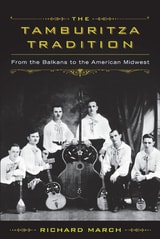
The Tamburitza Tradition
From the Balkans to the American MidwestRichard March
University of Wisconsin Press, 2013
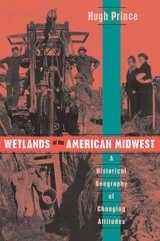
Wetlands of the American Midwest
A Historical Geography of Changing AttitudesHugh Prince
University of Chicago Press, 1997
As attitudes changed, so did scientific research agendas, government policies, and farmers' strategies for managing their land. Originally viewed as bountiful sources of wildlife by indigenous peoples, wet areas called "wet prairies," "swamps," or "bogs" in the late nineteenth and early twentieth centuries were considered productive only when drained for agricultural use. Beginning in the 1950s, many came to see these renamed "wetlands" as valuable for wildlife and soil conservation.
Prince's book will appeal to a wide readership, ranging from geographers and environmental historians to the many government and private agencies and individuals concerned with wetland research, management, and preservation.