Results by title
4 books match the query 'American Music'
Civic Jazz
American Music and Kenneth Burke on the Art of Getting AlongGregory Clark
University of Chicago Press, 2015
Jazz music, Clark argues, demonstrates how this aesthetic rhetoric of identification can bind people together through their shared experience in a common project. While such shared experience does not demand agreement—indeed, it often has an air of competition—it does align people in practical effort and purpose. Similarly, Clark shows, Burke considered Americans inhabitants of a persistently rhetorical situation, in which each must choose constantly to identify with some and separate from others. Thought-provoking and path-breaking, Clark’s harmonic mashup of music and rhetoric will appeal to scholars across disciplines as diverse as political science, performance studies, musicology, and literary criticism.
Right to the Juke Joint
A Personal History of American MusicPatrick B Mullen
University of Illinois Press, 2018
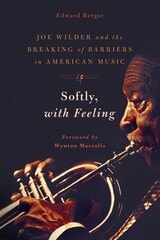
Softly, With Feeling
Joe Wilder and the Breaking of Barriers in American MusicEdward Berger
Temple University Press, 2014
"Joe Wilder set the table. His struggles made it easier for me and many others."--From the Foreword by Wynton Marsalis
Trumpeter Joe Wilder is distinguished for his achievements in both the jazz and classical worlds. He was a founding member of the Symphony of the New World, where he played first trumpet, and he performed as lead trumpet and soloist with Lionel Hampton, Jimmy Lunceford, Dizzy Gillespie, and Count Basie. Yet Wilder is also known as a pioneer who broke down racial barriers, the first African American to hold a principal chair in a Broadway show orchestra, and one of the first African Americans to join a network studio orchestra.
In Softly, with Feeling, Edward Berger tells Wilder's remarkable story-from his growing up in working-class Philadelphia to becoming one of the first 1,000 black Marines during World War II-with tremendous feeling and extensive reminiscences by Wilder and his colleagues, including renowned Philadelphia-area musicians Jimmy Heath and Buddy DeFranco. Berger also places Wilder's experiences within a broader context of American musical and social history.
Wilder's modesty and ability to perform in many musical genres may have prevented him from achieving popular recognition, but in Softly, with Feeling, his legacy and contributions to music and culture are assured.
Top 40 Democracy
The Rival Mainstreams of American MusicEric Weisbard
University of Chicago Press, 2014
In Top 40 Democracy, Eric Weisbard studies the evolution of this multicentered pop landscape, along the way telling the stories of the Isley Brothers, Dolly Parton, A&M Records, and Elton John, among others. He sheds new light on the upheavals in the music industry over the past fifteen years and their implications for the audiences the industry has shaped. Weisbard focuses in particular on formats—constructed mainstreams designed to appeal to distinct populations—showing how taste became intertwined with class, race, gender, and region. While many historians and music critics have criticized the segmentation of pop radio, Weisbard finds that the creation of multiple formats allowed different subgroups to attain a kind of separate majority status—for example, even in its most mainstream form, the R&B of the Isley Brothers helped to create a sphere where black identity was nourished. Music formats became the one reliable place where different groups of Americans could listen to modern life unfold from their distinct perspectives. The centers of pop, it turns out, were as complicated, diverse, and surprising as the cultural margins. Weisbard’s stimulating book is a tour de force, shaking up our ideas about the mainstream music industry in order to tease out the cultural importance of all performers and songs.