Results by title
6 books match the query 'American Popular Music'
American Popular Music
New Approaches to the Twentieth CenturyRachel Rubin
University of Massachusetts Press, 2001
Designed as a broad introductory survey, and written by experts in the field, this book examines the rise of American music over the past hundred years — the period in which that music came into its own and achieved unprecedented popularity. Beginning with a look at music as a business, eleven essays explore a variety of popular musical genres, including Tin Pan Alley, blues, jazz, country, gospel, rhythm and blues, rock and roll, folk, rap, and Mexican American corridos. Reading these essays, we come to see that the forms created by one group often appeal to, and are in turn influenced by, other groups—across lines of race, ethnicity, class, gender, region, and age. The chapters speak to one another, arguing for the primacy of such concepts as minstrelsy, urbanization, hybridity, and crossover as the most powerful tools for understanding American popular music. Moving beyond outdated music-industry categories and misleading genre labels, while acknowledging the complexities of the market, the book recovers and reinforces the essential blackness of much popular music—even a presumably white form like country and western. In addition to Rachel Rubin and Jeffrey Melnick, contributors include Reebee Garofalo, Geoffrey Jacques, Kip Lornell, Mark Anthony Neal, Millie Rahn, David Sanjek, James Smethurst, Elijah Wald, and Gail Hilson Woldu.
American Popular Music
Readings From the Popular Press Volume 2: The Age of RockTimothy E. Scheurer
University of Wisconsin Press, 1989

American Popular Music
Readings From the Popular Press Volume I: The Nineteenth-Century Tin Pan AlleyTimothy E. Scheurer
University of Wisconsin Press, 1989
Boogaloo
The Quintessence of American Popular MusicArthur Kempton
University of Michigan Press, 2005
Praise for Boogaloo:
"From Thomas A. Dorsey and gospel to Sam Cooke and the classic age of boogaloo ('soul') to George Clinton and hip hop, this comprehensive analysis of African-American popular music is a deep and gorgeous meditation on its aesthetics and business."
---Henry Louis Gates, Jr., W.E.B. Du Bois Professor of the Humanities, Harvard
"Surpassingly sympathetic and probing. . . . a panoramic critical survey of black popular music over seventy-five years. . . .There is no book quite like it."
---New York Review of Books
". . . moving, dense, and fascinating. . . ."
---New Yorker
". . . a grand and sweeping survey of the history of soul music in America. . . . one of the best books of music journalism. . . ."
---Publisher's Weekly
". . . a fascinating and often original addition to the extensive literature. . . . an astute and witty account. . . . there is plenty in Boogaloo to set the mind and heart alight, as well as some flashes of brilliance and originality rare in music writing today."
---Times Literary Supplement
Songbooks
The Literature of American Popular MusicEric Weisbard
Duke University Press, 2021
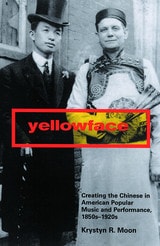
Yellowface
Creating the Chinese in American Popular Music and Performance, 1850s-1920sMoon, Krystyn R.
Rutgers University Press, 2004
Music and performance provide a unique window into the ways that cultural information is circulated and perceptions are constructed. Because they both require listening, are inherently ephemeral, and most often involve collaboration between disparate groups, they inform cultural perceptions differently from literary or visual art forms, which tend to be more tangible and stable.
In Yellowface, Krystyn R. Moon explores the contributions of writers, performers, producers, and consumers in order to demonstrate how popular music and performance has played an important role in constructing Chinese and Chinese American stereotypes. The book brings to life the rich musical period of the late nineteenth and early twentieth centuries. During this time, Chinese and Chinese American musicians and performers appeared in a variety of venues, including museums, community theaters, and world’s fairs, where they displayed their cultural heritage and contested anti-Chinese attitudes. A smaller number crossed over into vaudeville and performed non-Chinese materials. Moon shows how these performers carefully navigated between racist attitudes and their own artistic desires.
While many scholars have studied both African American music and blackface minstrelsy, little attention has been given to Chinese and Chinese American music. This book provides a rare look at the way that immigrants actively participated in the creation, circulation, and, at times, subversion of Chinese stereotypes through their musical and performance work.