Results by title
13 books match the query 'American Society'
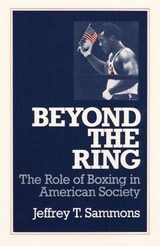
Beyond the Ring
The Role of Boxing in American SocietyJeffrey T. Sammons
University of Illinois Press, 1988
Primitive, dangerous, low-paying, crooked, exploitive--boxing, in all but a few cases, offered its athletes very little while taking everything. Why does boxing exist? What accounted for its decades-long popularity? What does its presence on the sport history landscape say about America?
Jeffrey T. Sammons looks at how boxing reflected the society that fostered it at different points in history. In the time of John L. Sullivan, the sport provided an arena for testing law, order, and social growth. Jack Johnson's career reflected the racism, nationalism, and xenophobia of the Progressive era. At its popular peak in the 1920s, boxing expressed tensions as disparate as the tug-of-war between modernism and tradition and the women's rights movement. From there, Sammons traces how the sport intertwined with Nazi antisemitism, reflected the hopes of the New Deal, produced the seminal figure Joe Louis, and stood at the nexus of the union of organized crime with business and television. Finally, he shows how Muhammad Ali and reactions to him exposed the shifting tides of racial issues and American involvement in Vietnam.
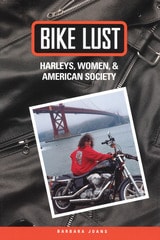
Bike Lust
Harleys, Women, And American SocietyBarbara Joans
University of Wisconsin Press, 2001
Bike Lust roars straight into the world of women bikers and offers us a ride. In this adventure story that is also an insider’s study of an American subculture, Barbara Joans enters as a passenger on the back of a bike, but soon learns to ride her own. As an anthropologist she untangles the rules, rituals, and rites of passage of the biker culture. As a new member of that culture, she struggles to overcome fear, physical weakness, and a tendency to shoot her mouth off—a tendency that very nearly gets her killed.
Bike Lust travels a landscape of contradictions. Outlaws still chase freedom on the highway, but so do thousands of riders of all classes, races, and colors. Joans introduces us to the women who ride the rear—the biker chick, the calendar slut straddling the hot engine, the back-seat Betty at the latest rally, or the underage groupie at the local run. But she also gives us the first close look at women who ride in their own right, on their own bikes, as well as a new understanding of changing world of male bikers. These are ordinary women’s lives made extraordinary, adding a dimension of courage to the sport not experienced by males, risking life and limb for a glimpse of the very edge of existence. This community of riders exists as a primal tribute to humanity's lust for freedom.
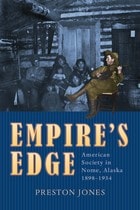
Empire's Edge
American Society in Nome, Alaska, 1898-1934Preston Jones
University of Alaska Press, 2006
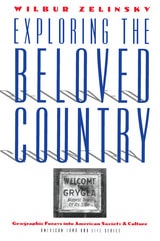
Exploring The Beloved Country
American Society And CultureWilbur Zelinsky
University of Iowa Press, 1994
For fifty years geographer Wilbur Zelinsky has charted the social, cultural, and historical map of the American experience. A self-confessed incurable landscape voyeur, he has produced order and pattern from massive amounts of data, zestfully finding societal meaning in the terra incognita of our postmodern existence. Now he has gathered his most original and exciting explorations into a volume that captures the nature and dynamics of this remarkable phenomenon we call the United States of America. Each the product of Zelinsky's joyous curiosity, these energetic essays trace the innermost contours of our bewildering American reality.
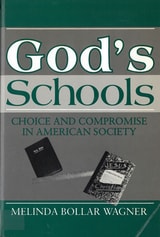
God's Schools
Choice and Compromise in American SocietyWagner, Melinda Bollar
Rutgers University Press, 1990
Many of us assume that Christian day schools foster a strict and conservative environment that is very different from the rest of the United States. Christian educators themselves foster this view when they say that following biblical strictures requires that they not always conform to this world. Melinda Wagner goes beyond this stereotype to portray the way these schools foster American popular culture and "professional education culture" as well as "Christian culture." In her participant observation study of a variety of Christian schools (sponsored by fundamentalist, evangelical, new charismatic, Holiness, and Pentecostal Christians), Wagner describes and interprets how such compromises are made.
In American culture, children are taught to meet challenges, to compete, and are rewarded for individual achievement. Conservative Christians label this individualism as "secular humanism," and find it antithetical to their view of the self. Instead, these Christians seek a culture of love, compassion, orderliness, non-competitiveness, and separation from the material trappings of this world.
But in reality, Wager finds that the schools mix Christian values with the values of American culture. She discovers that even in Christian schools students compete fiercely and are recognized for individual achievements. Christian schools incorporate norms and strategies from mainstream American education. Alternative Christian schools are not as alternative as they could be; they are walking the Christian walk the American way.
The Christian schools serve as a case study of the process of culture building. Conservative Christians are trying to revitalize their culture. Yet all along the way, they quite consciously compromise.

Institutions in American Society
Essays in Market, Political, and Social OrganizationsJohn E. Jackson, Editor
University of Michigan Press, 1990

Psychological Testing and American Society, 1890-1913
Sokal, Michael M
Rutgers University Press, 1990
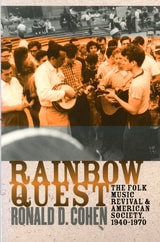
Rainbow Quest
The Folk Music Revival and American Society, 1940-1970Ronald D. Cohen
University of Massachusetts Press, 2002
For a brief period from the late 1950s to the mid-1960s, folk music captured a mass audience in the United States, as college students and others swarmed to concerts by the likes of Peter, Paul & Mary, Joan Baez, and Bob Dylan. In this comprehensive study, Ronald D. Cohen reconstructs the history of this singular cultural moment, tracing its origins to the early decades of the twentieth century. Drawing on scores of interviews and numerous manuscript collections, as well as his own extensive files, Cohen shows how a broad range of traditions—from hillbilly, gospel, blues, and sea shanties to cowboy, ethnic, and political protest music—all contributed to the genre known as folk. He documents the crucial work of John Lomax and other collectors who, with the assistance of recording companies, preserved and distributed folk music in the 1920s.
During the 1930s and 1940s, the emergence of left-wing politics and the rise of the commercial music marketplace helped to stimulate wider interest in folk music. Stars emerged, such as Woody Guthrie, Leadbelly, Pete Seeger, Burl Ives, and Josh White. With the success of the Weavers and the Kingston Trio in the 1950s, the stage was set for the full-blown “folk revival” of the early 1960s. Centered in New York's Greenwich Village and sustained by a flourishing record industry, the revival spread to college campuses and communities across the country. It included a wide array of performers and a supporting cast of journalists, club owners, record company executives, political activists, managers, and organizers. By 1965 the boom had passed its peak, as rock and roll came to dominate the marketplace, but the folk revival left an enduring musical legacy in American culture.
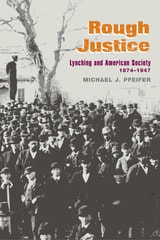
Rough Justice
Lynching and American Society, 1874-1947Michael J. Pfeifer
University of Illinois Press, 2004
Selective Service and American Society
Roger William Little
Russell Sage Foundation, 1969
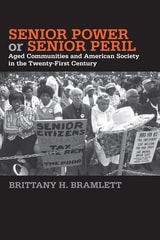
Senior Power or Senior Peril
Aged Communities and American Society in the Twenty-First CenturyBrittany H Bramlett
Temple University Press, 2015
In Senior Power or Senior Peril, Bramlett examines the assertions that the increasing number of older adult-concentrated communities across the United States form a growing bloc of senior power that will influence the redistribution of particularized welfare benefits to older adults at the expense of younger people. However, others suggest that political influence declines with old age. Bramlett uses interviews and on-site research at various senior communities to explore what qualities make an aged community politically unique, and the impact of the local aged context on residents' political knowledge, safety-net policy attitudes, efficacy, and political activity.
This path-breaking book identifies the political behaviors, attitudes, and political consciousness of both older and younger residents as it recounts the perceived and actual political power of seniors.
In the series The Social Logic of Politics, edited by Scott McClurg
The Artist in American Society
The Formative YearsNeil Harris
University of Chicago Press, 1982
Working-Class America
Essays on Labor, Community, and American SocietyEdited by Michael H. Frisch and Daniel J. Walkowitz
University of Illinois Press, 1983