Results by title
6 books match the query 'American Way'
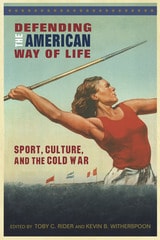
Defending the American Way of Life
Sport, Culture, and the Cold WarToby C. Rider
University of Arkansas Press, 2018
The Cold War was fought in every corner of society, including in the sport and entertainment industries. Recognizing the importance of culture in the battle for hearts and minds, the United States, like the Soviet Union, attempted to win the favor of citizens in nonaligned states through the soft power of sport. Athletes became de facto ambassadors of US interests, their wins and losses serving as emblems of broader efforts to shield American culture—both at home and abroad—against communism.
In Defending the American Way of Life, leading sport historians present new perspectives on high-profile issues in this era of sport history alongside research drawn from previously untapped archival sources to highlight the ways that sports influenced and were influenced by Cold War politics. Surveying the significance of sports in Cold War America through lenses of race, gender, diplomacy, cultural infiltration, anti-communist hysteria, doping, state intervention, and more, this collection illustrates how this conflict remains relevant to US sporting institutions, organizations, and ideologies today.
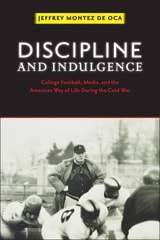
Discipline and Indulgence
College Football, Media, and the American Way of Life during the Cold WarMontez de Oca, Jeffrey
Rutgers University Press, 2013
The early Cold War (1947–1964) was a time of optimism in America. Flushed with confidence by the Second World War, many heralded the American Century and saw postwar affluence as proof that capitalism would solve want and poverty. Yet this period also filled people with anxiety. Beyond the specter of nuclear annihilation, the consumerism and affluence of capitalism’s success were seen as turning the sons of pioneers into couch potatoes.
In Discipline and Indulgence, Jeffrey Montez de Oca demonstrates how popular culture, especially college football, addressed capitalism’s contradictions by integrating men into the economy of the Cold War as workers, warriors, and consumers. In the dawning television age, college football provided a ritual and spectacle of the American way of life that anyone could participate in from the comfort of his own home. College football formed an ethical space of patriotic pageantry where men could produce themselves as citizens of the Cold War state. Based on a theoretically sophisticated analysis of Cold War media, Discipline and Indulgence assesses the period’s institutional linkage of sport, higher education, media, and militarism and finds the connections of contemporary sport media to today’s War on Terror.
The American Way of Peace
An InterpretationJan S. Prybyla
University of Missouri Press, 2005
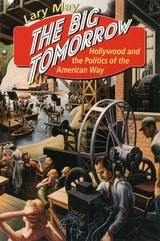
The Big Tomorrow
Hollywood and the Politics of the American WayLary May
University of Chicago Press, 2000
"The most exhilarating work of revisionist film history since Pauline Kael's Citizen Kane. . . . May's take on what movies once were (energizing, as opposed to enervating), and hence can become again, is enough to get you believing in them again as one of the regenerative forces America so sorely needs."—Jay Carr, Boston Globe
"A startling, revisionist history of Hollywood's impact on politics and American culture. . . . A convincing and important addition to American cultural criticism."—Publishers Weekly
"A controversial overview of 30 years of American film history; must reading for any serious student of the subject."—Choice
"A provocative social history of Hollywood's influence in American life from the 1930s to the 1950s. May argues persuasively that movies in the period offered a good deal of tough criticism of economic and social conditions in U.S. society. . . . May challenges us to engage in some serious rethinking about Hollywood's impact on American society in the middle of the twentieth century."—Robert Brent Toplin, American Historical Review
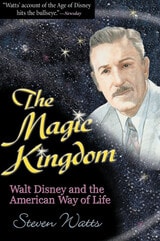
The Magic Kingdom
Walt Disney and the American Way of LifeSteven Watts
University of Missouri Press, 2001

War and Empire
The American Way of LifePaul L. Atwood
Pluto Press, 2010
In this provocative study, Paul Atwood attempts to show Americans that their history is one of constant wars of aggression and imperial expansion.
In his long teaching career, Atwood has found that most students know virtually nothing about America's involvement in the wars of the 20th century, let alone those prior to World War I. War and Empire aims to correct this, clearly and persuasively explaining US actions in every major war since the declaration of independence. The book shows that, far from being dragged reluctantly into foreign entanglements, America's leaders have always picked its battles in order to increase their influence and power, with little regard for the American soldiers and 'enemy' civilians killed or made to suffer in the process.
This book is an eye-opening introduction to the American way of life for undergraduate students of American history, politics and international relations.