Results by title
20 books match the query 'American wit and humor'

A Very Serious Thing
Women’s Humor and American CultureNancy A. Walker
University of Minnesota Press, 1988
A Very Serious Thing was first published in 1988. Minnesota Archive Editions uses digital technology to make long-unavailable books once again accessible, and are published unaltered from the original University of Minnesota Press editions.
"It is a very serious thing to be a funny woman." –Frances Miriam Berry Whitcher
A Very Serious Thing is the first book-length study of a part of American literature that has been consistently neglected by scholars and underrepresented in anthologies—American women's humorous writing. Nancy Walker proposes that the American humorous tradition to be redefined to include women's humor as well as men's, because, contrary to popular opinion, women do have a sense of humor.
Her book draws on history, sociology, anthropology, literature, and psychology to posit that the reasons for neglect of women's humorous expression are rooted in a male-dominated culture that has officially denied women the freedom and self-confidence essential to the humorist. Rather than a study of individual writers, the book is an exploration of relationships between cultural realities—including expectations of "true womanhood"—and women's humorous response to those realities.
Humorous expression, Walker maintains, is at odds with the culturally sanctioned ideal of the "lady," and much of women's humor seems to accept, while actually denying, this ideal. In fact, most of American women's humorous writing has been a feminist critique of American culture and its attitudes toward women, according to the author.
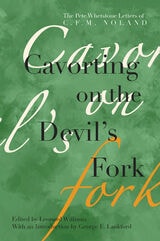
Cavorting on the Devil's Fork
The Pete Whetstone Letters of C. F. M. NolandLeonard Williams
University of Arkansas Press, 2006
By the 1840s American literature tradition had become fascinated with the frontier. The rural folk humor of the “Devil’s Fork” letters that a young Charles Fenton Mercer Noland (1810–1858) of central Arkansas began writing in 1837 was something the country wanted. His pieces were published regularly in New York’s Spirit of the Times, and he quickly achieved a reputation as one of the southwest’s best humorists. His tall tales told in dialect reflected the peculiar characteristics of the people of a backwoods region.
Noland’s semiautobiographical “Letters” were built around the experiences of Pete Whetstone, who, along with his neighbors, devoted himself to hunting, fishing, and an outdoors lifestyle. Through his first-person narration readers were able to experience an ideal southwest frontier existence. Here was a land of natural beauty, with clear rivers, forested mountains, and abundant game, a place where a person could live a free and rustic lifestyle.
Here too were horse races and bear fights, politics and balls. Unfortunately for Noland, an early death cut short a promising career. Had he lived longer and written more, he could have become one of America’s great nineteenth-century humorists. Midcentury America was certainly looking for one.
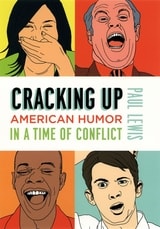
Cracking Up
American Humor in a Time of ConflictPaul Lewis
University of Chicago Press, 2006
What do Jon Stewart, Freddy Krueger, Patch Adams, and George W. Bush have in common? As Paul Lewis shows in Cracking Up, they are all among the ranks of joke tellers who aim to do much more than simply amuse. Exploring topics that range from the sadistic mockery of Abu Ghraib prison guards to New Age platitudes about the healing power of laughter, from jokes used to ridicule the possibility of global climate change to the heartwarming performances of hospital clowns, Lewis demonstrates that over the past thirty years American humor has become increasingly purposeful and embattled.
Navigating this contentious world of controversial, manipulative, and disturbing laughter, Cracking Up argues that the good news about American humor in our time—that it is delightful, relaxing, and distracting—is also the bad news. In a culture that both enjoys and quarrels about jokes, humor expresses our most nurturing and hurtful impulses, informs and misinforms us, and exposes as well as covers up the shortcomings of our leaders. Wondering what’s so funny about a culture determined to laugh at problems it prefers not to face, Lewis reveals connections between such seemingly unrelated jokers as Norman Cousins, Hannibal Lecter, Rush Limbaugh, Garry Trudeau, Jay Leno, Ronald Reagan, Beavis and Butt-Head, and Bill Clinton. The result is a surprising, alarming, and at times hilarious argument that will appeal to anyone interested in the ways humor is changing our cultural and political landscapes.
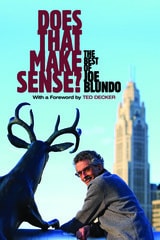
Does That Make Sense?
The Best of Joe BlundoJoe Blundo
The Ohio State University Press, 2019
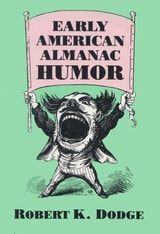
Early American Almanac Humor
University of Wisconsin Press, 1987
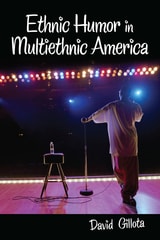
Ethnic Humor in Multiethnic America
Gillota, David
Rutgers University Press, 2013
Gillota investigates the manner in which various humorists respond to multiculturalism and the increasing diversity of the American population. Rather than looking at one or two ethnic groups at a time—as is common scholarly practice—the book focuses on the interplay between humorists from different ethnic communities. While some comic texts project a fantasy world in which diverse ethnic characters coexist in a rarely disputed harmony, others genuinely engage with the complexities and contradictions of multiethnic America.
The first chapter focuses on African American comedy with a discussion of such humorists as Paul Mooney and Chris Rock, who tend to reinforce a black/white vision of American race relations. This approach is contrasted to the comedy of Dave Chappelle, who looks beyond black and white and uses his humor to place blackness within a much wider multiethnic context.
Chapter 2 concentrates primarily on the Jewish humorists Sarah Silverman, Larry David, and Sacha Baron Cohen—three artists who use their personas to explore the peculiar position of contemporary Jews who exist in a middle space between white and other.
In chapter 3, Gillota discusses different humorous constructions of whiteness, from a detailed analysis of South Park to “Blue Collar Comedy” and the blog Stuff White People Like.
Chapter 4 is focused on the manner in which animated children’s film and the network situation comedy often project simplified and harmonious visions of diversity. In contrast, chapter 5 considers how many recent works, such as Harold and Kumar Go to White Castle and the Showtime series Weeds, engage with diversity in more complex and productive ways.
Fetching the Old Southwest
Humorous Writing from Longstreet to TwainJames H. Justus
University of Missouri Press, 2004
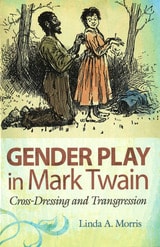
Gender Play in Mark Twain
Cross-Dressing and TransgressionLinda A. Morris
University of Missouri Press, 2007
Huckleberry Finn dressing as a girl is a famously comic scene in Mark Twain’s novel but hardly out of character—for the author, that is. Twain “troubled gender” in much of his otherwise traditional fiction, depicting children whose sexual identities are switched at birth, tomboys, same-sex married couples, and even a male French painter who impersonates his own fictive sister and becomes engaged to another man.
This book explores Mark Twain’s extensive use of cross-dressing across his career by exposing the substantial cast of characters who masqueraded as members of the opposite sex or who otherwise defied gender expectations. Linda Morris grounds her study in an understanding of the era’s theatrical cross-dressing and changing mores and even events in the Clemens household. She examines and interprets Twain’s exploration of characters who transgress gendered conventions while tracing the degree to which themes of gender disruption interact with other themes, such as his critique of race, his concern with death in his classic “boys’ books,” and his career-long preoccupation with twins and twinning.
Approaching familiar texts in surprising new ways, Morris reexamines the relationship between Huck and Jim; discusses racial and gender crossing in Pudd’nhead Wilson; and sheds new light on Twain’s difficulty in depicting the most famous cross-dresser in history, Joan of Arc. She also considers a number of his later “transvestite tales” that feature transgressive figures such as Hellfire Hotchkiss, who is hampered by her “misplaced sex.”
Morris challenges views of Twain that see his work as reinforcing traditional notions of gender along sharply divided lines. She shows that Twain depicts cross-dressing sometimes as comic or absurd, other times as darkly tragic—but that even at his most playful, he contests traditional Victorian notions about the fixity of gender roles.
Analyzing such characteristics of Twain’s fiction as his fascination with details of clothing and the ever-present element of play, Morris shows us his understanding that gender, like race, is a social construction—and above all a performance. Gender Play in Mark Twain: Cross-Dressing and Transgression broadens our understanding of the writer as it lends rich insight into his works.
Hysterical!
Women in American ComedyEdited by Linda Mizejewski and Victoria Sturtevant; foreword by Kathleen Rowe Karlyn
University of Texas Press, 2017
Ideal for classroom use, this anthology of original essays by the leading authorities on women’s comedy surveys the disorderly, subversive, and unruly performances of women comics from silent film to contemporary multimedia
Winner, Susan Koppleman Award for Best Anthology, Multi-Authored, or Edited Book in Feminist Studies, Popular and American Culture Associations (PACA), 2017
Amy Schumer, Samantha Bee, Mindy Kaling, Melissa McCarthy, Tig Notaro, Leslie Jones, and a host of hilarious peers are killing it nightly on American stages and screens large and small, smashing the tired stereotype that women aren’t funny. But today’s funny women aren’t a new phenomenon—they have generations of hysterically funny foremothers. Fay Tincher’s daredevil stunts, Mae West’s linebacker walk, Lucille Ball’s manic slapstick, Carol Burnett’s athletic pratfalls, Ellen DeGeneres’s tomboy pranks, Whoopi Goldberg’s sly twinkle, and Tina Fey’s acerbic wit all paved the way for contemporary unruly women, whose comedy upends the norms and ideals of women’s bodies and behaviors.
Hysterical! Women in American Comedy delivers a lively survey of women comics from the stars of the silent cinema up through the multimedia presences of Tina Fey and Lena Dunham. This anthology of original essays includes contributions by the field’s leading authorities, introducing a new framework for women’s comedy that analyzes the implications of hysterical laughter and hysterically funny performances. Expanding on previous studies of comedians such as Mae West, Moms Mabley, and Margaret Cho, and offering the first scholarly work on comedy pioneers Mabel Normand, Fay Tincher, and Carol Burnett, the contributors explore such topics as racial/ethnic/sexual identity, celebrity, stardom, censorship, auteurism, cuteness, and postfeminism across multiple media. Situated within the main currents of gender and queer studies, as well as American studies and feminist media scholarship, Hysterical! masterfully demonstrates that hysteria—women acting out and acting up—is a provocative, empowering model for women’s comedy.
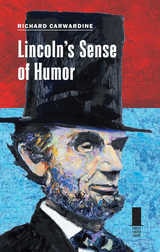
Lincoln's Sense of Humor
Richard Carwardine
Southern Illinois University Press, 2017
Winner, ISHS Annual Award for a Scholarly Publication, 2018
Abraham Lincoln was the first president to make storytelling, jokes, and laughter tools of the office, and his natural sense of humor has become legendary. Lincoln’s Sense of Humor registers the variety, complexity of purpose, and ethical dimension of Lincoln’s humor and pinpoints the political risks Lincoln ran in telling jokes while the nation was engaged in a bloody struggle for existence.
Complete with amusing anecdotes, this book shows how Lincoln’s uses of humor evolved as he matured and explores its versatility, range of expressions, and multiple sources: western tall tales, morality stories, bawdy jokes, linguistic tricks, absurdities, political satire, and sharp wit. While Lincoln excelled at self-mockery, nothing gave him greater pleasure than satirical work lampooning hypocrisy and ethical double standards. He particularly enjoyed David R. Locke’s satiric writings by Petroleum V. Nasby, a fictional bigoted secessionist preacher, and the book explores the nuances of Lincoln’s enthusiasm for what he called Locke’s genius, showing the moral springs of Lincoln’s humor.
Richard Carwardine methodically demonstrates that Lincoln’s funny stories were the means of securing political or personal advantage, sometimes by frontal assault on opponents but more often by depiction through parable, obfuscation through hilarity, refusal through wit, and diversion through cunning. Throughout his life Lincoln worked to develop the humorist’s craft and hone the art of storytelling. His jokes were valuable in advancing his careers as politician and lawyer and in navigating his course during a storm-tossed presidency. His merriness, however, coexisted with self-absorbed contemplation and melancholy. Humor was his lifeline; dark levity acted as a tonic, giving Lincoln strength to tackle the severe challenges he faced. At the same time, a reputation for unrestrained, uncontrollable humor gave welcome ammunition to his political foes. In fact, Lincoln’s jocularity elicited waves of criticism during his presidency. He was dismissed as a “smutty joker,” a “first rate second rate man,” and a “joke incarnated.”
Since his death, Lincoln’s anecdotes and jokes have become detached from the context that had given them their political and cultural bite, losing much of the ironic and satiric meaning that he had intended. With incisive analysis and laugh-inducing examples, Carwardine helps to recapture a strong component of Lincoln’s character and reanimates the good humor of our sixteenth president.
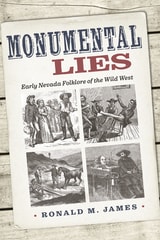
Monumental Lies
Early Nevada Folklore of the Wild WestRonald M. James
University of Nevada Press, 2023
Monumental Lies: Early Nevada Folklore of the Wild West opens the door to understanding how legends and traditions emerged during the first decades following the “Rush to Washoe,” which transformed the region beginning in 1859. During this Wild West period, there was widespread celebration of deceit, manifesting in tall tales, burlesque lies, practical jokes, and journalistic hoaxes. Humor was central to these endeavors and practitioners easily found themselves scorned if they failed to be adequately funny. This ethos became central to the way folklore emerged during the formative years of the Nevada territory and state.
The tens of thousands of people who came to the West, attracted by gold and silver mining, brought distinct cultural legacies. The interaction of diverse perspectives, even while new stories and traditions coalesced or simply appeared, was a complex process. Author Ronald M. James addresses how the fluidity of the region affected new expressions of folklore as they took root.
Mark Twain, often a go-to source for collections of early tall tales of this region, cannot be overlooked, but his interaction with local traditions was specific and narrow. More importantly, William Wright—publishing as Dan De Quille—arose as a key collector of legends, a counterpart of early European folklorists. With a bedrock understanding of what unfolded in the nineteenth century, it is possible to consider
Of Huck and Alice
Humorous Writing in American LiteratureNeil Schmitz
University of Minnesota Press, 1983
Of Huck and Alice was first published in 1983. Minnesota Archive Editions uses digital technology to make long-unavailable books once again accessible, and are published unaltered from the original University of Minnesota Press editions.
Huck Finn and Alice B. Toklas allow Mark Twain and Gertrude Stein to slip away from the cramped and smothery intentions of proper writing. Like Krazy Kat, who transforms the hurt of Ignatz Mouse's brick into humorous bliss, Huck and Alice brilliantly misrepresent painful authority. As exemplars of humorous skepticism, Mark Twain and Gertrude Stein are at the center of this far-ranging book that begins with an examination of Jacksonian dialect humor, ends with an account of the humorous style in post-modern American fiction, and considers along the way the sweet parlance of Krazy Kat, the meaning of Harpo Marx's silence, and the iconicity of Woody Allen's face. Schmitz's analysis of the humorous style explores the texture of its language, discusses its preferred forms, and shows how the humorist frames his or her question within the text.
On Humor
The Best from American LiteratureLouis J. Budd and Edwin H. Cady, eds.
Duke University Press, 1992
Presented in order of their first appearance, the articles in each volume constitute a revealing record of developing insights and important shifts of critical emphasis. Each article has opened a fresh line of inquiry, established a fresh perspective on a familiar topic, or settled a question that engaged the interest of experts.
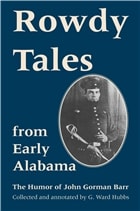
Rowdy Tales from Early Alabama
The Humor of John Gorman BarrJohn Gorman Barr
University of Alabama Press, 1989
The rollicking tales of Old Southwestern humor were a distinctive contribution to American folk culture provided by the frontiersmen of the South and Southwest, a tradition brought to its highest form in the work of Mark Twain. Among the precursors of Twain was John Gorman Barr of Tuscaloosa, Alabama. Like Twain, Barr grew up in a river town, worked in a printing office, and traveled widely; and again like Twain, Barr drew upon the people and places of his home region as the primary sources for his tales.
In addition to the pure entertainment Barr’s stories provide, they also furnish a comprehensive picture of Tuscaloosa and western Alabama in the 1850s—the roaring river town coexisting uneasily with the intellectual sophistication of the recently established University of Alabama.
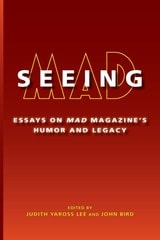
Seeing MAD
Essays on MAD Magazine's Humor and LegacyJudith Yaross Lee
University of Missouri Press, 2021
Mad magazine stands near the heart of post-WWII American humor, but at the periphery in scholarly recognition from American cultural historians, including humor specialists. This book fills that gap, with perceptive, informed, engaging, but also funny essays by a variety of scholars. The chapters, written by experts on humor, comics, and popular culture, cover the genesis of Mad; its editors and prominent contributors; its regular features and departments and standout examples of their contents; perspectives on its cultural and political significance; and its enduring legacy in American culture.
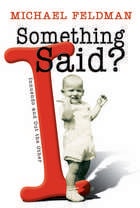
Something I Said?
Innuendo and Out the OtherMichael Feldman
University of Wisconsin Press, 2004
What we have here is another mighty slim volume from Michael Feldman, best known (when known at all) for his public radio show "Whad'ya Know" (sic). Feldman, who spouts off about things he knows "not much" about weekly, here writes them down:
· how to get your own radio show and what you can do with it once you do
· paranoia
· marriage (or as Feldman likes to refer to it, "a long-term bad relationship")
· Hitler
· SUVs
· child-rearing (although it sounds like it's the author who is being reared)
· a number of short pieces on places he and his crew have visited for their "remote possibilities"
· more references to "gentiles" than absolutely necessary (seems to be an issue for Feldman, although he is tickled with the
notion that, to a Mormon, he is one)
· some attempts to misrepresent scientific or social research for humorous purposes
· many personal revelations that prove the examined life is not necessarily worth living either
· and pages and pages of fluff.
Mr. Feldman has not been compared, to our knowledge, to S. J. Perlman.
But here is some of what Michael Feldman says in Something I Said:
"The paranoid no longer is: paranoia has outlived its usefulness when everybody is out to get us."
"Take the phrase 'no problem': I can use it, although it is the very opposite of my two-word world view ('Nothing works')."
"Whatever latitude beauty may have in the eye of the beholder, funny is not readily apparent to all, and, who knows, they may be right. More importantly, they may be bigger."
Includes a music CD by Michael Feldman and John Sieger.
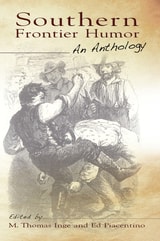
Southern Frontier Humor
An AnthologyEdited by M. Thomas Inge & Ed Piacentino
University of Missouri Press, 2010
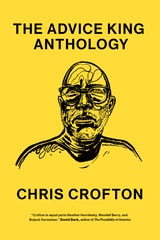
The Advice King Anthology
Chris Crofton
Vanderbilt University Press, 2022
If you are looking for traditional advice, this might not be the book for you. But if you care to find the incendiary, subversive, and hilarious alongside actual thoughts about addiction, depression, gentrification, politics, poetry, music, economic policy, living in New Nashville, and (inevitably) romance, the Advice King has much to offer.
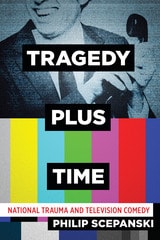
Tragedy Plus Time
National Trauma and Television ComedyBy Philip Scepanski
University of Texas Press, 2021
Following the most solemn moments in recent American history, comedians have tested the limits of how soon is “too soon” to joke about tragedy. Comics confront the horrifying events and shocking moments that capture national attention and probe the acceptable, or “sayable,” boundaries of expression that shape our cultural memory. In Tragedy Plus Time, Philip Scepanski examines the role of humor, particularly televised comedy, in constructing and policing group identity and memory in the wake of large-scale events.
Tragedy Plus Time is the first comprehensive work to investigate tragedy-driven comedy in the aftermaths of such traumas as the JFK assassination and 9/11, as well as during the administration of Donald Trump. Focusing on the mass publicization of television comedy, Scepanski considers issues of censorship and memory construction in the ways comedians negotiate emotions, politics, war, race, and Islamophobia. Amid the media frenzy and conflicting expressions of grief following a public tragedy, comedians provoke or risk controversy to grapple publicly with national traumas that all Americans are trying to understand for themselves.

Transcendental Wordplay
America’s Romantic Punsters and the Search for the Language of NatureMichael West
Ohio University Press, 2000
Throughout the first half of the nineteenth century, America was captivated by a muddled notion of “etymology.” New England Transcendentalism was only one outcropping of a nationwide movement in which schoolmasters across small-town America taught students the roots of words in ways that dramatized religious issues and sparked wordplay.
Shaped by this ferment, our major romantic authors shared the sensibility that Friedrich Schlegel linked to punning and christened “romantic irony.” Notable punsters or etymologists all, they gleefully set up as sages, creating jocular masterpieces from their zest for oracular wordplay. Their search for a primal language lurking beneath all natural languages provided them with something like a secret language that encodes their meanings. To fathom their essentially comic masterpieces we must decipher it.
Interpreting Thoreau as an ironic moralist, satirist, and social critic rather than a nature-loving mystic, Transcendental Wordplay suggests that the major American Romantics shared a surprising conservatism. In this award-winning study, Professor West rescues the pun from critical contempt and allows readers to enjoy it as a serious form of American humor.