Results by title
6 books match the query 'Americana'
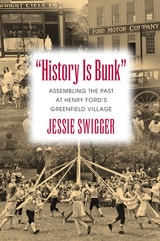
"History Is Bunk"
Assembling the Past at Henry Ford's Greenfield VillageJessie Swigger
University of Massachusetts Press, 2014
In 1916 a clearly agitated Henry Ford famously proclaimed that “history is more or less bunk.” Thirteen years later, however, he opened the outdoor history museum Greenfield Village in Dearborn, Michigan. It was written history's focus on politicians and military heroes that was bunk, he explained. Greenfield Village would correct this error by celebrating farmers and inventors.
The village eventually included a replica of Thomas Edison's Menlo Park, New Jersey, laboratory, the Wright brothers' cycle shop and home from Dayton, Ohio, and Ford's own Michigan birthplace. But not all of the structures were associated with famous men. Craft and artisan shops, a Cotswold cottage from England, and two brick slave cabins also populated the village landscape. Ford mixed replicas, preserved buildings, and whole-cloth constructions that together celebrated his personal worldview.
Greenfield Village was immediately popular. But that only ensured that the history it portrayed would be interpreted not only by Ford but also by throngs of visitors and the guides and publicity materials they encountered. After Ford's death in 1947, administrators altered the village in response to shifts in the museum profession at large, demographic changes in the Detroit metropolitan area, and the demands of their customers.
Jessie Swigger analyzes the dialogue between museum administrators and their audiences by considering the many contexts that have shaped Greenfield Village. The result is a book that simultaneously provides the most complete extant history of the site and an intimate look at how the past is assembled and constructed at history museums.
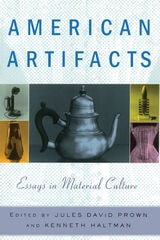
American Artifacts
Essays in Material CultureJules David Prown
Michigan State University Press, 2000
When defining culture, one must indeed take into account even the minutest of details. What of a lighter, for example, or a telephone? The essays in this new collection examine just that. The contributors pose not only a historical, pragmatic use for the items, but also delve into more imaginative aspects of what defines us as Americans. Both the lighter and the telephone are investigated, as well as how the lava lamp represents sixties counterculture and containment. The late nineteenth-century corset is discussed as an embodiment of womanhood, and an Amish quilt is used as an illustration of cultural continuity. These are just a few of the artifacts discussed. Scholars will be intrigued by the historical interpretations that contributors proposed concerning a teapot, card table, and locket; students will not only find merit in the expositions, but also by learning from the models how such interpretation can be carried out. This collection helps us understand that very thing that makes us who we are. Viewing these objects from both our past and our present, we can begin to define what it is to be American.

History Is Bunk
Assembling the Past at Henry Ford's Greenfield VillageSwigger Jessie
University of Massachusetts Press, 0
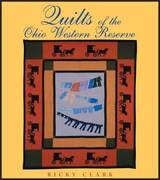
Quilts of the Ohio Western Reserve
Ricky Clark
Ohio University Press, 2005
Quilts of the Ohio Western Reserve includes early quilts brought from Connecticut to the Western Reserve in northeastern Ohio and contemporary quilts, including one by a conservative Amish woman and another inspired by Cleveland’s Rock and Roll Hall of Fame.
Ricky Clark, one of Ohio’s foremost quilt historians, has assembled exquisite examples of calamanco, “T” quilts, and borderless pieced quilts to show the influence of Connecticut aesthetics and history on the making of early quilts in this region. Rich in color, detail, and inventiveness, and often beautifully designed, the quilts of this region commemorate community history, from town fundraisers of the 1890s to a quilt designed by a Lake Erie shipbuilder. Sections of the book include quilts made during the Civil War and for postwar veterans’ organizations as well as military and presidential quilts that relate to the history of the Western Reserve.
Quilt design in Ohio has been celebrated in biennial exhibits, round-robin quilts, and most recently proudly painted on barns in rural Ohio. Quilts of the Ohio Western Reserve, lavishly illustrated with forty color photos of quilts, launches the Ohio Quilt Series. A welcome addition to Ohio’s cultural legacy, this book will interest the wider world of quilt and textile enthusiasts and historians.
The Vernor's Story
From Gnomes to NowLawrence L. Rouch
University of Michigan Press, 2003

Twentieth-Century Popular Culture in Museums and Libraries
Fred E.H. Schroeder
University of Wisconsin Press, 1981
The essays in this book investigate the reasons for present-day neglect of popular culture materials and chart the various routes by which conscientious and insightful librarians and museum directors can correct this disastrous oversight.