Results by title
3 books match the query 'Amos Doss, Harriet E.'
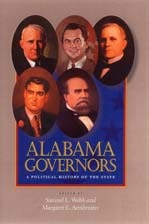
Alabama Governors
A Political History of the StateSamuel L. Webb
University of Alabama Press, 2001
The story of Alabama's governors has been often bizarre, occasionally inspiring, but never dull. Several of the state's early governors fought duels; one killed his wife's lover. A Reconstruction era-governor barricaded himself in his administrative office and refused to give it up when voters failed to reelect him. A 20th-century governor, an alumnus of Yale, married his first cousin and served as an officer in the Ku Klux Klan.
This collection of biographical essays, written by 34 noted historians and political scientists, chronicles the foibles and idiosyncrasies, in and out of office, of those who have served as the state's highest elected official. It also describes their courage; their meaningful policy initiatives; their accomplishments and failures; the complex factors that led to their actions or inaction; and the enormous consequences of their choices on the state's behalf.
Taken together, the essays provide a unified history of the state, with its recurring themes of race, federal-state relations, economic development, taxation, and education. Alabama Governors is certain to become an invaluable resource for teachers, students, librarians, journalists, and anyone interested in the colorful history and politics of the state.
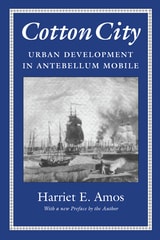
Cotton City
Urban Development in Antebellum MobileHarriet E. Amos Doss
University of Alabama Press, 2001
The exploration of the North-South relationship and the growth of of antebellum Mobile.
Cotton City offers a compelling exploration of Mobile, Alabama’s transformation into a thriving urban center during the antebellum period. Historian Harriet E. Amos examines how economic ambition, civic planning, and the cotton trade shaped the city’s development between 1819 and 1861. Through detailed archival research, Amos reveals how Mobile’s leaders sought to modernize infrastructure, expand commerce, and assert the city’s regional importance—all while navigating the tensions of slavery, class, and Southern identity.
This richly contextualized study highlights the interplay between urban growth and the broader forces of the Southern economy, making Cotton City a vital contribution to the histories of the American South, urbanization, and antebellum society.
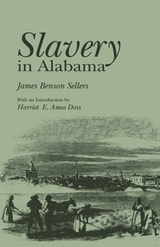
Slavery in Alabama
James Benson Sellers
University of Alabama Press, 1994
The only comprehensive statewide study of the institution of slavery in Alabama
Since its initial publication in 1950, Slavery in Alabama remains the only comprehensive statewide study of the institution of slavery in Alabama. Sellers concentrates on examining the social and economic aspects of how slavery operated in the state. After a brief discussion of slavery under imperial rulers of the colonial and territorial periods, Sellers focuses on the transplantation of the slavery system from the Atlantic seaboard states to Alabama.
Sellers used the primary sources available to him, including government documents, county and city records, personal papers, church records, and newspapers. His discussions of the church and the slave, and his treatment of the proslavery defense, deepen the comprehensiveness of his study. His two sections of photographs are special touches showing former slaves and churches with slave galleries.