Results by title
3 books match the query 'Analogy'
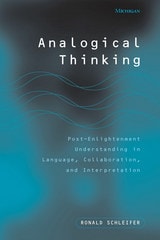
Analogical Thinking
Post-Enlightenment Understanding in Language, Collaboration, and InterpretationRonald Schleifer
University of Michigan Press, 2001
Analogical Thinking argues that sometime around the turn of the twentieth century, a new mode of comprehension arose, supplementing received Enlightenment ideas concerning the nature of understanding and explanation. Focusing on the innovations of structural linguistics and its poststructural legacy, the individualism of Enlightenment knowledge and the collaborations of post-Enlightenment information, and practices of reading and interpretation across the arts and sciences, Analogical Thinking examines the ways in which analogical presentations of similarities respond to the experiences of twentieth-century culture.
The book traces this mode of thinking in linguistics, collaborative intellectual work in the arts and sciences, and interpretations of literary and sacred texts, concluding with a reading of the concept of Enlightenment in a comparison of Descartes and Foucault. The book examines the poststructuralism of Derrida; the collaborations of information theory and modern science as opposed to the individualism of Adam Smith and others, and analogical interpretations of Yeats, Dinesen, the Bible, Dreiser, and Mailer. Its overall aim is to present an interdisciplinary examination of a particular kind of understanding that responds to the experiences of our time.
Ronald Schleifer is Professor of English, University of Oklahoma. His books include Rhetoric and Death: The Language of Modernism and Postmodern Discourse Theory, Criticism and Culture; and Culture and Cognition: The Boundaries of Literary and Scientific Inquiry.
[more]
Aquinas and Analogy
Ralph McInerny
Catholic University of America Press, 1996
The basic distinctions McInerny introduces, his criticism of the central piece in the literature, Cajetan's De nominum analogia, the applications he makes to problems such as that of the nature of metaphysics or of logic, his knowledge of contemporary debates on related topics, combine to make his contribution unique
[more]
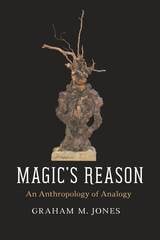
Magic's Reason
An Anthropology of AnalogyGraham M. Jones
University of Chicago Press, 2017
In Magic’s Reason, Graham M. Jones tells the entwined stories of anthropology and entertainment magic. The two pursuits are not as separate as they may seem at first. As Jones shows, they not only matured around the same time, but they also shared mutually reinforcing stances toward modernity and rationality. It is no historical accident, for example, that colonial ethnographers drew analogies between Western magicians and native ritual performers, who, in their view, hoodwinked gullible people into believing their sleight of hand was divine.
Using French magicians’ engagements with North African ritual performers as a case study, Jones shows how magic became enshrined in anthropological reasoning. Acknowledging the residue of magic’s colonial origins doesn’t require us to dispense with it. Rather, through this radical reassessment of classic anthropological ideas, Magic’s Reason develops a new perspective on the promise and peril of cross-cultural comparison.
Using French magicians’ engagements with North African ritual performers as a case study, Jones shows how magic became enshrined in anthropological reasoning. Acknowledging the residue of magic’s colonial origins doesn’t require us to dispense with it. Rather, through this radical reassessment of classic anthropological ideas, Magic’s Reason develops a new perspective on the promise and peril of cross-cultural comparison.
[more]