Results by title
3 books match the query 'Anaphora'
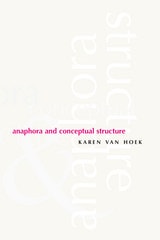
Anaphora and Conceptual Structure
Karen van Hoek
University of Chicago Press, 1997
Karen van Hoek presents a cogent analysis of the classic problem of constraints on pronominal anaphora within the framework of Cognitive Grammar. Van Hoek proceeds from the position that grammatical structure can be characterized in terms of semantic and phonological representations, without autonomous syntactic structures or principles such as tree structures or c-command. She argues that constraints on anaphora can be explained in terms of semantic interactions between nominals and the contexts in which they are embedded.
Integrating the results of previous work, Van Hoek develops a model in which some nominals function as "conceptual reference points" that dominate over stretches defined by the semantic relations among elements. When a full noun is in the domain of a reference point, coreference is ruled out, since the speaker would be sending contradictory messages about the salience of the noun's referent.
With profound implications for the nature of syntax, this book will interest theoretical linguists of all persuasions.
[more]
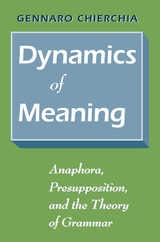
Dynamics of Meaning
Anaphora, Presupposition, and the Theory of GrammarGennaro Chierchia
University of Chicago Press, 1995
In The Dynamics of Meaning, Gennaro Chierchia tackles central issues in dynamic semantics and extends the general framework.
Chapter 1 introduces the notion of dynamic semantics and discusses in detail the phenomena that have been used to motivate it, such as "donkey" sentences and adverbs of quantification. The second chapter explores in greater depth the interpretation of indefinites and issues related to presuppositions of uniqueness and the "E-type strategy." In Chapter 3, Chierchia extends the dynamic approach to the domain of syntactic theory, considering a range of empirical problems that includes backwards anaphora, reconstruction effects, and weak crossover. The final chapter develops the formal system of dynamic semantics to deal with central issues of definites and presupposition. Chierchia shows that an approach based on a principled enrichment of the mechanisms dealing with meaning is to be preferred on empirical grounds over approaches that depend on an enrichment of the syntactic apparatus.
Dynamics of Meaning illustrates how seemingly abstract stances on the nature of meaning can have significant and far-reaching linguistic consequences, leading to the detection of new facts and influencing our understanding of the syntax/semantics/pragmatics interface.
[more]
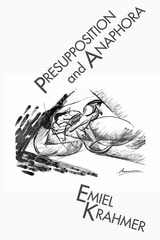
Presupposition and Anaphora
Emiel Krahmer
CSLI, 1998
In this book, two related phenomena are studied: presupposition and anaphora. Dynamic semantics is by now widely accepted as a first-rate foundation for such an exercise and it forms the backbone of most of the work in this book. A recurring additional theme of the present book is the usefulness of techniques from partial logic in the treatment of both phenomena. Rather than adding completely new semantic theories to the present gamut of theories, the author discusses a number of existing approaches which aim at accounting for the behavior of presuppositions and/or anaphors, makes improvements where necessary, and compares the results. Presupposition and Anaphora starts with an introduction to a number of dynamic semantic theories and their correlations, paying special attention to the treatment of disjunctions and negations. Subsequently, presuppositions are studied in the context of partial logics, Montague Grammar and dynamic semantics.
[more]