Results by title
5 books match the query 'Ancient Andes'
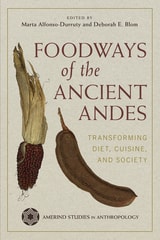
Foodways of the Ancient Andes
Transforming Diet, Cuisine, and SocietyMarta P Alfonso-Durruty
University of Arizona Press, 2023
Exploring the multiple social, ecological, cultural, and ontological dimensions of food in the Andean past, the contributors of Foodways of the Ancient Andes offer diverse theoretical perspectives and methodological approaches that reveal the richness, sophistication, and ingenuity of Andean peoples. The volume spans time periods and localities in the Andean region to reveal how food is intertwined with multiple aspects of the human experience, from production and consumption to ideology and sociopolitical organization. It illustrates the Andean peoples’ resilience in the face of challenges brought about by food scarcity and environmental change. Chapters dissect the intersection of food, power, and status in early states and empires; examine the impact of food during times of conflict and instability; and illuminate how sacred and high-status foods contributed to the building of the Inka Empire.
Featuring forty-six contributors from ten countries, the chapters employ new analytical methods, integrating different food data and interdisciplinary research to show that food can provide not only simple nutrition but also a multitude of strategies, social and political relationships, and ontologies that are otherwise invisible in the archaeological record.
Contributors
Aleksa K. Alaica
Sonia Alconini
Marta Alfonso-Durruty
Sarah I. Baitzel
Véronique Bélisle
Carolina Belmar
Carrie Anne Berryman
Matthew E. Biwer
Deborah E. Blom
Tamara L. Bray
Matthew T. Brown
Maria C. Bruno
José M. Capriles
Katherine L. Chiou
Susan D. deFrance
Lucia M. Diaz
Richard P. Evershed
Maureen E. Folk
Alexandra Greenwald
Chris Harrod
Christine A. Hastorf
Iain Kendall
Kelly J. Knudson
BrieAnna S. Langlie
Cecilia Lemp
Petrus le Roux
Marcos Martinez
Anahí Maturana-Fernández
Weston C. McCool
Melanie J. Miller
Nicole Misarti
Flavia Morello
Patricia Quiñonez Cuzcano
Omar Reyes
Arturo F. Rivera Infante
Manuel San Román
Francisca Santana-Sagredo
Beth K. Scaffidi
Augusto Tessone
Andrés Troncoso
Tiffiny A. Tung
Mauricio Uribe
Natasha P. Vang
Sadie L. Weber
Kurt M. Wilson
Michelle E. Young
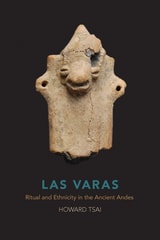
Las Varas
Ritual and Ethnicity in the Ancient AndesHoward Tsai
University of Alabama Press, 2020
Recent popular discourse on nationalism and ethnicity assumes that humans by nature prefer “tribalism,” as if people cannot help but divide themselves along lines of social and ethnic difference. Research from anthropology, history, and archaeology, however, shows that individuals actively construct cultural and social ideologies to fabricate the stereotypes, myths, and beliefs that separate “us” from “them.” Archaeologist Howard Tsai and his team uncovered a thousand-year-old village in northern Peru where rituals were performed to recognize and reinforce ethnic identities.
This site—Las Varas—is located near the coast of Peru in a valley leading into the Andes. Excavations revealed a western entrance to Las Varas for those arriving from the coast and an eastern entryway for those coming from the highlands. Rituals were performed at both of these entrances, indicating that the community was open to exchange and interaction, yet at the same time controlled the flow of people and goods through ceremonial protocols. Using these checkpoints and associated rituals, the villagers of Las Varas were able to maintain ethnic differences between themselves and visitors from foreign lands.
Las Varas: Ritual and Ethnicity in the Ancient Andes reveals a rare case of finding ethnicity relying solely on archaeological remains. In this monograph, data from the excavation of Las Varas are analyzed within a theoretical framework based on current understandings of ethnicity. Tsai’s method, approach, and inference demonstrate the potential for archaeologists to discover how ethnic identities were constructed in the past, ultimately making us question the supposed naturalness of tribal divisions in human antiquity.
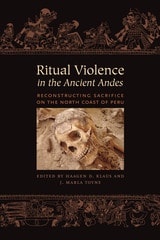
Ritual Violence in the Ancient Andes
Reconstructing Sacrifice on the North Coast of PeruEdited by Haagen D. Klaus and J. Marla Toyne
University of Texas Press, 2016
Traditions of sacrifice exist in almost every human culture and often embody a society’s most meaningful religious and symbolic acts. Ritual violence was particularly varied and enduring in the prehistoric South American Andes, where human lives, animals, and material objects were sacrificed in secular rites or as offerings to the divine. Spectacular discoveries of sacrificial sites containing the victims of violent rituals have drawn ever-increasing attention to ritual sacrifice within Andean archaeology. Responding to this interest, this volume provides the first regional overview of ritual killing on the pre-Hispanic north coast of Peru, where distinct forms and diverse trajectories of ritual violence developed during the final 1,800 years of prehistory.
Presenting original research that blends empirical approaches, iconographic interpretations, and contextual analyses, the contributors address four linked themes—the historical development and regional variation of north coast sacrifice from the early first millennium AD to the European conquest; a continuum of ritual violence that spans people, animals, and objects; the broader ritual world of sacrifice, including rites both before and after violent offering; and the use of diverse scientific tools, archaeological information, and theoretical interpretations to study sacrifice. This research proposes a wide range of new questions that will shape the research agenda in the coming decades, while fostering a nuanced, scientific, and humanized approach to the archaeology of ritual violence that is applicable to archaeological contexts around the world.
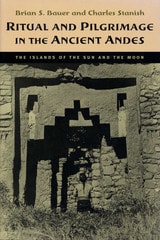
Ritual and Pilgrimage in the Ancient Andes
The Islands of the Sun and the MoonBy Brian S. Bauer and Charles Stanish
University of Texas Press, 2001
The Islands of the Sun and the Moon in Bolivia's Lake Titicaca were two of the most sacred locations in the Inca empire. A pan-Andean belief held that they marked the origin place of the Sun and the Moon, and pilgrims from across the Inca realm made ritual journeys to the sacred shrines there. In this book, Brian Bauer and Charles Stanish explore the extent to which this use of the islands as a pilgrimage center during Inca times was founded on and developed from earlier religious traditions of the Lake Titicaca region.
Drawing on a systematic archaeological survey and test excavations in the islands, as well as data from historical texts and ethnography, the authors document a succession of complex polities in the islands from 2000 BC to the time of European contact in the 1530s AD. They uncover significant evidence of pre-Inca ritual use of the islands, which raises the compelling possibility that the religious significance of the islands is of great antiquity. The authors also use these data to address broader anthropological questions on the role of pilgrimage centers in the development of pre-modern states.
The Mountain Embodied
Head Shaping and Personhood in the Ancient AndesMatthew C. Velasco
University of Texas Press, 2025
A study of the ancient practice of Andean head shaping and its cultural connotations.
In the late sixteenth century, Spanish conquerors in Peru’s Colca Valley encountered the Collaguas and Cavanas, Indigenous people who undertook a striking form of body modification: Collaguas bound the heads of infants and children so that their skulls grew narrow and elongated, and Cavanas so that their skulls became wide and squat. Head shaping resulted in craniums that resembled two specific mountains associated with the groups. For Europeans, shaped skulls immediately and durably became a marker of territorialized ethnic difference.
The Mountain Embodied offers a more nuanced story. Having studied hundreds of samples of human remains, bioarchaeologist Matthew Velasco argues that reducing head shape to a mere ethnic marker is a colonial invention. Instead, the social significance of head shaping was protean and intersected with other structures of difference, such as gender, kinship, and status, influencing experience within the community. Head shaping, then, was one factor in the construction of a locally embedded kind of subjectivity. An outsider could deduce group identity from head shape, but for practitioners, head shaping reflected something else: nothing less than personhood itself.