Results by title
2 books match the query 'Andean People'
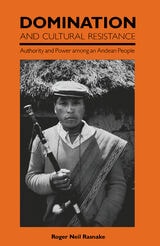
Domination and Cultural Resistance
Authority and Power Among an Andean PeopleRoger Neil Rasnake
Duke University Press, 1988
Domination and Cultural Resistance examines the social life of the Yura, a Quechua-speaking Andean ethnic group of central Bolivia, and focuses especially on their indigenous authorities, the kuraqkuna or elders. Combining ethnohistorical research with contemporary fieldwork, Roger Neil Rasnake traces the evolution of leadership roles within the changing composition of the native Andean social groupings, the ayllus—from the consolidation of pre-Hispanic Aymara polities, through the pressures of the Spanish colonial regime and the increasing fragmentation of the republican era, to the present.
[more]
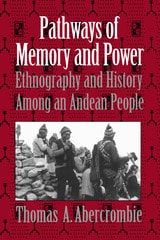
Pathways of Memory and Power
Ethnography and History among an Andean PeopleThomas A. Abercrombie
University of Wisconsin Press, 1998
Pathways of Memory and Power crosses the disciplinary boundary where anthropology and history meet, exploring the cultural frontier of the colonial and postcolonial Andes. Thomas A. Abercrombie uses his fieldwork in the Aymara community of Santa Barbara de Culta, Bolivia, as a starting point for his ambitious examination of the relations between European forms of historical consciousness and indigenous Andean ways of understanding the past. Writing in an inviting first-person narrative style, Abercrombie confronts the ethics of fieldwork by comparing ethnographic experience to the power-laden contexts that produce historical sources.
Making clear the early and deep intermingling of practices and world views among Spaniards and Andeans, Christians and non-Christians, Abercrombie critiques both the romanticist tendency to regard Andean culture as still separate from and resistant to European influences, and the melodramatic view that all indigenous practices have been obliterated by colonial and national elites. He challenges prejudices that, from colonial days to the present, have seen Andean historical knowledge only in mythic narratives or narratives of personal experience. Bringing an ethnographer’s approach to historiography, he shows how complex Andean rituals that hybridize European and indigenous traditions—such as libation dedications and llama sacrifices held on saints’ day festivals—are in fact potent evidence of social memory in the community.
Making clear the early and deep intermingling of practices and world views among Spaniards and Andeans, Christians and non-Christians, Abercrombie critiques both the romanticist tendency to regard Andean culture as still separate from and resistant to European influences, and the melodramatic view that all indigenous practices have been obliterated by colonial and national elites. He challenges prejudices that, from colonial days to the present, have seen Andean historical knowledge only in mythic narratives or narratives of personal experience. Bringing an ethnographer’s approach to historiography, he shows how complex Andean rituals that hybridize European and indigenous traditions—such as libation dedications and llama sacrifices held on saints’ day festivals—are in fact potent evidence of social memory in the community.
[more]