Results by title
7 books match the query 'Animal experimentation'
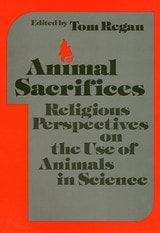
Animal Sacrifices
edited by Tom Regan, introduction by John Bowker
Temple University Press, 1987
The issues of animal rights and the use of animals in scientific experimentation are fraught with controversy. In an effort to define the bases of such strong emotional response towards an ethical issue, this book presents the teachings of the major religions of the world concerning animals and, more specifically, their use in science. Judaism, Christianity, Islam, Hinduism, Jainism, Buddhism, and Confucianism are represented in this collection of eight essays by religious authorities.
Scriptural writings, written and oral tradition, law, religious parables, and even folklore are used to illustrate the position of each religion on this question. When there are no specific teachings regarding the relatively recent use of animals in scientific research, conclusions are derived from the view of man’s relations with the rest of the world.
In addition to the essays dealing with specific religions, there is also a chapter detailing recent uses of animals in scientific research throughout the world. It is estimated that 500 million animals a year are sacrificed to science. This volume attempts to find out for what purposes they are used, under what conditions, and with what legal protection.
Based on a conference which explored the views of religion toward scientific experimentation on animals, this collection of essays addresses an explosive issue from a number of different perspectives. Animal Sacrifices is a fair-minded and informative discussion of a contemporary ethical dilemma.
Contributors: John Bowker, Sidney Gendin, Rabbi Dr. J. David Bleich, Andrew Linzey, James Gaffney, Al-Hafiz, B. Z. Masri, Basant K. Lal, Christopher Chapple, Rodney L. Taylor, and the editor.

Hearts And Minds
The Controversy Over Laboratory AnimalsJulian Groves
Temple University Press, 1996

Lab Dog
What Global Science Owes American BeaglesBrad Bolman
University of Chicago Press, 2025
Intrepid, docile, and cloaked in coats of white, black, and tan, beagles were one of the most popular breeds in the United States in the twentieth century. From Snoopy to dog shows, many Americans loved and identified with beagles. But during the same period, as scientists searched for a standard research dog, beagles emerged as something else: an ideal animal for laboratory experimentation.
In Lab Dog, historian Brad Bolman explains how the laboratory dog became a subject of intense focus for twentieth-century scientists and charts the beagle’s surprising trajectory through global science. Following beagles as they moved from eugenics to radiobiology, pharmaceutical testing to Alzheimer’s studies, Lab Dog sheds new light on pivotal stories of twentieth-century science, including the Manhattan Project, tobacco controversies, contraceptive testing, and behavioral genetics research. Bolman shows how these experiments shaped our understanding of dogs as intelligent companions who deserve moral protection and socialization—and in some cases, daily medication. Compelling and accessible, Lab Dog tells the thorny story of the participation of beagles in science, including both their sacrifices and their contributions, and offers a glimpse into the future of animal experimentation.

Near Human
Border Zones of Species, Life, and BelongingMette N. Svendsen
Rutgers University Press, 2022
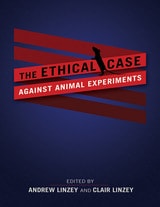
The Ethical Case against Animal Experiments
Andrew Linzey, Clair Linzey
University of Illinois Press, 2018
The Ethical Case against Animal Experiments begins with the Oxford Centre for Animal Ethics's groundbreaking and comprehensive ethical critique of the practice of animal experiments. A second section offers original writings that engage with, and elaborate on, aspects of the Oxford Centre report. The essayists explore historical, philosophical, and personal perspectives that range from animal experiments in classical times to the place of necessity in animal research to one researcher's painful journey from researcher to opponent.
A devastating look at a contemporary moral crisis, The Ethical Case against Animal Experiments melds logic and compassion to mount a powerful challenge to human cruelty.

Trixy
A NovelElizabeth Stuart Phelps, Edited and with an introduction by Emily E. VanDette
Northwestern University Press, 2019
Trixy is a 1904 novel by the best-selling but largely forgotten American author and women’s rights activist Elizabeth Stuart Phelps. The book decries the then common practice of vivisection, or scientific experiments on live animals. In Trixy, contemporary readers can trace the roots of the early animal rights movement in Phelps’s influential campaign to introduce legislation to regulate or end this practice. Phelps not only presents a narrative polemic against the cruelty of vivisection but argues that training young doctors in it makes them bad physicians. Emily E. VanDette’s introduction demonstrates that Phelps’s protest writing, which included fiction, pamphlets, essays, and speeches, was well ahead of its time.
Though not well known today, Phelps’s 1868 spiritualist novel, The Gates Ajar, which offered a comforting view of the afterlife to readers traumatized by the Civil War, was the century’s second best-selling American novel, surpassed only by Uncle Tom’s Cabin. Recently scholars and readers have begun to reexamine Phelps’s significance. As contemporary authors, including Peter Singer, Jonathan Safran Foer, Donna J. Haraway, Gary L. Francione, and Carol J. Adams, have extended her vision, they have also created new audiences for her work.
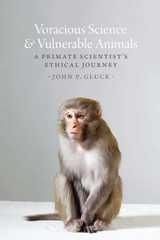
Voracious Science and Vulnerable Animals
A Primate Scientist's Ethical JourneyJohn P. Gluck
University of Chicago Press, 2016
Gluck begins by taking us inside the laboratory of Harry F. Harlow at the University of Wisconsin, where Gluck worked as a graduate student in the 1960s. Harlow’s primate lab became famous for his behavioral experiments in maternal deprivation and social isolation of rhesus macaques. Though trained as a behavioral scientist, Gluck finds himself unable to overlook the intense psychological and physical damage these experiments wrought on the macaques. Gluck’s sobering and moving account reveals how in this and other labs, including his own, he came to grapple with the uncomfortable justifications that many researchers were offering for their work. As his sense of conflict grows, we’re right alongside him, developing a deep empathy for the often smart and always vulnerable animals used for these experiments.
At a time of unprecedented recognition of the intellectual cognition and emotional intelligence of animals, Voracious Science and Vulnerable Animals is a powerful appeal for our respect and compassion for those creatures who have unwillingly dedicated their lives to science. Through the words of someone who has inflicted pain in the name of science and come to abhor it, it’s important to know what has led this far to progress and where further inroads in animal research ethics are needed.