Results by title
4 books match the query 'Animal psychology'

Animal Minds
Donald R. Griffin
University of Chicago Press, 1992
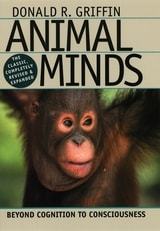
Animal Minds
Beyond Cognition to ConsciousnessDonald R. Griffin
University of Chicago Press, 2001
With this new edition of his classic book, which he has completely revised and updated, Griffin moves beyond considerations of animal cognition to argue that scientists can and should investigate questions of animal consciousness. Using examples from studies of species ranging from chimpanzees and dolphins to birds and honeybees, he demonstrates how communication among animals can serve as a "window" into what animals think and feel, just as human speech and nonverbal communication tell us most of what we know about the thoughts and feelings of other people. Even when they don't communicate about it, animals respond with sometimes surprising versatility to new situations for which neither their genes nor their previous experiences have prepared them, and Griffin discusses what these behaviors can tell us about animal minds. He also reviews the latest research in cognitive neuroscience, which has revealed startling similarities in the neural mechanisms underlying brain functioning in both humans and other animals. Finally, in four chapters greatly expanded for this edition, Griffin considers the latest scientific research on animal consciousness, pro and con, and explores its profound philosophical and ethical implications.
Two Lessons on Animal and Man
Gilbert Simondon
University of Minnesota Press, 2011
Simondon is a secret password among certain discussions within philosophy today. As a philosopher of technology, Simondon’s work has a place at the forefront of current thinking in media, technology, psychology, and philosophy with complex accounts of man’s relationship to technology and the realm that continues to form itself via this tension between man and his technical universe. In this introduction to Simondon’s oeuvre, the reader has access to the grounding of one of the most fundamental and critical questions that has been the focus of philosophy for millennia: the relationship between man and animal.

Wild Justice
The Moral Lives of AnimalsMarc Bekoff and Jessica Pierce
University of Chicago Press, 2009
Scientists have long counseled against interpreting animal behavior in terms of human emotions, warning that such anthropomorphizing limits our ability to understand animals as they really are. Yet what are we to make of a female gorilla in a German zoo who spent days mourning the death of her baby? Or a wild female elephant who cared for a younger one after she was injured by a rambunctious teenage male? Or a rat who refused to push a lever for food when he saw that doing so caused another rat to be shocked? Aren’t these clear signs that animals have recognizable emotions and moral intelligence? With Wild Justice Marc Bekoff and Jessica Pierce unequivocally answer yes.
Marrying years of behavioral and cognitive research with compelling and moving anecdotes, Bekoff and Pierce reveal that animals exhibit a broad repertoire of moral behaviors, including fairness, empathy, trust, and reciprocity. Underlying these behaviors is a complex and nuanced range of emotions, backed by a high degree of intelligence and surprising behavioral flexibility. Animals, in short, are incredibly adept social beings, relying on rules of conduct to navigate intricate social networks that are essential to their survival. Ultimately, Bekoff and Pierce draw the astonishing conclusion that there is no moral gap between humans and other species: morality is an evolved trait that we unquestionably share with other social mammals.
Sure to be controversial, Wild Justice offers not just cutting-edge science, but a provocative call to rethink our relationship with—and our responsibilities toward—our fellow animals.