Results by title
10 books match the query 'Anniversaries, etc'
9/11
The Culture of CommemorationDavid Simpson
University of Chicago Press, 2006
In 9/11, Simpson argues that elements of the conventional culture of mourning and remembrance—grieving the dead, summarizing their lives in obituaries, and erecting monuments in their memory—have been co-opted for political advantage. He also confronts those who labeled the event an “apocalypse,” condemning their exploitation of 9/11 for the defense of torture and war.
In four elegant chapters—two of which expand on essays originally published in the London Review of Books to great acclaim—Simpson analyzes the response to 9/11: the nationally syndicated “Portraits of Grief” obituaries in the New York Times; the debates over the rebuilding of the World Trade Center towers and the memorial design; the representation of American and Iraqi dead after the invasion of March 2003, along with the worldwide circulation of the Abu Ghraib torture photographs; and the urgent and largely ignored critique of homeland rhetoric from the domain of critical theory.
Calling for a sustained cultural and theoretical analysis, 9/11 is the first book of its kind to consider the events of that tragic day with a perspective so firmly grounded in the humanities and so persuasive about the contribution they can make to our understanding of its consequences.
Alaska at 50
The Past, Present, and Future of Alaska StatehoodEdited by Gregory W. Kimura
University of Alaska Press, 2009
In 2009 Alaska celebrates its fiftieth anniversary of U.S. statehood. To commemorate that milestone, Alaska at 50 brings together some of today’s most noteworthy and recognizable writers and researchers to address the past, present, and future of Alaska. Divided into three overarching sections—art, culture, and humanities; law, economy, and politics; and environment, people, and place—Alaska at 50 is written in highly accessible prose. Illustrations and photographs of significant artefacts of Alaska history enliven the text. Each contributor brings a strong voice and prescription for the next fifty years, and the resulting work presents Alaskans and the nation with an overview of Alaska statehood and ideas for future development.
Black America in the Shadow of the Sixties
Notes on the Civil Rights Movement, Neoliberalism, and PoliticsClarence Lang
University of Michigan Press, 2015
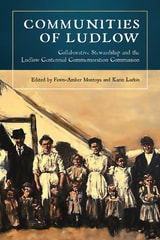
Communities of Ludlow
Collaborative Stewardship and the Ludlow Centennial Commemoration CommissionFawn-Amber Montoya
University Press of Colorado, 2021
The history of the Ludlow Massacre encompasses the stories of immigrant groups, women, the working-class, and people of color as much as the story of that tragedy, and the continued relevance of these issues creates a need for remembrance and discussion of how to make the events of the Ludlow Massacre available to contemporary society. The book outlines recent efforts to remember and commemorate this important historical event, documenting the unique collaborations in public scholarship and outreach among the diverse group of people involved in marking the 100-year anniversary of the Ludlow Massacre. The chapters relate the tales of the stewards of the Ludlow Massacre—the various communities that rallied together to keep this history alive and show its relevance, including lineal descendants, members of the United Mine Workers of America, historians, archaeologists, scholars, artists, interpreters, authors, playwrights, and politicians. The book also offers tips, strategies, and cautionary tales for practicing engaged public scholarship.
The history of the Ludlow Massacre has been told as a tragedy of striking miners in the West that occurred during a turbulent time in US labor relations, but it is so much more than that. Communities of Ludlow explores the intersections of public scholarship, advocacy, and personal experience, weaving these perspectives together with models for practicing public scholarship to illustrate the power of creating spaces for sharing ideas and information in an environment that encourages creativity, open dialogue, public outreach, political action, and alternative narratives.
Contributors: Robert Butero, Robin Henry, Michael Jacobson, Elizabeth Jameson, Linda Linville, Matthew Maher, Yolanda Romero
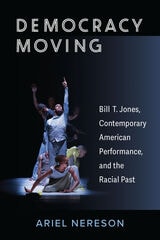
Democracy Moving
Bill T. Jones, Contemporary American Performance, and the Racial PastAriel Nereson
University of Michigan Press, 2022
The project addresses how different communities choose to commemorate historical figures, events, and places through art—whether performance, oratory, song, statuary, or portraiture—and in particular, Black US American counter-memorial practices that address histories of slavery. Advancing the theory of oscillation as Black aesthetic praxis, author Ariel Nereson celebrates Bill T. Jones as a public intellectual whose practice has contributed to the project of understanding America’s relationship to its troubled past. The book features materials from Bill T. Jones/Arnie Zane Company’s largely unexplored archive, interviews with artists, and photos that document this critical stage of Jones’s career as it explores how aesthetics, as ideas in action, can imagine more just and equitable social formations.
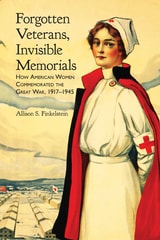
Forgotten Veterans, Invisible Memorials
How American Women Commemorated the Great War, 1917–1945Allison S. Finkelstein
University of Alabama Press, 2021
Investigates the groundbreaking role American women played in commemorating those who served and sacrificed in World War I
In Forgotten Veterans, Invisible Memorials: How American Women Commemorated the Great War, 1917–1945 Allison S. Finkelstein argues that American women activists considered their own community service and veteran advocacy to be forms of commemoration just as significant and effective as other, more traditional forms of commemoration such as memorials. Finkelstein employs the term “veteranism” to describe these women’s overarching philosophy that supporting, aiding, and caring for those who served needed to be a chief concern of American citizens, civic groups, and the government in the war’s aftermath. However, these women did not express their views solely through their support for veterans of a military service narrowly defined as a group predominantly composed of men and just a few women. Rather, they defined anyone who served or sacrificed during the war, including women like themselves, as veterans.
These women veteranists believed that memorialization projects that centered on the people who served and sacrificed was the most appropriate type of postwar commemoration. They passionately advocated for memorials that could help living veterans and the families of deceased service members at a time when postwar monument construction surged at home and abroad. Finkelstein argues that by rejecting or adapting traditional monuments or by embracing aspects of the living memorial building movement, female veteranists placed the plight of all veterans at the center of their commemoration efforts. Their projects included diverse acts of service and advocacy on behalf of people they considered veterans and their families as they pushed to infuse American memorial traditions with their philosophy. In doing so, these women pioneered a relatively new form of commemoration that impacted American practices of remembrance, encouraging Americans to rethink their approach and provided new definitions of what constitutes a memorial. In the process, they shifted the course of American practices, even though their memorialization methods did not achieve the widespread acceptance they had hoped it would.
Meticulously researched, Forgotten Veterans, Invisible Memorials utilizes little-studied sources and reinterprets more familiar ones. In addition to the words and records of the women themselves, Finkelstein analyzes cultural landscapes and ephemeral projects to reconstruct the evidence of their influence. Readers will come away with a better understanding of how American women supported the military from outside its ranks before they could fully serve from within, principally through action-based methods of commemoration that remain all the more relevant today.
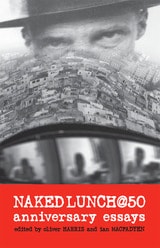
Naked Lunch @ 50
Anniversary EssaysEdited by Oliver Harris and Ian MacFadyen
Southern Illinois University Press, 2009
Naked Lunch was banned, castigated, and recognized as a work of genius on its first publication in 1959, and fifty years later it has lost nothing of its power to astonish, shock, and inspire. A lacerating satire, an exorcism of demons, a grotesque cabinet of horrors, it is the Black Book of the Beat Generation, the forerunner of the psychedelic counterculture, and a progenitor of postmodernism and the digital age. A work of excoriating laughter, linguistic derangement, and transcendent beauty, it remains both influential and inimitable.
This is the first book devoted in its entirety to William Burroughs’ masterpiece, bringing together an international array of scholars, artists, musicians, and academics from many fields to explore the origins, writing, reception, and complex meanings of Naked Lunch. Tracking the legendary book from Texas and Mexico to New York, Tangier, and Paris, Naked Lunch@50 significantly advances our understanding and appreciation of this most elusive and uncanny of texts.
Contributors:
Contributors:
Keith Albarn
Eric Andersen
Gail-Nina Anderson
Théophile Aries
Jed Birmingham
Shaun de Waal
Richard Doyle
Loren Glass
Oliver Harris
Kurt Hemmer
Allen Hibbard
Rob Holton
Andrew Hussey
Rob Johnson
Jean-Jacques Lebel
Ian MacFadyen
Polina Mackay
Jonas Mekas
Barry Miles
R. B. Morris
Timothy S. Murphy
Jurgen Ploog
Davis Schneiderman
Jennie Skerl
DJ Spooky
Philip Taaffe
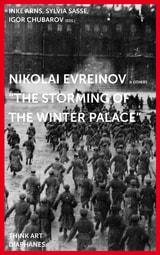
Nikolai Evreinov & Others
»The Storming of the Winter Palace«Edited by Inke Arns, Sylvia Sasse, and Igor Chubarov
Diaphanes, 2017
Nikolaj Evreinov: “The Storming of the Winter Palace” tells the fascinating story of this production. Taking readers through the relevant history, the authors describe the role of The Storming of the Winter Palace in commemorating Soviet power. With a wealth of illustrations, they also show how photographs of Evreinov’s theatrical storming eventually became historical documents of the October Revolution themselves.
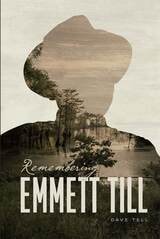
Remembering Emmett Till
Dave Tell
University of Chicago Press, 2019
In Remembering Emmett Till, Dave Tell gives us five accounts of the commemoration of this infamous crime. In a development no one could have foreseen, Till’s murder—one of the darkest moments in the region’s history—has become an economic driver for the Delta. Historical tourism has transformed seemingly innocuous places like bridges, boat landings, gas stations, and riverbeds into sites of racial politics, reminders of the still-unsettled question of how best to remember the victim of this heinous crime. Tell builds an insightful and persuasive case for how these memorials have altered the Delta’s physical and cultural landscape, drawing potent connections between the dawn of the civil rights era and our own moment of renewed fire for racial justice.
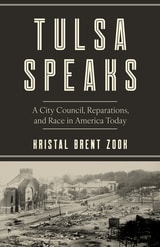
Tulsa Speaks
A City Council, Reparations, and Race in America TodayKristal Brent Zook
Rutgers University Press, 2026
In 2021, the international media descended upon Tulsa, Oklahoma, for the centennial commemoration of the May 31–June 1, 1921, massacre in which a white mob killed more than three hundred African American residents, burned homes and businesses, and decimated a thriving town once referred to as “Black Wall Street.”
Tulsa Speaks is about the ongoing work of the Tulsa City Council, both before the Centennial and afterward, when the cameras were no longer trained on the city. It dives deep into the interpersonal dynamics among the nine councilors, exploring the continuing fight for reparations and racial justice and the long-running efforts of councilor, Vanessa Hall-Harper of District 1, to bring repair to Greenwood.
Tulsa, like many municipal bodies across the country, serves as a hopeful sign of what we might become, as Americans and as a microcosm of race relations in America today.