Results by title
5 books match the query 'Anonymous'

Anonymous in Their Own Names
Doris E. Fleischman, Ruth Hale, and Jane GrantSusan Henry
Vanderbilt University Press, 2012
Yet these women's achievements have been invisible to countless authors who have written about their husbands. This invisibility is especially ironic given that all three were feminists who kept their birth names when they married as a sign of their equality with their husbands, then battled the government and societal norms to retain their names. Hale and Grant so believed in this cause that in 1921 they founded the Lucy Stone League to help other women keep their names, and Grant and Fleischman revived the league in 1950. This was the same year Grant and her second husband, William Harris, founded White Flower Farm, pioneering at that time and today one of the country's most celebrated commercial nurseries.
Despite strikingly different personalities, the three women were friends and lived in overlapping, immensely stimulating New York City circles. Susan Henry explores their pivotal roles in their husbands' extraordinary success and much more, including their problematic marriages and their strategies for overcoming barriers that thwarted many of their contemporaries.
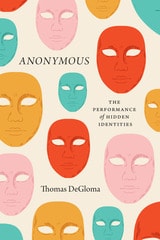
Anonymous
The Performance of Hidden IdentitiesThomas DeGloma
University of Chicago Press, 2023
In recent years, anonymity has rocked the political and social landscape. There are countless examples: An anonymous whistleblower was at the heart of President Trump’s first impeachment, an anonymous group of hackers compromised more than 77 million Sony accounts, and best-selling author Elena Ferrante resolutely continued to hide her real name and identity. In Anonymous, Thomas DeGloma draws on a fascinating set of contemporary and historical cases to build a sociological theory that accounts for the many faces of anonymity. He asks a number of pressing questions about the social conditions and effects of anonymity. What is anonymity, and why, under various circumstances, do individuals act anonymously? How do individuals accomplish anonymity? How do they use it, and, in some situations, how is it imposed on them?
To answer these questions, DeGloma tackles anonymity thematically, dedicating each chapter to a distinct type of anonymous action, including ones he dubs protective, subversive, institutional, and ascribed. Ultimately, he argues that anonymity and pseudonymity are best understood as performances in which people obscure personal identities as they make meaning for various audiences. As they bring anonymity and pseudonymity to life, DeGloma shows, people work to define the world around them to achieve different goals and objectives.
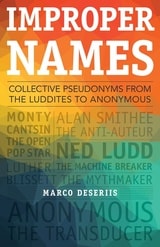
Improper Names
Collective Pseudonyms from the Luddites to AnonymousMarco Deseriis
University of Minnesota Press, 2015
Improper Names offers a genealogy and theory of the “improper name,” which author Marco Deseriis defines as the adoption of the same pseudonym by organized collectives, affinity groups, and individual authors. Although such names are often invented to pursue a specific social or political agenda, they are soon appropriated for different and sometimes diverging purposes. This book examines the tension arising from struggles for control of a pseudonym’s symbolic power.
Deseriis provides five fascinating and widely varying case studies. Ned Ludd was the legendary and eponymous leader of the English Luddites, textile workers who threatened the destruction of industrial machinery and then advanced a variety of economic and political demands. Alan Smithee—an alias coined by Hollywood film directors in 1969 in order to disown films that were recut by producers—became a contested signature and was therefore no longer effective to signal prevarication to Hollywood insiders. Monty Cantsin was an “open pop star” created by U.S. and Canadian artists in the late 1970s to critique bourgeois notions of authorship, but its communal character was compromised by excessive identification with individual users of the name. The Italian media activists calling themselves Luther Blissett, aware of the Cantsin experience, implemented measures to prevent individuals from assuming the alias, which was used to author media pranks, sell apocryphal manuscripts to publishers, fabricate artists and artworks, and author best-selling novels. The longest chapter here is devoted to the contemporary “hacktivist” group known as Anonymous, which protests censorship and restricted access to information and information technologies.
After delving into a rich philosophical debate on community among those who have nothing in common, the book concludes with a reflection on how the politics of improper names affects present-day anticapitalist social movements such as Occupy and 15-M.

Texas in 1837
An Anonymous, Contemporary NarrativeEdited by Andrew Forest Muir
University of Texas Press, 1958
Written anonymously in 1838–39 by a "Citizen of Ohio," Texas in 1837 is the earliest known account of the first year of the Texas republic. Providing information nowhere else available, the still-unknown author describes a land rich in potential but at the time "a more suitable arena for those who have everything to make and nothing to lose than [for] the man of capital or family."
The author arrived at Galveston Island on March 22, 1837, before the city of Galveston was founded, and spent the next six months in the republic. His travels took him to Houston, then little more than a camp made up of brush shelters and jerry-built houses, and as far west as San Antonio. He observed and was generally unimpressed by governmental and social structures just beginning to take shape. He attended the first anniversary celebration of the Battle of San Jacinto and has left a memorable account of Texas' first Independence Day. His inquiring mind and objective, actue observations of early Texas provide us a way of returning to the past, revisiting landmarks that have vanished forever.
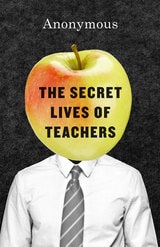
The Secret Lives of Teachers
Anonymous
University of Chicago Press, 2015
This is not a how-to manual. Rather, the author explores the dimensions of teaching that no one else has, those private thoughts few would dare put into a book but that form an important part of the day-to-day experience of a teacher. We see him ponder the clothes that people wear, think frankly about money (and the imbalance of its distribution), get wrangled by parents, provide on-the-fly psychotherapy, drape niceties over conversations that are actually all-out warfare, drop an f-bomb or two, and deal with students who are just plain unlikeable. We also see him envy, admire, fear, and hope; we see him in adulation and uncertainty, and in energy and exhaustion. We see him as teachers really are: human beings with a complex, rewarding, and very important job.
There has been no shortage of commentary on the teaching profession over the decades, but none quite like this. Unflinching, wry, and at times laugh-out-loud funny, it’s written for every teacher out there who has ever scrambled, smirked, or sighed—and toughed it out nonetheless.