Results by title
2 books match the query 'Anonymous writings'
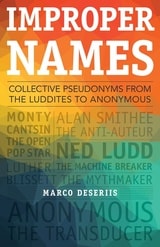
Improper Names
Collective Pseudonyms from the Luddites to AnonymousMarco Deseriis
University of Minnesota Press, 2015
Improper Names offers a genealogy and theory of the “improper name,” which author Marco Deseriis defines as the adoption of the same pseudonym by organized collectives, affinity groups, and individual authors. Although such names are often invented to pursue a specific social or political agenda, they are soon appropriated for different and sometimes diverging purposes. This book examines the tension arising from struggles for control of a pseudonym’s symbolic power.
Deseriis provides five fascinating and widely varying case studies. Ned Ludd was the legendary and eponymous leader of the English Luddites, textile workers who threatened the destruction of industrial machinery and then advanced a variety of economic and political demands. Alan Smithee—an alias coined by Hollywood film directors in 1969 in order to disown films that were recut by producers—became a contested signature and was therefore no longer effective to signal prevarication to Hollywood insiders. Monty Cantsin was an “open pop star” created by U.S. and Canadian artists in the late 1970s to critique bourgeois notions of authorship, but its communal character was compromised by excessive identification with individual users of the name. The Italian media activists calling themselves Luther Blissett, aware of the Cantsin experience, implemented measures to prevent individuals from assuming the alias, which was used to author media pranks, sell apocryphal manuscripts to publishers, fabricate artists and artworks, and author best-selling novels. The longest chapter here is devoted to the contemporary “hacktivist” group known as Anonymous, which protests censorship and restricted access to information and information technologies.
After delving into a rich philosophical debate on community among those who have nothing in common, the book concludes with a reflection on how the politics of improper names affects present-day anticapitalist social movements such as Occupy and 15-M.
The Power to Name
A History of Anonymity in Colonial West AfricaStephanie Newell
Ohio University Press, 2013
Between the 1880s and the 1940s, the region known as British West Africa became a dynamic zone of literary creativity and textual experimentation. African-owned newspapers offered local writers numerous opportunities to contribute material for publication, and editors repeatedly defined the press as a vehicle to host public debates rather than simply as an organ to disseminate news or editorial ideology. Literate locals responded with great zeal, and in increasing numbers as the twentieth century progressed, they sent in letters, articles, fiction, and poetry for publication in English- and African-language newspapers.
The Power to Name offers a rich cultural history of this phenomenon, examining the wide array of anonymous and pseudonymous writing practices to be found in African-owned newspapers between the 1880s and the 1940s, and the rise of celebrity journalism in the period of anticolonial nationalism. Stephanie Newell has produced an account of colonial West Africa that skillfully shows the ways in which colonized subjects used pseudonyms and anonymity to alter and play with colonial power and constructions of African identity.