Results by title
5 books match the query 'Antebellum South'
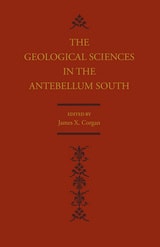
Geological Sciences in the Antebellum South
Edited by James X. Corgan
University of Alabama Press, 1982
Tracing the roots of earth science before the Civil War.
Geological Sciences in the Antebellum South by James Corgan offers a rich and revealing examination of the origins and development of geological inquiry in the American South during the decades (1796-1850s) leading up to the Civil War. At a time when scientific disciplines in the United States were still taking shape, Southern scholars, educators, and naturalists played a critical—if often overlooked—role in advancing geological knowledge. Corgan brings this history to life through a careful exploration of the people, institutions, and ideas that defined early earth science in the region.
From the study of mineral resources and soil composition to the broader effort to understand the region’s unique landscapes, geology intersected with agriculture, industry, and economic development in powerful ways. Corgan demonstrates how these scientific endeavors were shaped by—and in turn helped shape—the cultural and intellectual environment of the South. This book also highlights the contributions of key figures and institutions that fostered scientific inquiry, including early universities, state surveys, and learned societies. These networks connected Southern researchers to national and international scientific communities, positioning the region as an active participant in the broader expansion of 19th-century science. At the same time, the book addresses the challenges and limitations faced by Southern scientists, offering a nuanced perspective on how regional identity, resources, and social structures influenced the trajectory of scientific progress.
By situating geology within the broader context of antebellum history, Corgan provides readers with a deeper understanding of how scientific thought developed alongside—and in dialogue with—the political, economic, and cultural forces of the period. The result is a compelling interdisciplinary study that bridges the history of science and Southern history, shedding new light on a formative era in American intellectual life. Geological Sciences in the Antebellum South will appeal to historians, geologists, and scholars of American studies. It is an essential resource for anyone interested in the foundations of scientific inquiry in the United States and the enduring impact of geology on the development of the American South.
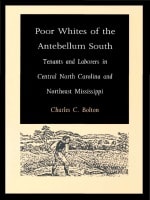
Poor Whites of the Antebellum South
Tenants and Laborers in Central North Carolina and Northeast MississippiCharles C. Bolton
Duke University Press, 1994
Looking at two specific regions--the "settled" central piedmont of North Carolina and the "frontier" of northeast Mississippi--Bolton describes how poor whites played an important, though circumscribed, role in the local economy. Dependent on temporary employment, they represented a troubling presence in a society based on the principles of white independence and black slavery. Although perceived by southern leaders as a threat, poor whites, Bolton argues, did not form a political alliance with either free or enslaved blacks because of numerous factors including white racism, kinship ties, religion, education, and mobility. A concluding discussion of the crisis of 1860-61 examines the rejection of secession by significant numbers of poor whites, as well as the implications for their future as the Old South turned toward the new.
Poor Whites of the Antebellum South sheds light on a group often neglected in southern history. It is an important contribution that will be of interest to all students and historians of the American South.
Sex, Sickness, and Slavery
Illness in the Antebellum SouthMarli F. Weiner with Mazie Hough
University of Illinois Press, 2014

Unitarianism in the Antebellum South
The Other Invisible InstitutionJohn Allen Macaulay
University of Alabama Press, 2001

Violence and Culture in the Antebellum South
By Dickson D. Bruce, Jr.
University of Texas Press, 1979
This provocative book draws from a variety of sources—literature, politics, folklore, social history—to attempt to set Southern beliefs about violence in a cultural context. According to Dickson D. Bruce, the control of violence was a central concern of antebellum Southerners.
Using contemporary sources, Bruce describes Southerners’ attitudes as illustrated in their duels, hunting, and the rhetoric of their politicians. He views antebellum Southerners as pessimistic and deeply distrustful of social relationships and demonstrates how this world view impelled their reliance on formal controls to regularize human interaction.
The attitudes toward violence of masters, slaves, and “plain-folk”—the three major social groups of the period—are differentiated, and letters and family papers are used to illustrate how Southern child-rearing practices contributed to attitudes toward violence in the region. The final chapter treats Edgar Allan Poe as a writer who epitomized the attitudes of many Southerners before the Civil War.