Results by title
5 books match the query 'Antebellum United States'
Archives of Labor
Working-Class Women and Literary Culture in the Antebellum United StatesLori Merish
Duke University Press, 2017
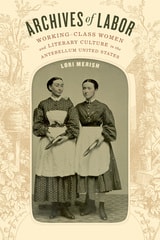
In Archives of Labor Lori Merish establishes working-class women as significant actors within literary culture, dramatically redrawing the map of nineteenth-century US literary and cultural history. Delving into previously unexplored archives of working-class women's literature—from autobiographies, pamphlet novels, and theatrical melodrama to seduction tales and labor periodicals—Merish recovers working-class women's vital presence as writers and readers in the antebellum era. Her reading of texts by a diverse collection of factory workers, seamstresses, domestic workers, and prostitutes boldly challenges the purportedly masculine character of class dissent during this era. Whether addressing portrayals of white New England "factory girls," fictional accounts of African American domestic workers, or the first-person narratives of Mexican women working in the missions of Mexican California, Merish unsettles the traditional association of whiteness with the working class to document forms of cross-racial class identification and solidarity. In so doing, she restores the tradition of working women's class protest and dissent, shows how race and gender are central to class identity, and traces the ways working women understood themselves and were understood as workers and class subjects.
[more]
Banking on Slavery
Financing Southern Expansion in the Antebellum United StatesSharon Ann Murphy
University of Chicago Press, 2023
A sobering excavation of how deeply nineteenth-century American banks were entwined with the institution of slavery.
It’s now widely understood that the fullest expression of nineteenth-century American capitalism was found in the structures of chattel slavery. It’s also understood that almost every other institution and aspect of life then was at least entangled with—and often profited from—slavery’s perpetuation. Yet as Sharon Ann Murphy shows in her powerful and unprecedented book, the centrality of enslaved labor to banking in the antebellum United States is far greater than previously thought.
Banking on Slavery sheds light on precisely how the financial relationships between banks and slaveholders worked across the nineteenth-century South. Murphy argues that the rapid spread of slavery in the South during the 1820s and ’30s depended significantly upon southern banks’ willingness to financialize enslaved lives, with the use of enslaved individuals as loan collateral proving central to these financial relationships. She makes clear how southern banks were ready—and, in some cases, even eager—to alter time-honored banking practices to meet the needs of slaveholders. In the end, many of these banks sacrificed themselves in their efforts to stabilize the slave economy. Murphy also details how banks and slaveholders transformed enslaved lives from physical bodies into abstract capital assets. Her book provides an essential examination of how our nation’s financial history is more intimately intertwined with the dehumanizing institution of slavery than scholars have previously thought.
[more]
Banking on Slavery
Financing Southern Expansion in the Antebellum United StatesSharon Ann Murphy
University of Chicago Press, 2023
This is an auto-narrated audiobook version of this book.
A sobering excavation of how deeply nineteenth-century American banks were entwined with the institution of slavery.
It’s now widely understood that the fullest expression of nineteenth-century American capitalism was found in the structures of chattel slavery. It’s also understood that almost every other institution and aspect of life then was at least entangled with—and often profited from—slavery’s perpetuation. Yet as Sharon Ann Murphy shows in her powerful and unprecedented book, the centrality of enslaved labor to banking in the antebellum United States is far greater than previously thought.
Banking on Slavery sheds light on precisely how the financial relationships between banks and slaveholders worked across the nineteenth-century South. Murphy argues that the rapid spread of slavery in the South during the 1820s and ’30s depended significantly upon southern banks’ willingness to financialize enslaved lives, with the use of enslaved individuals as loan collateral proving central to these financial relationships. She makes clear how southern banks were ready—and, in some cases, even eager—to alter time-honored banking practices to meet the needs of slaveholders. In the end, many of these banks sacrificed themselves in their efforts to stabilize the slave economy. Murphy also details how banks and slaveholders transformed enslaved lives from physical bodies into abstract capital assets. Her book provides an essential examination of how our nation’s financial history is more intimately intertwined with the dehumanizing institution of slavery than scholars have previously thought.
[more]
Home Fronts
Domesticity and Its Critics in the Antebellum United StatesLora Romero
Duke University Press, 1997
Unlike studies of nineteenth-century culture that perpetuate a dichotomy of a public, male world set against a private, female world, Lora Romero’s Home Fronts shows the many, nuanced, and sometimes contradictory cultural planes on which struggles for authority unfolded in antebellum America.
Romero remaps the literary landscape of the last century by looking at the operations of domesticity on the frontier as well as within the middle-class home and by reconsidering such crucial (if sometimes unexpected) sites for the workings of domesticity as social reform movements, African-American activism, and homosocial high culture. In the process, she indicts theories of the nineteenth century based on binarisms and rigidity while challenging models of power and resistance based on the idea that "culture" has the capacity to either free or enslave. Through readings of James Fenimore Cooper, Catherine Beecher, Harriet Beecher Stowe, Maria Stewart, and Nathaniel Hawthorne, Romero shows how the politics of culture reside in local formulations rather than in essential and ineluctable political structures.
Romero remaps the literary landscape of the last century by looking at the operations of domesticity on the frontier as well as within the middle-class home and by reconsidering such crucial (if sometimes unexpected) sites for the workings of domesticity as social reform movements, African-American activism, and homosocial high culture. In the process, she indicts theories of the nineteenth century based on binarisms and rigidity while challenging models of power and resistance based on the idea that "culture" has the capacity to either free or enslave. Through readings of James Fenimore Cooper, Catherine Beecher, Harriet Beecher Stowe, Maria Stewart, and Nathaniel Hawthorne, Romero shows how the politics of culture reside in local formulations rather than in essential and ineluctable political structures.
[more]
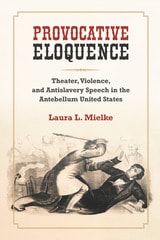
Provocative Eloquence
Theater, Violence, and Antislavery Speech in the Antebellum United StatesLaura L. Mielke
University of Michigan Press, 2019
In the mid-19th century, rhetoric surrounding slavery was permeated by violence. Slavery’s defenders often used brute force to suppress opponents, and even those abolitionists dedicated to pacifism drew upon visions of widespread destruction. Provocative Eloquence recounts how the theater, long an arena for heightened eloquence and physical contest, proved terribly relevant in the lead up to the Civil War. As antislavery speech and open conflict intertwined, the nation became a stage. The book brings together notions of intertextuality and interperformativity to understand how the confluence of oratorical and theatrical practices in the antebellum period reflected the conflict over slavery and deeply influenced the language that barely contained that conflict. The book draws on a wide range of work in performance studies, theater history, black performance theory, oratorical studies, and literature and law to provide a new narrative of the interaction of oratorical, theatrical, and literary histories of the nineteenth-century U.S.
[more]