Results by title
8 books match the query 'Anthologies'
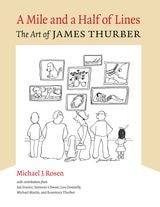
A Mile and a Half of Lines
The Art of James ThurberMichael J. Rosen, with contributions from Ian Frazier, Seymour Chwast, Liza Donnelly, Michael Maslin, and Rosemary Thurber
The Ohio State University Press, 2019
Including some 260 drawings, this collection is the first comprehensive focus on his work as an artist, a cartoonist, and an illustrator. With commentary from a host of preeminent cartoonists and writers, including Ian Frazier, Seymour Chwast, and Michael Maslin, A Mile and a Half of Lines celebrates the significance of Thurber’s spontaneous, unstudied, and novel drawing style that not only altered the nature of American cartooning but also expanded the very possibilities of an illustrated line. Coinciding with the first major retrospective of Thurber’s art presented by the Columbus Museum of Art in 2019, A Mile and a Half of Lines showcases both classic Thurber as well as visual material never before seen in print.
Aesthetics of Renewal
Martin Buber's Early Representation of Hasidism as KulturkritikMartina Urban
University of Chicago Press, 2008
Canons by Consensus
Critical Trends and American Literature AnthologiesJoseph Csicsila, with a foreword by Tom Quirk
University of Alabama Press, 2004
The first systematic analysis of American literature textbooks used by college instructors in the last century
Scholars have long noted the role that college literary anthologies play in the rising and falling reputations of American authors. Canons by Consensus examines this classroom fixture in detail to challenge and correct a number of assumptions about the development of the literary canon throughout the 20th century.
Joseph Csicsila analyzes more than 80 anthologies published since 1919 and traces not only the critical fortunes of individual authors, but also the treatment of entire genres and groupings of authors by race, region, gender, and formal approach. In doing so, he calls into question accusations of deliberate or inadvertent sexism and racism. Selections by anthology editors, Csicsila demonstrates, have always been governed far more by prevailing trends in academic criticism than by personal bias.
Academic anthologies are found to constitute a rich and often overlooked resource for studying American literature, as well as an irrefutable record of the academy’s changing literary tastes throughout the last century.
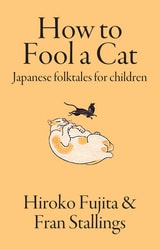
How to Fool a Cat
Japanese Folktales for ChildrenHiroko Fujita & Fran Stallings
Parkhurst Brothers, Inc., 2015
“Charming and captivating, these authentic and little-known Japanese folktales are told clearly and simply, making them easily accessible to young listeners at home or in the classroom. Thoughtful comments and notes from the two tellers provide clear tips for successful telling, along with a very useful glossary. If you tell stories to children, this is a must-purchase book!”
—Sherry Norfolk, Storyteller, Author and Teaching Artist
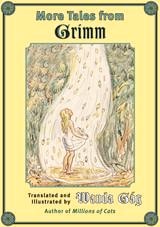
More Tales from Grimm
Wanda Gág
University of Minnesota Press, 2006
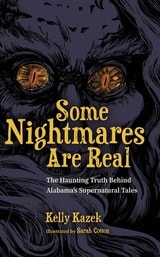
Some Nightmares Are Real
The Haunting Truth Behind Alabama’s Supernatural Talesby Kelly Kazek, illustrated by Sarah Cotton
University of Alabama Press, 2024
Southern writer and folklorist Kelly Kazek’s collection of eerie and enigmatic Alabama ghost stories
Dark secrets lurk beneath the sleepy surface of Alabama. Ghosts and grisly creatures haunt the towns and forests. In the great Southern ghost-story tradition, famed Alabama storyteller Kelly Kazek weaves a gothic tapestry of ten stories drawn from real people and legendary creatures, cursed places, and harrowing events.
Each story or legend takes readers to a different place in Alabama. Read about the bestial Wolf Woman who terrified Mobilians in the haunted old port city. In the northern city of Huntsville, visit the Dead Children’s Playground in gloomy Maple Hill Cemetery. In Jacksonville, feel the cold grip of the Old Mill Witch, rumored to protect the workers at the rickety cotton yarn mill. Hear about the mysterious green light that drifts along the Alabama River in the Black Belt hamlet of Gee’s Bend and learn about the role the Gee’s Bend Ferry played in the Civil Rights Movement.
Unlike most ghost-story collections, Some Nightmares Are Real includes an appendix of facts, historical resources, and information about how to visit the locations. These contemporary stories embrace a beloved Southern folkloric tradition for a new generation of young readers. The tales will terrify and ensnare ghost-story lovers of all ages. So settle in, pull the covers up tight, and maybe turn on the light, because the truth is: Some Nightmares Are Real.
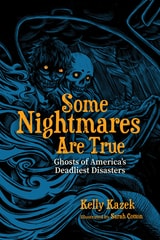
Some Nightmares Are True
Ghosts of America's Deadliest Disastersby Kelly Kazek, illustrated by Sarah Cotton
University of Alabama Press, 2025
Digging up the eerie aftermath of America’s deadliest disasters—where ghost stories take root, history lingers in the shadows, and the past refuses to stay buried.
In this haunting follow-up to Some Nightmares Are Real: The Haunting Truth Behind Alabama’s Supernatural Tales, journalist and storyteller Kelly Kazek investigates supernatural folklore grounded in historical catastrophe. This time, she ventures far beyond Alabama, unearthing the eerie legends born from their aftermath of nine of America’s most infamous disasters. From the strangling suffocation of the Boston Molasses Flood and the terror of Galveston’s notorious Great Storm, to flames blasting from the Triangle Shirtwaist Factory disaster, Some Nightmares Are True examines ghost stories that have haunted communities long after the news headlines stopped.
Each spooky story blends vivid storytelling with meticulous research, connecting real events to the ghostly lore they inspired. Kazek explores not just the moment of disaster, but how grief, resilience, and remembrance shape the way stories live on—through newspaper archives, folklore, and generations of retelling.
With both wry Southern sensibility and journalistic rigor, Kazek explores how moments of tragedy like the Dixie Tornado Outbreak in Alabama, the capsizing of the SS Eastland in Chicago, and the haunting aftermath of the Schoolchildren’s Blizzard in Nebraska leave lasting imprints on generational memory. These sites of devastation become more than historical footnotes; they transform into hallowed grounds where grief lingers, legends remain, and the line between fact and folklore dissolves.
For ghost hunters, or simply those brave enough to follow their curiosity into learning more about the stories’ historical facts, Kazek has compiled a robust appendix that provides context, source materials, and location details, making this a perfect pick to toss in the car for that late-night road trip adventure. But remember, Some Nightmares Are True.
The Whole Book
Cultural Perspectives on the Medieval MiscellanyStephen G. Nichols and Siegfried Wenzel, Editors
University of Michigan Press, 1996
This group of papers, edited by two well-known scholars of the medieval world, offers both general and particular approaches to the issues surrounding manuscripts produced in the medieval habit of "miscellany," works of seemingly diverse natures bound together into one volume. Julia Boffey investigates how certain poetical miscellanies came to be assembled, for example, while Sylvia Huot suggests that the miscellany had many different sorts of function and significance. Siegfried Wenzel considers a taxonomy of such collections, and A. S. G. Edwards' paper considers Bodleian Selden B.24 as an example of how the notions of canon, authorship, and attribution might come into play. Ann Matter's final chapter offers the notion that what we call "miscellanies" are likely to have an internal logic that we have been trained to miss, but can come to understand. Other contributors are Ralph Hanna III, Georg Knauer, Stephen Nichols, James J. O'Donnell, and Barbara A. Shailor.
Because The Whole Book deals not only with the content of miscellanies but also with contemporary literary principles, this volume will be of interest to a wide circle of literary critics and historians, as well as to students of the survival of literature and of cultural values.
Stephen G. Nichols is James M. Beall Professor of French and Chair of the Department of French, The Johns Hopkins University. Siegfried Wenzel is Professor of English, University of Pennsylvania.