Results by title
11 books match the query 'Anthropological ethics'
Afterlives of Affect
Science, Religion, and an Edgewalker’s SpiritMatthew C. Watson
Duke University Press, 2020
Decay
Ghassan Hage, editor
Duke University Press, 2021
Contributors. Cameo Dalley, Peter D. Dwyer, Akhil Gupta, Ghassan Hage, Michael Herzfeld, Elise Klein, Bart Klem, Tamara Kohn, Michael Main, Fabio Mattioli, Debra McDougall, Monica Minnegal, Violeta Schubert
Detours
Travel and the Ethics of Research in the Global SouthEdited by M. Bianet Castellanos
University of Arizona Press, 2019
Influenced by the works of anthropologists Ruth Behar and Renato Rosaldo, the scholars and journalists in this volume consider how first encounters—those initial, awkward attempts to learn about a culture and a people—evolved into enduring and critical engagements. Contemplating the ethics and racial politics of traveling and doing research abroad, they call attention to the power and privilege that permit researchers to enter people’s lives, ask intimate questions, and publish those disclosures. Focusing on Latin America and the Caribbean, they ask, Why this place? What keeps us coming back? And what role do we play in producing narratives of inequality, uneven development, and global spectacle?
The book examines the “politics of return”—the experiences made possible by revisiting a field site over extended periods of time—of scholars and journalists who have spent decades working in and writing about Latin America and the Caribbean. Contributors aren’t telling a story of enlightenment and goodwill; they focus instead on the slippages and conundrums that marked them and raised questions of their own intentions and intellectual commitments.
Speaking from the intersection of race, class, and gender, the contributors explore the hubris and nostalgia that motivate returning again and again to a particular place. Through personal stories, they examine their changing ideas of Latin America and the Caribbean and how those places have shaped the people they’ve become, as writers, as teachers, and as activists.

Emergent Forms of Life and the Anthropological Voice
Michael M. J. Fischer
Duke University Press, 2003
A vigorous advocate of the anthropological voice and method, Fischer emphasizes the ethical dimension of cultural anthropology. Ethnography, he suggests, is uniquely situated to gather and convey observations fundamental to the creation of new social institutions for an evolving civil society. In Emergent Forms of Life and the Anthropological Voice Fischer considers a dazzling array of subjects—among them Iranian and Polish cinema, cyberspace, autobiographical and fictional narrative, and genomic biotechnologies—and, in the process, demonstrates a cultural anthropology for a highly networked world. He lays the groundwork for a renewed and powerful twenty-first-century anthropology characterized by a continued insistence on empirical fieldwork, engagements with other disciplines, and dialogue with interlocutors around the globe.
Engaged Observer
Anthropology, Advocacy, and ActivismSanford, Victoria
Rutgers University Press, 2006
Anthropology has long been associated with an ethos of “engagement.” The field’s core methods and practices involve long-term interpersonal contact between researchers and their study participants, giving major research topics in the field a distinctively human face. Can research findings be authentic and objective? Are anthropologists able to use their data to aid the participants of their study, and is that aid always welcome?
In Engaged Observer, Victoria Sanford and Asale Angel-Ajani bring together an international array of scholars who have been embedded in some of the most conflict-ridden and dangerous zones in the world to reflect on the role and responsibility of anthropological inquiry. They explore issues of truth and objectivity, the role of the academic, the politics of memory, and the impact of race, gender, and social position on the research process. Through ethnographic case studies, they offer models for conducting engaged research and illustrate the contradictions and challenges of doing so.
Exotic No More
Anthropology on the Front LinesEdited by Jeremy MacClancy
University of Chicago Press, 2002
In Exotic No More, an initiative of the Royal Anthropological Institute, some of today's most respected anthropologists demonstrate, in clear, unpretentious prose, the tremendous contributions that anthropology can make to contemporary society. They cover issues ranging from fundamentalism to forced migration, child labor to crack dealing, human rights to hunger, ethnicity to environmentalism, intellectual property rights to international capitalisms. But Exotic No More is more than a litany of gloom and doom; the essays also explore topics usually associated with leisure or "high" culture, including the media, visual arts, tourism, and music. Each author uses specific examples from their fieldwork to illustrate their discussions, and 62 photographs enliven the text.
Throughout the book, the contributors highlight anthropology's commitment to taking people seriously on their own terms, paying close attention to what they are saying and doing, and trying to understand how they see the world and why. Sometimes this bottom-up perspective makes the strange familiar, but it can also make the familiar strange, exposing the cultural basis of seemingly "natural" behaviors and challenging us to rethink some of our most cherished ideas—about gender, "free" markets, "race," and "refugees," among many others.
Contributors:
William O. Beeman
Philippe Bourgois
John Chernoff
E. Valentine Daniel
Alex de Waal
Judith Ennew
James Fairhead
Sarah Franklin
Michael Gilsenan
Faye Ginsburg
Alma Gottlieb
Christopher Hann
Faye V. Harrison
Richard Jenkins
Melissa Leach
Margaret Lock
Jeremy MacClancy
Jonathan Mazower
Ellen Messer
A. David Napier
Nancy Scheper-Hughes
Jane Schneider
Parker Shipton
Christopher B. Steiner
Framing a Lost City
Science, Photography, and the Making of Machu PicchuBy Amy Cox Hall
University of Texas Press, 2017
When Hiram Bingham, a historian from Yale University, first saw Machu Picchu in 1911, it was a ruin obscured by overgrowth whose terraces were farmed a by few families. A century later, Machu Picchu is a UNESCO world heritage site visited by more than a million tourists annually. This remarkable transformation began with the photographs that accompanied Bingham’s article published in National Geographic magazine, which depicted Machu Picchu as a lost city discovered. Focusing on the practices, technologies, and materializations of Bingham’s three expeditions to Peru (1911, 1912, 1914–1915), this book makes a convincing case that visualization, particularly through the camera, played a decisive role in positioning Machu Picchu as both a scientific discovery and a Peruvian heritage site.
Amy Cox Hall argues that while Bingham’s expeditions relied on the labor, knowledge, and support of Peruvian elites, intellectuals, and peasants, the practice of scientific witnessing, and photography specifically, converted Machu Picchu into a cultural artifact fashioned from a distinct way of seeing. Drawing on science and technology studies, she situates letter writing, artifact collecting, and photography as important expeditionary practices that helped shape the way we understand Machu Picchu today. Cox Hall also demonstrates that the photographic evidence was unstable, and, as images circulated worldwide, the “lost city” took on different meanings, especially in Peru, which came to view the site as one of national patrimony in need of protection from expeditions such as Bingham’s.

From Racism to Genocide
Anthropology in the Third ReichGretchen E. Schafft
University of Illinois Press, 2007
In paperback for the first time, From Racism to Genocide is an explosive, richly detailed account of how Nazi anthropologists justified racism, developed practical applications of racist theory, and eventually participated in every phase of the Holocaust.
Using original sources and previously unpublished documentation, Gretchen E. Schafft shows the total range of anti-human activity from within the confines of a particular discipline. Based on seven years of archival research in the United States and abroad, the work includes many original photos and documents, most of which have never before been published. It uses primary data and original texts whenever possible, including correspondence written by perpetrators. The book also reveals that the United States was not merely a bystander in this research, but instead contributed professional and financial support to early racial research that continued through the first five years of Hitler’s regime.
Negotiating Culture
Heritage, Ownership, and Intellectual PropertyLaetitia La Follette
University of Massachusetts Press, 2013
This provocative collection of essays—a series of case studies in cultural ownership by scholars from a range of fields—explores issues of cultural heritage and intellectual property in a variety of contexts, from contests over tangible artifacts as well as more abstract forms of culture such as language and oral traditions to current studies of DNA and genes that combine nature and culture, and even new, nonproprietary models for the sharing of digital technologies. Each chapter sets the debate in its historical and disciplinary context and suggests how the approaches to these issues are changing or should change.
One of the most innovative aspects of the volume is the way each author recognizes the social dimensions of group ownership and demonstrates the need for negotiation and new models. The collection as a whole thus challenges the reader to reevaluate traditional ways of thinking about cultural ownership and to examine the broader social contexts within which negotiation over the ownership of culture is taking place.
In addition to Laetitia La Follette, contributors include David Bollier, Stephen Clingman, Susan DiGiacomo, Oriol Pi-Sunyer, Margaret Speas, Banu Subramaniam, Joe Watkins, and H. Martin Wobst.
Plundered Skulls and Stolen Spirits
Inside the Fight to Reclaim Native America's CultureChip Colwell
University of Chicago Press, 2017
Five decades ago, Native American leaders launched a crusade to force museums to return their sacred objects and allow them to rebury their kin. Today, hundreds of tribes use the Native American Graves Protection and Repatriation Act to help them recover their looted heritage from museums across the country. As senior curator of anthropology at the Denver Museum of Nature & Science, Chip Colwell has navigated firsthand the questions of how to weigh the religious freedom of Native Americans against the academic freedom of scientists and whether the emptying of museum shelves elevates human rights or destroys a common heritage. This book offers his personal account of the process of repatriation, following the trail of four objects as they were created, collected, and ultimately returned to their sources: a sculpture that is a living god, the scalp of a massacre victim, a ceremonial blanket, and a skeleton from a tribe considered by some to be extinct. These specific stories reveal a dramatic process that involves not merely obeying the law, but negotiating the blurry lines between identity and morality, spirituality and politics.
Things, like people, have biographies. Repatriation, Colwell argues, is a difficult but vitally important way for museums and tribes to acknowledge that fact—and heal the wounds of the past while creating a respectful approach to caring for these rich artifacts of history.
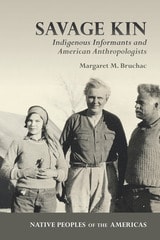
Savage Kin
Indigenous Informants and American AnthropologistsMargaret M. Bruchac
University of Arizona Press, 2018
This book reconceptualizes the intimate details of encounters with Native interlocutors who by turns inspired, facilitated, and resisted the anthropological enterprise. Like other texts focused on this era, Savage Kin features some of the elite white men credited with salvaging material that might otherwise have been lost. Unlike other texts, this book highlights the intellectual contributions and cultural strategies of unsung Indigenous informants without whom this research could never have taken place.
These bicultural partnerships transgressed social divides and blurred the roles of anthropologist/informant, relative/stranger, and collector/collected. Yet these stories were obscured by collecting practices that separated people from objects, objects from communities, and communities from stories. Bruchac’s decolonizing efforts include “reverse ethnography”—painstakingly tracking seemingly unidentifiable objects, misconstrued social relations, unpublished correspondence, and unattributed field notes—to recover this evidence. Those early encounters generated foundational knowledges that still affect Indigenous communities today.
Savage Kin also contains unexpected narratives of human and other-than-human encounters—brilliant discoveries, lessons from ancestral spirits, prophetic warnings, powerful gifts, and personal tragedies—that will move Native and non-Native readers alike.