Results by title
5 books match the query 'Anti - Semitism'
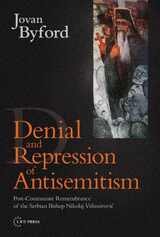
Denial and Repression of Anti-Semitism
Post-Communist Rehabilitation of the Serbian Bishop Nikolaj VelimirovicJovan Byford
Central European University Press, 2008

Legacies of Anti-Semitism in France
Jeffrey Mehlman
University of Minnesota Press, 1983
Legacies of Anti-Semitism in France was first published in 1983. Minnesota Archive Editions uses digital technology to make long-unavailable books once again accessible, and are published unaltered from the original University of Minnesota Press editions.
These four essays—on Blanchot, Lacan, Giraudoux, and Gide—have as their focus the barely imaginable coherence which the writings of four major contemporaries take on when read in the light of France's pre-World War II heritage of anti-Jewish thought. As the essays delve into such crucial topics as the inaugural silence in Blanchot's sense of literature, the "style" of Lacan, Giraudoux's relation to Racine, and the sexual politics of Gide, they engage a realm that at times seems—or seemed—anti-Semitic in its essence. Negotiating the complex ramifications of a lost tradition and the structure of its obliteration, Jeffrey Mehlman, in his conclusion, speculates on the emblematic value of Walter Benjamin's perpetually deferred "journey to Palestine via France" and its import for textual interpretation.
A French version of Mehlman's essay on Blanchot, published in Tel quel,spurred an impassioned journalistic debate in Paris and London. Broadening still further the context of that inquiry, Legacies will prove a source of provocation and insight to all who are interested in the intellectual history of contemporary France.

Pound in Purgatory
From Economic Radicalism to Anti-SemitismLeon Surette
University of Illinois Press, 1999
From 1931 to 1945 Pound's poetry took a back seat to his activities as an economic reformer and propagandist for the corporate state. Pound believed he had a simple and practical solution for the economic woes of the world brought on by the Great Depression, and he became increasingly preoccupied with capturing political power for the economic reform he envisioned.
As the world spiraled toward war, Pound's program of economic reform foundered and he gradually succumbed to a paranoid belief in a Jewish conspiracy. Through an incisive analysis of Pound's correspondence and writings, much of it previously unexamined, Surette shows how this belief fostered the virulent anti-Semitism that pervades his work-–both poetry and prose-–from this time forward.
Soviet Jewry in the 1980s
The Politics of Anti-Semitism and Emigration and the Dynamics of ResettlementRobert O. Freedman, ed.
Duke University Press, 1989
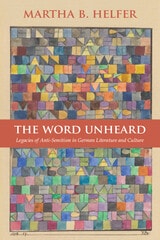
The Word Unheard
Legacies of Anti-Semitism in German Literature and CultureMartha B. Helfer
Northwestern University Press, 2011
The publication of Martha B. Helfer’s The Word Unheard: Legacies of Anti-Semitism in German Literature and Culture marks a stunningly original new direction in the interpretation of canonical works of eighteenth- and nineteenth-century German literature.
Between 1749 and 1850—the formative years of the so-called Jewish Question in Germany—the emancipation debates over granting full civil and political rights to Jews provided the topical background against which all representations of Jewish characters and concerns in literary texts were read. Helfer focuses sharply on these debates and demonstrates through close readings of works by Gotthold Lessing, Friedrich Schiller, Achim von Arnim, Annette von Droste- Hülshoff, Adalbert Stifter, and Franz Grillparzer how disciplinary practices within the field of German studies have led to systematic blind spots in the scholarship on anti-Semitism to date.
While all the authors discussed are well known and justly celebrated, the particular works addressed represent an effective mix of enduring classics and less recognized, indeed often scandalously overlooked, texts whose consideration leads to a reevaluation of the author’s more mainstream oeuvre. Although some of the works and authors chosen have previously been noted for their anti-Semitic proclivities, the majority have not, and some have even been marked by German scholarship as philo-Semitic—a view that The Word Unheard undertakes not so much to refute as to complicate, and in the process to question not only these texts but also the deafness of the German scholarly tradition. With implications that reach into many disciplines, The Word Unheard will be a foundational study for all scholars of modern Germany.