Results by title
5 books match the query 'Anti-Nazi movement'
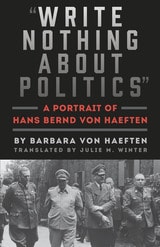
"Write Nothing about Politics"
A Portrait of Hans Bernd von HaeftenBarbara von Haeften
Michigan State University Press, 2018
Barbara von Haeften’s memoir provides us with a moving account of the life of her husband Hans Bernd von Haeften, a lawyer, diplomat, and member of the Kreisau Circle resistance group in Nazi Germany. The Kreisau Circle participated in the assassination attempt of Hitler on July 20, 1944, carried out by Claus von Stauffenberg and Werner von Haeften, Hans’s brother. The Circle had also developed extensive plans for a new government to be put into place after the removal of Hitler. Drawing on personal letters and clear memories, this biography describes the life and political activity of an extraordinary man who was executed in the struggle to save Germany from the disastrous consequences of Hitler’s regime, and it sheds light on Barbara von Haeften’s knowledge of and participation in the resistance movement.
[more]
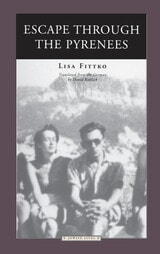
Escape Through the Pyrenees
Lisa Fittko
Northwestern University Press, 2000
Though it reads like a suspense novel, this memoir is Lisa Fittko's extraordinary story of life as an "enemy alien" in France before and after the German invasion of 1940. Escaping a French prison, Fittko and her husband found their way to the Pyrenees and, while awaiting permission to enter Spain, helped hundreds of refugees, including Walter Benjamin, escape deportation, torture, and death at the hands of the Nazis.
[more]
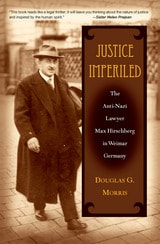
Justice Imperiled
The Anti-Nazi Lawyer Max Hirschberg in Weimar GermanyDouglas G. Morris
University of Michigan Press, 2005
"This book reads like a legal thriller; it will leave you thinking about the nature of justice and inspired by the human spirit."
-Sister Helen Prejean
Justice Imperiled is the story of the brilliant lawyer Max Hirschberg, one of Germany's most courageous defenders of justice in the face of Hitler's rise to power.
Hirschberg lived an extraordinary life at a defining moment in German and European history. By the time he fled Nazi Germany in 1934, he had argued a series of cases in Munich's courtrooms that shed light on the history of political justice in pre-Nazi Germany and, by extension, the miscarriage of justice in all Western democracies.
Hirschberg was a rare figure: he fought for cases that reflected the new democracy rather than the old monarchy, that valued equality rather than hierarchy, and that showed respect for workers as well as aristocrats.
Throughout the Weimar period Hirschberg squared off in court against Munich's conservatives, reactionaries, and Nazis-twice facing Hitler himself. As he litigated politically charged disputes, he also began fighting to reverse the criminal convictions of innocent defendants and to study what mistaken verdicts teach us about the criminal justice system as a whole.
In a unique blend of biography and courtroom drama, Justice Imperiled captures the excitement of Hirschberg's actual cases and presents legal battles that still rage, in different circumstances, to this day.
[more]
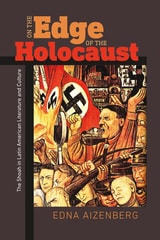
On the Edge of the Holocaust
The Shoah in Latin American Literature and CultureEdna Aizenberg
Brandeis University Press, 2015
In this bold study, Edna Aizenberg offers a much-needed corrective to both Latin American literary scholarship and popular assumptions that the whole of Latin America served as a Nazi refuge both during and after World War II. Analyzing the treatment of the Shoah by five leading figures in Argentine, Brazilian, and Chilean writing—Alberto Gerchunoff, Clarice Lispector, Jorge Luis Borges, Gabriela Mistral, and Joao Guimaraes Rosa—Aizenberg illuminates how Latin American intellectuals engaged with the horrific information that reached them regarding the Holocaust, including the sympathy and collaboration of their own governments with the Nazis. Aizenberg emphasizes how—through fiction, journalism, and activism—these five culture-makers opposed and fought fascism. At the same time, her readings of individual texts confront shopworn clichés about Latin American writing and literature, suggesting deeper and richer dimensions to many canonical works. This interdisciplinary book fills critical gaps in both Holocaust and Latin American studies, and will be of great interest to scholars and students in both fields.
[more]

Resistance against the Third Reich
1933-1990Edited by Michael Geyer and John W. Boyer
University of Chicago Press, 1994
"The history of resistance affords a powerful example of why the present should try to remember a more distant, early modern past" write Michael Geyer and John W. Boyer in their introduction to Resistance against the Third Reich. Addressing the legacy of European resistance, this volume examines the nature of political opposition to unjust rule, which is so often grounded in the bitter conflicts between church and state. This collection is a timely effort to link recent advances in European history with lingering questions concerning resistance against the Third Reich.
Contributors include Geoffrey Cocks, Werner G. Jeanrond, Tony Judt, Claudia Koonz, Hans Mommsen, and Frank Trommler.
Contributors include Geoffrey Cocks, Werner G. Jeanrond, Tony Judt, Claudia Koonz, Hans Mommsen, and Frank Trommler.
[more]