Results by title
38 books match the query 'Anti-racism'

A Feminist Theory of Violence
A Decolonial PerspectiveFrançoise Vergès
Pluto Press, 2022
***Winner of an English PEN Award 2022***
The mainstream conversation surrounding gender equality is a repertoire of violence: harassment, rape, abuse, femicide. These words suggest a cruel reality. But they also hide another reality: that of gendered violence committed with the complicity of the State.
In this book, Françoise Vergès denounces the carceral turn in the fight against sexism. By focusing on 'violent men', we fail to question the sources of their violence. There is no doubt as to the underlying causes: racial capitalism, ultra-conservative populism, the crushing of the Global South by wars and imperialist looting, the exile of millions and the proliferation of prisons - these all put masculinity in the service of a policy of death.
Against the spirit of the times, Françoise Vergès refuses the punitive obsession of the State in favour of restorative justice.

A Promise And A Way Of Life
White Antiracist ActivismBecky Thompson
University of Minnesota Press, 2001
The first in-depth look at white people’s activism in fighting racism during the past fifty years.
Not since the Civil Rights Movement of the 1950s and 1960s, when many white college students went south to fight against Jim Crow laws, has white antiracist activity held the public’s attention. Yet there have always been white people involved in fighting racism. In this passionate work, Becky Thompson looks at white Americans who have struggled against racism, offering examples of both successes and failures, inspirations, practical philosophies, and a way ahead.
A Promise and a Way of Life weaves an account of the past half-century based on the life histories of thirty-nine people who have placed antiracist activism at the center of their lives. Through a rich and fascinating narrative that links individual experiences with social and political history, Thompson shows the ways, both public and personal, in which whites have opposed racism during several social movements: the Civil Rights and Black Power movements, multiracial feminism, the Central American peace movement, the struggle for antiracist education, and activism against the prison industry. Beginning with the diverse catalysts that started these activists on their journeys, this book demonstrates the contributions and limitations of white antiracism in key social justice movements.
Through these stories, crucial questions are raised: Does antiracist work require a repudiation of one’s whiteness or can that identity be transformed through political commitment and alliances? What do white people need to do to undermine white privilege? What would it take to build a multiracial movement in which white people are responsible for creating antiracist alliances while not co-opting people of color?
Unique in its depth and thoroughness, A Promise and a Way of Life is essential for anyone currently fighting racism or wondering how to do so. Through its demonstration of the extraordinary personal and social transformations ordinary people can make, it provides a new paradigm for movement activity, one that will help to incite and guide future antiracist activism.

A White Side of Black Britain
Interracial Intimacy and Racial LiteracyFrance Winddance Twine
Duke University Press, 2010
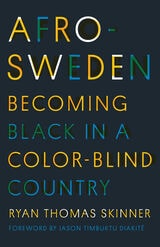
Afro-Sweden
Becoming Black in a Color-Blind CountryRyan Thomas Skinner
University of Minnesota Press, 2022
A compelling examination of Sweden’s African and Black diaspora
Contemporary Sweden is a country with a worldwide progressive reputation, despite an undeniable tradition of racism within its borders. In the face of this contradiction of culture and history, Afro-Swedes have emerged as a vibrant demographic presence, from generations of diasporic movement, migration, and homemaking. In Afro-Sweden, Ryan Thomas Skinner uses oral histories, archival research, ethnography, and textual analysis to explore the history and culture of this diverse and growing Afro-European community.
Skinner employs the conceptual themes of “remembering” and “renaissance” to illuminate the history and culture of the Afro-Swedish community, drawing on the rich theoretical traditions of the African and Black diaspora. Remembering fosters a sustained meditation on Afro-Swedish social history, while Renaissance indexes a thriving Afro-Swedish public culture. Together, these concepts illuminate significant existential modes of Afro-Swedish being and becoming, invested in and contributing to the work of global Black studies.
The first scholarly monograph in English to focus specifically on the African and Black diaspora in Sweden, Afro-Sweden emphasizes the voices, experiences, practices, knowledge, and ideas of these communities. Its rigorously interdisciplinary approach to understanding diasporic communities is essential to contemporary conversations around such issues as the status and identity of racialized populations in Europe and the international impact of Black Lives Matter.

Antiblackness
Moon-Kie Jung and João H. Costa Vargas, editors
Duke University Press, 2021
Contributors. Mohan Ambikaipaker, Jodi A. Byrd, Iyko Day, Anthony Paul Farley, Crystal Marie Fleming, Sarah Haley, Tanya Katerí Hernández, Sarah Ihmoud, Joy James, Moon-Kie Jung, Jae Kyun Kim, Charles W. Mills, Dylan Rodríguez, Zach Sell, João H. Costa Vargas, Frank B. Wilderson III, Connie Wun
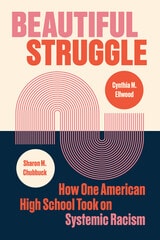
Beautiful Struggle
How One American High School Took on Systemic RacismSharon M. Chubbuck and Cynthia M. Ellwood
University of Chicago Press, 2026
An in-depth look at how one high school addressed racial inequality head-on.
The new superintendent stood before the faculty of “Oakmont High,” a large, diverse public school, and spoke a cold truth about American education. He described seeing the vibrant mix of students in the school’s hallways disperse into racially segregated classrooms when the bell rang. The fact was that students were sorted into tracks—supposedly race-neutral, “ability-based” pathways—that led to sharply unequal experiences and opportunities throughout high school and often their whole lives. “Why is it fair for white kids to have a better education than Black kids?” the superintendent asked his faculty. “It’s racism pure and simple, and it’s going to stop!”
Racial inequality persists because racism is systemic, baked into countless interlacing beliefs, practices, and structures that make up the way we do school. Tracking is one of many such practices. In Beautiful Struggle, Sharon M. Chubbuck and Cynthia M. Ellwood examine eleven years of transformation by administrators, teachers, students, and others as they tackled systemic racism head-on, starting with tracking. The people of OHS encountered intense resistance and made extraordinary inroads. They fought inequality with hard conversations and concrete steps. They dramatically increased Black and brown students’ access to rich, rigorous learning from the moment students entered as freshmen. They questioned and restructured the interconnected web of policy and practices in every aspect of the school. Students themselves propelled major changes in academic opportunity and the very culture of the school.
Chubbuck and Ellwood argue that taking on racial inequality requires an unrelenting focus on racial justice, challenging systems on every front, broad collective leadership across race and role, and the will to navigate difference and conflict. The story within Beautiful Struggle offers a hopeful though sobering path forward.
Becoming Trustworthy White Allies
Melanie S. Morrison
Duke University Press, 2025

Between Brown and Black
Anti-Racist Activism in BrazilAntonio José Bacelar da Silva
Rutgers University Press, 2022
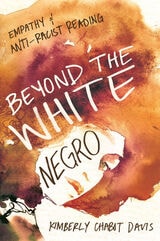
Beyond the White Negro
Empathy and Anti-Racist ReadingKimberly Chabot Davis
University of Illinois Press, 2014
Davis analyzes how white engagement with African American novels, film narratives, and hip-hop can help form anti-racist attitudes that may catalyze social change and racial justice. Though acknowledging past failures to establish cross-racial empathy, she focuses on examples that show avenues for future progress and change. Her study of ethnographic data from book clubs and college classrooms shows how engagement with African American culture and pedagogical support can lead to the kinds of white self-examination that make empathy possible. The result is a groundbreaking text that challenges the trend of focusing on society's failures in achieving cross-racial empathy and instead explores possible avenues for change.
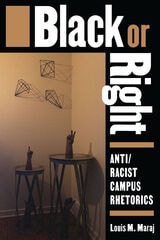
Black or Right
Anti/Racist Campus RhetoricsLouis M. Maraj
Utah State University Press, 2020
Offering four Black rhetorics as antiracist means for rhetorical reclamation—autoethnography, hashtagging, inter(con)textual reading, and reconceptualized disruption—the book uses Black feminist relationality via an African indigenous approach. Maraj examines fluid, quotidian ways Black folk engage anti/racism at historically white institutions in the United States in response to violent campus spaces, educational structures, protest movements, and policy practice. Black or Right’s experimental, creative style strives to undiscipline knowledge from academic confinement. Exercising different vantage points in each chapter—autoethnographer, digital media scholar/pedagogue, cultural rhetorician, and critical discourse analyst—Maraj challenges readers to ecologically understand shifting, multiple meanings of Blackness in knowledge-making. Black or Right’s expressive form, organization, narratives, and poetics intimately interweave with its argument that Black folk must continuously invent “otherwise” in reiterative escape from oppressive white spaces.
In centering Black experiences, Black theory, and diasporic Blackness, Black or Right mobilizes generative approaches to destabilizing institutional whiteness, as opposed to reparative attempts to “fix racism,” which often paradoxically center whiteness. It will be of interest to both academic and general readers and significant for specialists in cultural rhetorics, Black studies, and critical theory.
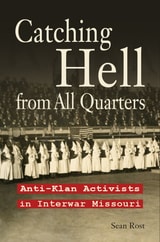
Catching Hell from All Quarters
Anti-Klan Activists in Interwar MissouriSean Rost
University of Missouri Press, 2025
Although anit-Klan activism was nation-wide, Missouri provides an excellent case study for the rise and fall of the second Klan as the organization gained a large membership and obtained a notable level of political power in some parts of the Show-Me State. Significantly, despite membership totals comparable to that of neighboring states, the Missouri Klan did not translate its recruiting success into substantial influence and political power due to significant local opposition from anti-Klan activists.
Catching Hell from All Quarters addresses key questions about the legacy of the Klan, both in Missouri and nationwide. Traditional scholarship on the second Klan stops at the hooded order’s decline at the start of the Great Depression, thus neatly splitting that era’s Klan from the Civil Rights Movement era Klan of the 1950s and 1960s. This book, however, draws direct connections between both eras by highlighting continued anti-Klan activism as well as several far-right, fascist, and white supremacist organizations that found support among Klan members (both active and former) during the 1930s and 1940s and aided not only in the Klan’s re-emergence after World War II but also influenced present-day hate groups.
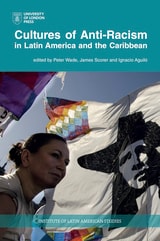
Cultures of Anti-Racism in Latin America and the Caribbean
Edited by Peter Wade, James Scorer, and Ignacio Aguiló
University of London Press, 2019
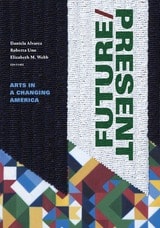
FUTURE/PRESENT
Arts in a Changing AmericaDaniela Alvarez, Roberta Uno, and Elizabeth M. Webb, editors
Duke University Press, 2024
Selected contributors. Dahlak Brathwaite, adrienne maree brown, Jeff Chang, Tameca Cole, Ofelia Esparza, Antoine Hunter, Nobuko Miyamoto, Wendy Red Star, Spel, Jose Antonio Vargas, Carrie Mae Weems, Hinaleimoana Kwai Kong Wong-Kalu
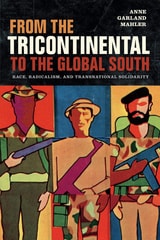
From the Tricontinental to the Global South
Race, Radicalism, and Transnational SolidarityAnne Garland Mahler
Duke University Press, 2018
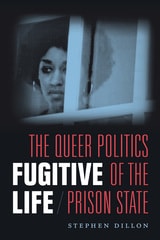
Fugitive Life
The Queer Politics of the Prison StateStephen Dillon
Duke University Press, 2018
I Hope I Join the Band
Narrative, Affiliation, and Antiraciset RhetoricFrankie Condon
Utah State University Press, 2012
"Both from the Right and from the Left, we are stymied in talking well with one another about race and racism, by intransigent beliefs in our own goodness as well as by our conviction that such talk is useless. . . . White antiracist epistemology needs to begin not with our beliefs, but with our individual and collective awakening to that which we do not know."
Drawing on scholarship across disciplines ranging from writing and rhetoric studies to critical race theory to philosophy, I Hope I Join the Band examines the limits and the possibilities for performative engagement in antiracist activism. Focusing particularly on the challenges posed by raced-white identity to performativity, and moving between narrative and theoretical engagement, thebook names and argues for critical shifts in the understandings and rhetorical practices that attend antiracist activism.
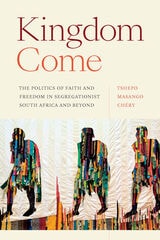
Kingdom Come
The Politics of Faith and Freedom in Segregationist South Africa and BeyondTshepo Masango Chéry
Duke University Press, 2023
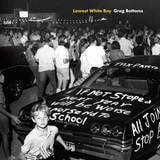
Lowest White Boy
Greg Bottoms
West Virginia University Press, 2019
An innovative, hybrid work of literary nonfiction, Lowest White Boy takes its title from Lyndon Johnson’s observation during the civil rights era: “If you can convince the lowest white man he’s better than the best colored man, he won’t notice you’re picking his pocket.”
Greg Bottoms writes about growing up white and working class in Tidewater, Virginia, during school desegregation in the 1970s. He offers brief stories that accumulate to reveal the everyday experience of living inside complex, systematic racism that is often invisible to economically and politically disenfranchised white southerners—people who have benefitted from racism in material ways while being damaged by it, he suggests, psychologically and spiritually. Placing personal memories against a backdrop of documentary photography, social history, and cultural critique, Lowest White Boy explores normalized racial animus and reactionary white identity politics, particularly as these are collected and processed in the mind of a child.
Mapping Racial Literacies
College Students Write about Race and SegregationSophie R. Bell
Utah State University Press, 2020
This textual ethnography embeds early college students’ writing in deep historical and theoretical contexts and looks for new ways that their writing contributes to and reshapes contemporary understandings of how US and global citizens are thinking about race. The book is a teaching narrative, tracing a teaching journey that considers student writing not only in the moments it is assigned but also in continual revisions of the course, making it a useful tool in helping college-age students see, explore, and articulate the role of race in determining their life experiences and opportunities.
Sophie Bell’s work narrates the experiences of a white teacher making mistakes in teaching about race and moving forward through those mistakes, considering that process valuable and, in fact, necessary. Providing a model for future scholars on how to carve out a pedagogically responsive identity as a teacher, Mapping Racial Literacies contributes to the scholarship on race and writing pedagogy and encourages teachers of early college classes to bring these issues front and center on the page, in the classroom, and on campus.
Metaracial
Hegel, Antiblackness, and Political IdentityRei Terada
University of Chicago Press, 2023
Exploring anxieties raised by Atlantic slavery in radical enlightenment literature concerned about political unfreedom in Europe, Metaracial argues that Hegel's philosophy assuages these anxieties for the left. Interpreting Hegel beside Rousseau, Kant, Mary Shelley, and Marx, Terada traces Hegel's transposition of racial hierarchy into a hierarchy of stances toward reality. By doing so, she argues, Hegel is simultaneously antiracist and antiblack. In dialogue with Black Studies, psychoanalysis, and critical theory, Metaracial offers a genealogy of the limits of antiracism.
Narratives of Joy and Failure in Antiracist Assessment
Exploring Collaborative Writing AssessmentsAsao B. Inoue
University Press of Colorado, 2024
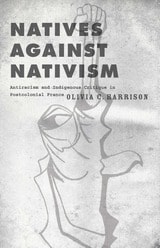
Natives against Nativism
Antiracism and Indigenous Critique in Postcolonial FranceOlivia C. Harrison
University of Minnesota Press, 2023
Examining the intersection of Palestine solidarity movements and antiracist activism in France from the 1970s to the present
For the pasty fifty years, the Palestinian question has served as a rallying cry in the struggle for migrant rights in postcolonial France, from the immigrant labor associations of the 1970s and Beur movements of the 1980s to the militant decolonial groups of the 2000s. In Natives against Nativism, Olivia C. Harrison explores the intersection of anticolonial solidarity and antiracist activism from the 1970s to the present.
Natives against Nativism analyzes a wide range of texts—novels, memoirs, plays, films, and militant archives—that mobilize the twin figures of the Palestinian and the American Indian in a crossed critique of Eurocolonial modernity. Harrison argues that anticolonial solidarity with Palestinians and Indigenous Americans has been instrumental in developing a sophisticated critique of racism across imperial formations—in this case, France, the United States, and Israel.
Serving as the first relational study of antiracism in France, Natives against Nativism observes how claims to indigeneity have been deployed in multiple directions, both in the ongoing struggle for migrant rights and racial justice, and in white nativist claims in France today.
New Work of Writing Across the Curriculum
Diversity and Inclusion, Collaborative Partnerships, and Faculty DevelopmentStaci M. Perryman-Clark
Utah State University Press, 2023
Many of these initiatives are created in isolation, reinforcing institutional silos that are not used strategically to gain the attention of senior administrators, particularly those working at state-supported public institutions who must manage shrinking institutional budgets. Yet teaching and learning centers and WAC programs gain tremendously from one another by building explicit partnerships on campus-wide diversity initiatives that emphasize cultural competence. In addition, both cultural competence and written proficiency enhance the transferable skills necessary for completing undergraduate education requirements, and this work can be leveraged to draw the attention of senior administrative leadership.
Faculty development and WAC need to make diversity and inclusion initiatives a priority for professional development. The New Work of Writing Across the Curriculum reviews initiatives that point to increased understanding of diversity and inclusion that will be of significance to administrators, WAC specialists, faculty developers, and diversity officers across the spectrum of institutions of higher learning.
On Music Theory, and Making Music More Welcoming for Everyone
Philip Ewell
University of Michigan Press, 2023
Winner of the 2024 Association of American Publishers PROSE Award for Music and Performing Arts
Since its inception in the mid-twentieth century, American music theory has been framed and taught almost exclusively by white men. As a result, whiteness and maleness are woven into the fabric of the field, and BIPOC music theorists face enormous hurdles due to their racial identities. In On Music Theory, Philip Ewell brings together autobiography, music theory and history, and theory and history of race in the United States to offer a black perspective on the state of music theory and to confront the field’s white supremacist roots. Over the course of the book, Ewell undertakes a textbook analysis to unpack the mythologies of whiteness and western-ness with respect to music theory, and gives, for the first time, his perspective on the controversy surrounding the publication of volume 12 of the Journal of Schenkerian Studies. He speaks directly about the antiblackness of music theory and the antisemitism of classical music writ large and concludes by offering suggestions about how we move forward. Taking an explicitly antiracist approach to music theory, with this book Ewell begins to create a space in which those who have been marginalized in music theory can thrive.
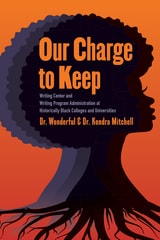
Our Charge to Keep
Writing Center and Writing Program Administration at Historically Black Colleges and UniversitiesWonderful Faison
Utah State University Press, 2026
The first book to explore writing center (WC) and writing program (WP) administration in HBCUs, Our Charge to Keep nuances ideas of ethical tutoring, explores Black college students’ beliefs about using Black Language in academic writing, provides new theories about tutoring, and gives insights into infrastructure and challenges facing WC and WP administrators in HBCU settings.
Many writing center directors have taken up the challenge to interrogate the impact of systemic racism on writing center theory, research, pedagogy, praxes, and daily operations, but the focus has largely been on predominantly white institutions (PWIs). As a result, writing center theory and research has unintentionally excluded the practices of everyday HBCU writing centers—their pedagogies, praxes, theories, and research. This edited volume rectifies this marginality by centering the epistemologies, practices, and wisdom of HBCU writing administrators, theorists, and practitioners. Chapters examine antiracist pedagogy, first-year writing challenges, the role of the larger HBCU community, and more.
Our Charge to Keep is a collection of writings that ultimately demystifies the administration of HBCU writing centers and inspires critical curiosity about them. Dr. Wonderful and Kendra Mitchell frame and showcase the resilience of HBCU writing center directors in combating the residual impact of systemic oppression and point the way forward for PWIs to shift toward new HBCU-centered perspectives on how to institute true antiracist policies and initiatives.
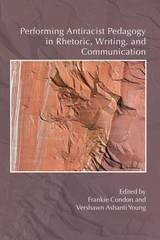
Performing Antiracist Pedagogy in Rhetoric, Writing, and Communication
Frankie Condon
University Press of Colorado, 2017
In Performing Antiracist Pedagogy, Frankie Condon and Vershawn Ashanti Young seek to help create openings to address race and racism not only in course readings and class discussion in writing, rhetoric, and communication courses but also in wider public settings. The contributors to this collection, drawn from a wide range of disciplines, urge readers to renew their commitment to intelligently and publicly deliberate race and to counteract the effects of racism. The book is both theoretically rigorous and practical, providing readers with insightful analyses of race and racism and useful classroom suggestions and examples.
Contributors: Chiara Bacigalupa, Sophia Bell, Susan Leigh Brooks, Frankie Condon, Rasha Diab, John Dean, Thomas Ferrell, Beth Godbee, Dae-Joong Kim, Timothy Lensmire, Calvin M. Logue, Aja Y. Martinez, Rebecca Nathan, Bobbi Olson, Jessica Parker, Charise Pimentel, Octavio Pimentel, Mya Poe, Neil Simpkins, Nathan Snaza, Deatra Sullivan, Vershawn Ashanti Young
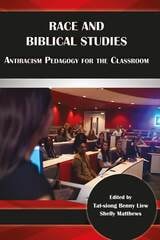
Race and Biblical Studies
Antiracism Pedagogy for the ClassroomTat-siong Benny Liew
SBL Press, 2022
Classrooms as communities are temporary, but the racial effects can be long term.
The biblical studies classroom can be a site of personal and social transformation. To make it a space for positive change, the contributors to this volume question and reevaluate traditional teaching practices and assessment tools that foreground white, Western scholarship in order to offer practical guidance for an antiracist pedagogy. The introduction and fifteen essays provide tools for engaging issues of social context and scriptural authority, nationalism and religious identities, critical race theory, and how race, gender, and class can be addressed empathetically. Contributors Sonja Anderson, Randall C. Bailey, Eric D. Barreto, Denise Kimber Buell, Greg Carey, Haley Gabrielle, Wilda C. Gafney, Julián Andrés González Holguín, Sharon Jacob, Tat-siong Benny Liew, Francisco Lozada Jr., Shelly Matthews, Roger S. Nam, Wongi Park, Jean-Pierre Ruiz, Abraham Smith, and Kay Higuera Smith share their experience creating classrooms that are spaces that enable the production of new knowledge without reproducing a white subject of the geopolitical West.
Race, Rhetoric, and Research Methods
Alexandria Lockett
University Press of Colorado, 2021
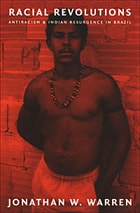
Racial Revolutions
Antiracism and Indian Resurgence in BrazilJonathan W. Warren
Duke University Press, 2001
The growing number of pardos who claim Indian identity represents a radical shift in the direction of Brazilian racial formation. For centuries, the predominant trend had been for Indians to shed tribal identities in favor of non-Indian ones. Warren argues that many factors—including the reduction of state-sponsored anti-Indian violence, intervention from the Catholic church, and shifts in anthropological thinking about ethnicity—have prompted a reversal of racial aspirations and reimaginings of Indianness. Challenging the current emphasis on blackness in Brazilian antiracist scholarship and activism, Warren demonstrates that Indians in Brazil recognize and oppose racism far more than any other ethnic group.
Racial Revolutions fills a number of voids in Latin American scholarship on the politics of race, cultural geography, ethnography, social movements, nation building, and state violence.
Designated a John Hope Franklin Center book by the John Hope Franklin Seminar Group on Race, Religion, and Globalization.
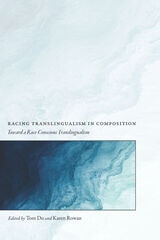
Racing Translingualism in Composition
Toward a Race-Conscious Translingualismedited by Tom Do and Karen Rowan
Utah State University Press, 2022
This collection extends the disciplinary conversations about translingualism by foregrounding the role race and racism play in the construction and maintenance of language differences. In doing so, the contributors examine the co-naturalization of race and language in order to theorize a race-conscious translingual praxis. The book begins by offering generative critiques of translingualism, centering on the ways in which the approach’s democratic orientation to language avoids issues of race, language, and power and appeals to colorblind racist tropes of equal opportunity. Following these critiques, contributors demonstrate the important intersections of race and translingualism by drawing upon voices typically marginalized by monolingual language ideologies and pedagogies. Finally, Racing Translingualism concludes by attending to the pedagogical implications of a race-conscious translingual praxis in writing and literacy education.
Making the case for race-conscious, rather than colorblind, theories and pedagogies, Racing Translingualism offers a unique take on how translingualism is theorized and practiced and moves the field forward through its direct consideration of the links between language, race, and racism.
Contributors: Lindsey Albracht, Steven Alvarez, Bethany Davila, Tom Do, Jaclyn Hilberg, Bruce Horner, Aja Martinez, Esther Milu, Stephanie Mosher, Yasmine Romero, Karen Rowan, Rachael Shapiro, Shawanda Stewart, Brian Stone, Victor Villanueva, Missy Watson

Racism And Anti-Racism In Europe
Alana Lentin
Pluto Press, 2004
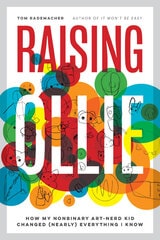
Raising Ollie
How My Nonbinary Art-Nerd Kid Changed (Nearly) Everything I KnowTom Rademacher
University of Minnesota Press, 2021
The account of one radically new school year for a Teacher of the Year and for his nonbinary, art-obsessed, brilliant child
Seven-year-old Ollie was researching local advanced school programs—because every second grader does that, right? Ollie, who used to hate weekends because they meant no school, was crying on the way to school almost every day. Sure, there were the slings and arrows of bullies and bad teachers, but, maybe worse, Ollie, a funny, anxious, smart kid with a thing for choir and an eye for graphic art, was gravely underchallenged and also struggling with identity and how to live totally as themselves. Ollie begged to switch to a new school with “kids like me,” where they wouldn’t feel so alone, or so bored, and so they made the change.
Raising Ollie is dad Tom Rademacher’s story (really, many stories) of that eventful and sometimes painful school year, parenting Ollie and relearning every day what it means to be a father and teacher. As Ollie—who is nonbinary and uses they/them pronouns, and prefers art to athletics, vegetables to cake, and animals to most humans—flourishes in their new school, Rademacher is making an eye-opening adjustment to a new school of his own, one that’s whiter and more suburban than anywhere he has previously taught, with a history of racial tension that he tries to address and navigate.
While Ollie is learning to code, 3D model, animate, speak Japanese, and finally feel comfortable at school, Rademacher increasingly sees how his own educational struggles, anxieties, and childhood upbringing are reflected in his teaching, writing, and parenting, as well as in Ollie’s experience. And with this story of one anything-but-academic year of inquiry and wonder, doubt and revelation, he shows us how raising a kid changes everything—and how much raising a kid like Ollie can teach us about who we are and what we’re doing in the world.
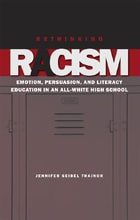
Rethinking Racism
Emotion, Persuasion, and Literacy Education in an All-White High SchoolJennifer Seibel Trainor
Southern Illinois University Press, 2008
In Rethinking Racism: Emotion, Persuasion, and Literacy Education in an All-White High School, Jennifer Seibel Trainor proposes a new understanding of the roots of racism, one that is based on attention to the role of emotion and the dynamics of persuasion. This one-year ethnographic study argues against previous assumptions about racism, demonstrating instead how rhetoric and emotion, as well as the processes and culture of schools, are involved in the formation of racist beliefs.
Telling the story of a year spent in an all-white high school, Trainor suggests that contrary to prevailing opinion, racism often does not stem from ignorance, a lack of exposure to other cultures, or the desire to protect white privilege. Rather, the causes of racism are frequently found in the realms of emotion and language, as opposed to rational calculations of privilege or political ideologies. Trainor maintains that racist assertions often originate not from prejudiced attitudes or beliefs but from metaphorical connections between racist ideas and nonracist values. These values are reinforced, even promoted by schooling via "emotioned rules" in place in classrooms: in tacit, unexamined lessons, rituals, and practices that exert a powerful—though largely unacknowledged—persuasive force on student feelings and beliefs about race.
Through in-depth analysis of established anti-racist pedagogies, student behavior, and racial discourses, Trainor illustrates the manner in which racist ideas are subtly upheld through social and literacy education in the classroom—and are thus embedded in the infrastructures of schools themselves. It is the emotional and rhetorical framework of the classroom that lends racism its compelling power in the minds of students, even as teachers endeavor to address the issue of cultural discrimination. This effort is continually hindered by an incomplete understanding of the function of emotions in relation to antiracist persuasion and cannot be remedied until the root of the problem is addressed.
Rethinking Racism calls for a fresh approach to understanding racism and its causes, offering crucial insight into the formative role of schooling in the perpetuation of discriminatory beliefs. In addition, this highly readable narrative draws from white students' own stories about the meanings of race in their learning and their lives. It thus provides new ways of thinking about how researchers and teachers rep- resent whiteness. Blending narrative with more traditional forms of ethnographic analysis, Rethinking Racism uncovers the ways in which constructions of racism originate in literacy research and in our classrooms—and how these constructions themselves can limit the rhetorical positions students enact.
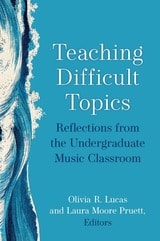
Teaching Difficult Topics
Reflections from the Undergraduate Music ClassroomOlivia R. Lucas and Laura Moore Pruett
University of Michigan Press, 2024
The teaching reflections in Teaching Difficult Topics examine difficult themes that fall into three primary categories: subjects that instructors sense to be controversial or emotionally challenging to discuss, those that derive from or intersect with real-world events that are difficult to process, and bigger-picture discussions of how music studies often focuses on dominant narratives while overlooking other perspectives. Some chapters offer practical guidance, lesson plans, and teaching materials to enable instructors to build discussions of race, gender, sexuality, and traumatic histories into their own classrooms; others take a more global view, reflecting on the importance and relevance of teaching these difficult topics and on how to respond in the music classroom when external events disrupt daily life.
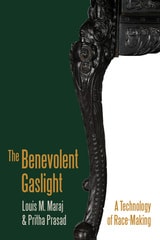
The Benevolent Gaslight
A Technology of Race-MakingLouis M. Maraj
Utah State University Press, 2026
At the intersection of rhetorical studies and critical race/ethnic studies, The Benevolent Gaslight analyzes cultural and political discourses that recharacterize acts of racial violence as teaching moments and learning opportunities. Naming this phenomenon “benevolent gaslighting,” Louis M. Maraj and Pritha Prasad explore its application across academic disciplines/epistemologies, educational history, and university race management, while also diving into how popular culture and political figures use benevolent gaslighting to reinscribe normative operations of race, gender, and sexuality.
Although this rhetoric usually presents as progressive, when used for the purposes of advancing “antiracism,” the benevolent gaslight re-centers the very whiteness it supposedly critiques. It prompts peoples of color to question their histories, memories, and realities by suggesting their pain has been necessary for positive social change and by situating racial trauma as opportunities for public learning. Specific examples include antiracist teaching initiatives and the sudden proliferation of apologies for past acts of racism by public figures. Both trends saw an uptick from 2020 onward as a result of publicity crises and public “reckonings” necessitated by Black Lives Matter protests in response to widely reported, hypervisible anti-Black violences like the murders of George Floyd, Breonna Taylor, and Ahmaud Arbery.
These discourses deflect blame for past or present racial violence by narrating it as an opportunity for “antiracist” growth and intervention. Utilizing conventional academic and creative/narrative methods to examine examples of the benevolent gaslight across US histories of education during the First Reconstruction, the post–Civil Rights management of student activists in the university, and the progressivist discourses of humanities disciplines and popular culture, this book reveals the insidious ways in which peoples of color are routinely (re)traumatized through mechanisms of “pedagogy.”
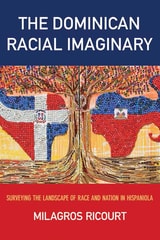
The Dominican Racial Imaginary
Surveying the Landscape of Race and Nation in HispaniolaRicourt, Milagros
Rutgers University Press, 2016
This book begins with a simple question: why do so many Dominicans deny the African components of their DNA, culture, and history?
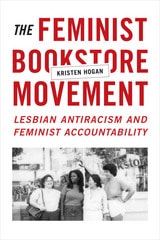
The Feminist Bookstore Movement
Lesbian Antiracism and Feminist AccountabilityKristen Hogan
Duke University Press, 2016
Who Is Antiracist?
Beliefs, Motivations, and PoliticsGeorge Yancey and Hayoung Oh
Temple University Press, 2025
Who Is Antiracist? provides a systematic approach to understanding the motivations and intentions of racial progressives as well as the impact of political ideology on antiracism. The authors discuss the theoretical origins of contemporary antiracism and review key works of antiracism to piece together the characteristics that define it. They also create the Antiracism Attitude Scale to explore the demographic makeup and social views of those who support the type of antiracism popularized in the United States.
Acknowledging that antiracism faces powerful challenges in fully obtaining the goals articulated by its proponents, Who Is Antiracist? enlightens us about the continuing racial conflict in our society and warns against the risk of antiracism becoming just a proxy for ordinary party politics.