Results by title
7 books match the query 'Anxieties'
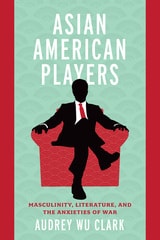
Asian American Players
Masculinity, Literature, and the Anxieties of WarAudrey Wu Clark
The Ohio State University Press, 2023
The player is a womanizer, a trickster, a gambler—but can Asian American men fully participate in this kind of masculinity? In Asian American Players, Audrey Wu Clark showcases how the literary figure of the Asian American player unsettles the hegemony of white American masculinity through mimicry, even as that masculinity socially and politically alienates him. She examines gendered and racialized US militarism through works written during major postmodern American wars, investigating how books by John Okada, David Henry Hwang, Chang-rae Lee, Frances Khirallah Noble, and Viet Thanh Nguyen (re)fashion Asian American masculinity in ways that ultimately mimic masculinist American foreign policy and military strategies during corresponding wars. She unearths a dual picture of Asian American players: as traces of the anxiety of America’s quest for empowerment and continued military and industrial dominance in the international arena and as those tarred as inferior and disloyal outsiders within this mirrored global dominance. She thus finds new inroads into understanding US imperialism and militarism and identifies ways that key literary figures have written against insidious tropes.
Difficult Attachments
Anxieties of Kinship and CareKathryn E. Goldfarb
Rutgers University Press, 2025
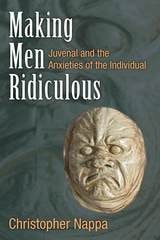
Making Men Ridiculous
Juvenal and the Anxieties of the IndividualChristopher Nappa
University of Michigan Press, 2018
In his sixteen verse satires, Juvenal presents speakers who decry the breakdown in traditional Roman values and the status of Roman men as they are confronted by upstart foreigners, devious and deviant women, class traitors, the power of the imperial household, and even the body itself. The satirist castigates vice and immorality even as he revels in describing them. This book locates Juvenal’s targets among the matrices of birth, wealth, class, gender, and ethnicity and walks carefully through a number of his most arresting vignettes in order to show not only what, but how, he satirizes. Moreover, the analysis shows that Juvenal’s portraits sometimes escape his grasp, and, as often as not, he ends up undermining the voice with which he speaks and the values he claims to hold dear. Individual chapters look at the satirist himself, rebellious bodies, disgraced aristocrats, uppity (even murderous) wives, and the necessary but corrupting power of money. The conclusion considers the endurance of both the targets and the rhetoric behind them in the modern world.
Making Men Ridiculous will interest scholars and advanced students of ancient satire, later European satire, imperial Roman culture and literature, and class, gender, and sexuality in the ancient world.
Talking to Strangers
Anxieties of Citizenship since Brown v. Board of EducationDanielle Allen
University of Chicago Press, 2004
Returning to the landmark Brown v. Board of Education decision of 1954 and to the famous photograph of Elizabeth Eckford, one of the Little Rock Nine, being cursed by fellow "citizen" Hazel Bryan, Allen argues that we have yet to complete the transition to political friendship that this moment offered. By combining brief readings of philosophers and political theorists with personal reflections on race politics in Chicago, Allen proposes strikingly practical techniques of citizenship. These tools of political friendship, Allen contends, can help us become more trustworthy to others and overcome the fossilized distrust among us.
Sacrifice is the key concept that bridges citizenship and trust, according to Allen. She uncovers the ordinary, daily sacrifices citizens make to keep democracy working—and offers methods for recognizing and reciprocating those sacrifices. Trenchant, incisive, and ultimately hopeful, Talking to Strangers is nothing less than a manifesto for a revitalized democratic citizenry.
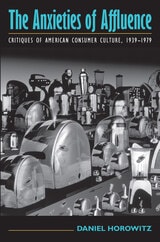
The Anxieties of Affluence
Critiques of American Consumer Culture, 1939-1979Daniel Horowitz
University of Massachusetts Press, 2004
This book charts the reactions of prominent American writers to the unprecedented prosperity of the decades following World War II. It begins with an examination of Lewis Mumford's wartime call for “democratic” consumption and concludes with an analysis of the origins of President Jimmy Carter's “malaise” speech of 1979. Between these bookends, Daniel Horowitz documents a broad range of competing views, each in its own way reflective of a deep-seated ambivalence toward consumer culture.
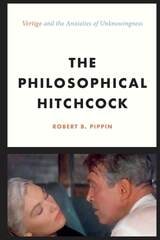
The Philosophical Hitchcock
“Vertigo” and the Anxieties of UnknowingnessRobert B. Pippin
University of Chicago Press, 2017
A bold, brilliant exploration of one of the most admired works of cinema, The Philosophical Hitchcock will lead philosophers and cinephiles alike to a new appreciation of Vertigo and its meanings.

The Voice in the Garden
Andrei Bolotov and the Anxieties of Russian Pastoral 1738-1833Thomas Newlin
Northwestern University Press, 2001