Results by title
9 books match the query 'Anzaldúa, Gloria'
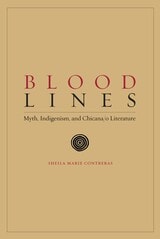
Blood Lines
Myth, Indigenism, and Chicana/o LiteratureBy Sheila Marie Contreras
University of Texas Press, 2008
2009 — Runner-up, Modern Language Association Prize in United States Latina and Latino and Chicana and Chicano Literary and Cultural Studies
Blood Lines: Myth, Indigenism, and Chicana/o Literature examines a broad array of texts that have contributed to the formation of an indigenous strand of Chicano cultural politics. In particular, this book exposes the ethnographic and poetic discourses that shaped the aesthetics and stylistics of Chicano nationalism and Chicana feminism. Contreras offers original perspectives on writers ranging from Alurista and Gloria Anzaldúa to Lorna Dee Cervantes and Alma Luz Villanueva, effectively marking the invocation of a Chicano indigeneity whose foundations and formulations can be linked to U.S. and British modernist writing.
By highlighting intertextualities such as those between Anzaldúa and D. H. Lawrence, Contreras critiques the resilience of primitivism in the Mexican borderlands. She questions established cultural perspectives on "the native," which paradoxically challenge and reaffirm racialized representations of Indians in the Americas. In doing so, Blood Lines brings a new understanding to the contradictory and richly textured literary relationship that links the projects of European modernism and Anglo-American authors, on the one hand, and the imaginary of the post-revolutionary Mexican state and Chicano/a writers, on the other hand.
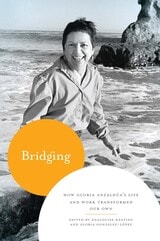
Bridging
How Gloria Anzaldúa's Life and Work Transformed Our OwnEdited by AnaLouise Keating and Gloria González-López
University of Texas Press, 2011
The inspirational writings of cultural theorist and social justice activist Gloria Anzaldúa have empowered generations of women and men throughout the world. Charting the multiplicity of Anzaldúa's impact within and beyond academic disciplines, community trenches, and international borders, Bridging presents more than thirty reflections on her work and her life, examining vibrant facets in surprising new ways and inviting readers to engage with these intimate, heartfelt contributions.
Bridging is divided into five sections: The New Mestizas: "transitions and transformations"; Exposing the Wounds: "You gave me permission to fly in the dark"; Border Crossings: Inner Struggles, Outer Change; Bridging Theories: Intellectual Activism with/in Borders; and "Todas somos nos/otras": Toward a "politics of openness." Contributors, who include Norma Elia Cantú, Elisa Facio, Shelley Fisher Fishkin, Aída Hurtado, Andrea Lunsford, Denise Segura, Gloria Steinem, and Mohammad Tamdgidi, represent a broad range of generations, professions, academic disciplines, and national backgrounds. Critically engaging with Anzaldúa's theories and building on her work, they use virtual diaries, transformational theory, poetry, empirical research, autobiographical narrative, and other genres to creatively explore and boldly enact future directions for Anzaldúan studies.
A book whose form and content reflect Anzaldúa's diverse audience, Bridging perpetuates Anzaldúa's spirit through groundbreaking praxis and visionary insights into culture, gender, sexuality, religion, aesthetics, and politics. This is a collection whose span is as broad and dazzling as Anzaldúa herself.
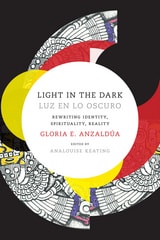
Light in the Dark/Luz en lo Oscuro
Rewriting Identity, Spirituality, RealityGloria E. Anzaldua
Duke University Press, 2015
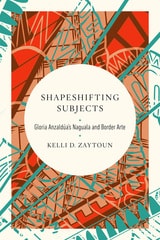
Shapeshifting Subjects
Gloria Anzaldua's Naguala and Border ArteKelli D. Zaytoun
University of Illinois Press, 2022
An original and moving analysis, Shapeshifting Subjects draws on unpublished archival material to apply Anzaldúa's ideas to new areas of thought and action.
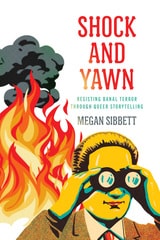
Shock and Yawn
Resisting Banal Terror Through Queer StorytellingMegan Sibbett
The Ohio State University Press, 2026
Building on queer theorists’ critiques of intimate and administrative violence, especially Gloria Anzaldúa’s “intimate terrorism,” Sibbett develops methodologies for conceptualizing and subverting violence aimed at queer, racialized, and gendered bodies in this era of surveillance and increasing authoritarianism. Sibbett addresses book bans, anti-trans legislation, idealized histories of westward expansion, and more, examining materials that include public service announcements, advertising, social media, news reports, poems, interviews, and novels. In so doing, she demonstrates the crucial role queer testimonies—and queer histories and queer futures—play in revealing systemic violence and illuminating the transformative potential of everyday resistance.
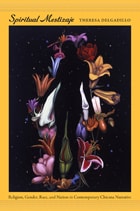
Spiritual Mestizaje
Religion, Gender, Race, and Nation in Contemporary Chicana NarrativeTheresa Delgadillo
Duke University Press, 2011
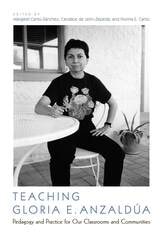
Teaching Gloria E. Anzaldúa
Pedagogy and Practice for Our Classrooms and CommunitiesEdited by Margaret Cantú-Sánchez, Candace de León-Zepeda, Norma E. Cantú
University of Arizona Press, 2020
Gloria Evangelina Anzaldúa—theorist, Chicana, feminist—famously called on scholars to do work that matters. This pronouncement was a rallying call, inspiring scholars across disciplines to become scholar-activists and to channel their intellectual energy and labor toward the betterment of society. Scholars and activists alike have encountered and expanded on these pathbreaking theories and concepts first introduced by Anzaldúa in Borderlands/La frontera and other texts.
Teaching Gloria E. Anzaldúa is a pragmatic and inspiring offering of how to apply Anzaldúa’s ideas to the classroom and in the community rather than simply discussing them as theory. The book gathers nineteen essays by scholars, activists, teachers, and professors who share how their first-hand use of Anzaldúa’s theories in their classrooms and community environments.
The collection is divided into three main parts, according to the ways the text has been used: “Curriculum Design,” “Pedagogy and Praxis,” and “Decolonizing Pedagogies.” As a pedagogical text, Teaching Gloria E. Anzaldúa also offers practical advice in the form of lesson plans, activities, and other suggested resources for the classroom. This volume offers practical and inspiring ways to deploy Anzaldúa’s transformative theories with real and meaningful action.
Contributors
Carolina E. Alonso
Cordelia Barrera
Christina Bleyer
Altheria Caldera
Norma E. Cantú
Margaret Cantú-Sánchez
Freyca Calderon-Berumen
Stephanie Cariaga
Dylan Marie Colvin
Candace de León-Zepeda
Miryam Espinosa-Dulanto
Alma Itzé Flores
Christine Garcia
Patricia M. García
Patricia Pedroza González
María del Socorro Gutiérrez-Magallanes
Leandra H. Hernández
Nina Hoechtl
Rían Lozano
Socorro Morales
Anthony Nuño
Karla O’Donald
Christina Puntasecca
Dagoberto Eli Ramirez
José L. Saldívar
Tanya J. Gaxiola Serrano
Verónica Solís
Alexander V. Stehn
Carlos A. Tarin
Sarah De Los Santos Upton
Carla Wilson
Kelli Zaytoun
The Anzaldúan Theory Handbook
AnaLouise Keating
Duke University Press, 2022

Women Reading Women Writing
Ann Louise Keating
Temple University Press, 1996