Results by title
4 books match the query 'Apollo'
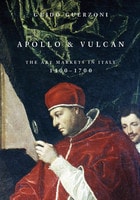
Apollo and Vulcan
The Art Markets in Italy, 1400-1700Guido Guerzoni
Michigan State University Press, 2011
Guido Guerzoni presents the results of fifteen years of research into one of the more hotly debated topics among historians of art and of economics: the history of art markets. Dedicating equal attention to current thought in the fields of economics, economic history, and art history, Guerzoni offers a broad and far-reaching analysis of the Italian scene, highlighting the existence of different forms of commercial interchange and diverse kinds of art markets. In doing so he ranges beyond painting and sculpture, to examine as well the economic drivers behind architecture, decorative and sumptuary arts, and performing or ephemeral events.
Organized by thematic areas (the ethics and psychology of consumption, an analysis of the demand, labor markets, services, prices, laws) that cover a large chronological period (from the 15th through the 17th century), various geographical areas, and several institution typologies, this book offers an exhaustive and up-to-date study of an increasingly fascinating topic.
[more]

Both, Apollo
Mary Wilson
Omnidawn, 2022
A poetry collection that employs intuition, humor, and celebration while seeking to break out of restrictive social structures.
Mary Wilson’s Both, Apollo speaks from inside the bodies and binaries that so often act as constraints. It sometimes tries to negotiate its way out. It laments, celebrates, reasons, jokes, and occasionally begs. It runs into a wall and hugs it, offers it pizza, and speeds through grammars and cities until dizziness catapults it from the grid. It tries to queer the echoes of its language in the hope that a rhyme might break the logic of “either/or” and give rise to “both/and.”
Both, Apollo is a love poem to whatever has the grace to appear, quietly finding hope. Moments of humor and tenderness accompany the speaker with each act of crossing and circling back. The poems in Both, Apollo are constantly in flux, and Wilson’s lyricism acts as a teaching tool for using both the real and the imagination to guide us in moment-by-moment navigation of our world.
Both, Apollo won the Omnidawn Chapbook contest, selected by Victoria Chang.
[more]
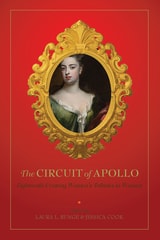
The Circuit of Apollo
Eighteenth-Century Women’s Tributes to WomenLaura Runge
University of Delaware Press, 2019
Written by a combination of established scholars and new critics in the field, the essays collected in Circuit of Apollo attest to the vital practice of commemorating women’s artistic and personal relationships. In doing so, they illuminate the complexity of female friendships and honor as well as the robust creativity and intellectual work contributed by women to culture in the long eighteenth century. Women’s tributes to each other sometimes took the form of critical engagement or competition, but they always exposed the feminocentric networks of artistic, social, and material exchange women created and maintained both in and outside of London. This volume advocates for a new perspective for researching and teaching early modern women that is grounded in admiration.
Published by University of Delaware Press. Distributed worldwide by Rutgers University Press.
Published by University of Delaware Press. Distributed worldwide by Rutgers University Press.
[more]

The Myth of Apollo and Daphne from Ovid to Quevedo
Love, Agon, and the GrotesqueMary E. Barnard
Duke University Press, 1987
The transformation of the myth of Apollo and Daphne in literary treatments from Ovid through the Spanish Golden Age are studied in theme and variation, showing how the protean figures of the myth meant different things to different ages, each age fashioning the lovers in its own image. The Myth of Apollo and Daphne focuses on the themes of love, agon, and the grotesque and their transformations as the writers, through a kind of artificial mythopoeia, invent variants for the tale, altering the ancient model to create their new, distinctive visions.
[more]