Results by title
2 books match the query 'Aporia'
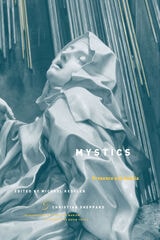
Mystics
Presence and AporiaEdited by Michael Kessler and Christian Sheppard
University of Chicago Press, 2003
When we speak of mystics, we normally think of people who have confessed extraordinary experiences of divine presence. But mysticism can also refer to the ways that people have described and explained such phenomena—ways that challenge our normal modes of thinking and believing. And the study of mystics can show problems inherent to experience and language—how to speak and think about what affects people but lies beyond language or thought.
Mystics presents a collection of previously unpublished essays by prominent scholars that consider both the idea of mystics and mysticism. The contributors offer detailed discussions of a variety of mystics from history, including Dionysius the Areopagite, Thomas Aquinas, Joan of Arc, Nicholas of Cusa, Saint Teresa of Avila, Martin Luther, and George Herbert. Essays on mysticism in George Bataille, Maurice Blanchot, and contemporary technology bring the volume into the twenty-first century.
For anyone interested in the state of current thinking about mysticism, this collection will be an essential touchstone.
Contributors:
Thomas A. Carlson, Alexander Golitzin, Kevin Hart, Amy Hollywood, Michael Kessler, Jean-Luc Marion, Bernard McGinn, Françoise Meltzer, Susan Schreiner, Regina M. Schwartz, Christian Sheppard, David Tracy
[more]
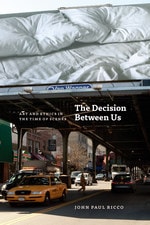
The Decision Between Us
Art and Ethics in the Time of ScenesJohn Paul Ricco
University of Chicago Press, 2014
The Decision Between Us combines an inventive reading of Jean-Luc Nancy with queer theoretical concerns to argue that while scenes of intimacy are spaces of sharing, they are also spaces of separation. John Paul Ricco shows that this tension informs our efforts to coexist ethically and politically, an experience of sharing and separation that informs any decision. Using this incongruous relation of intimate separation, Ricco goes on to propose that “decision” is as much an aesthetic as it is an ethical construct, and one that is always defined in terms of our relations to loss, absence, departure, and death.
Laying out this theory of “unbecoming community” in modern and contemporary art, literature, and philosophy, and calling our attention to such things as blank sheets of paper, images of unmade beds, and the spaces around bodies, The Decision Between Us opens in 1953, when Robert Rauschenberg famously erased a drawing by Willem de Kooning, and Roland Barthes published Writing Degree Zero, then moves to 1980 and the “neutral mourning” of Barthes’ Camera Lucida, and ends in the early 1990s with installations by Felix Gonzalez-Torres. Offering surprising new considerations of these and other seminal works of art and theory by Jean Genet, Marguerite Duras, and Catherine Breillat, The Decision Between Us is a highly original and unusually imaginative exploration of the spaces between us, arousing and evoking an infinite and profound sense of sharing in scenes of passionate, erotic pleasure as well as deep loss and mourning.
Laying out this theory of “unbecoming community” in modern and contemporary art, literature, and philosophy, and calling our attention to such things as blank sheets of paper, images of unmade beds, and the spaces around bodies, The Decision Between Us opens in 1953, when Robert Rauschenberg famously erased a drawing by Willem de Kooning, and Roland Barthes published Writing Degree Zero, then moves to 1980 and the “neutral mourning” of Barthes’ Camera Lucida, and ends in the early 1990s with installations by Felix Gonzalez-Torres. Offering surprising new considerations of these and other seminal works of art and theory by Jean Genet, Marguerite Duras, and Catherine Breillat, The Decision Between Us is a highly original and unusually imaginative exploration of the spaces between us, arousing and evoking an infinite and profound sense of sharing in scenes of passionate, erotic pleasure as well as deep loss and mourning.
[more]