Results by title
16 books match the query 'Appadurai, Arjun'

A Colonial Lexicon
Of Birth Ritual, Medicalization, and Mobility in the CongoNancy Rose Hunt
Duke University Press, 1999
Relying on archival research in England and Belgium, as well as fieldwork in the Congo, Hunt reconstructs an ethnographic history of a remote British Baptist mission struggling to survive under the successive regimes of King Leopold II’s Congo Free State, the hyper-hygienic, pronatalist Belgian Congo, and Mobutu’s Zaire. After exploring the roots of social reproduction in rituals of manhood, she shows how the arrival of the fast and modern ushered in novel productions of gender, seen equally in the forced labor of road construction and the medicalization of childbirth. Hunt focuses on a specifically interwar modernity, where the speed of airplanes and bicycles correlated with a new, mobile medicine aimed at curbing epidemics and enumerating colonial subjects. Fascinating stories about imperial masculinities, Christmas rituals, evangelical humor, colonial terror, and European cannibalism demonstrate that everyday life in the mission, on plantations, and under a strongly Catholic colonial state was never quite what it seemed. In a world where everyone was living in translation, privileged access to new objects and technologies allowed a class of “colonial middle figures”—particularly teachers, nurses, and midwives—to mediate the evolving hybridity of Congolese society. Successfully blurring conventional distinctions between precolonial, colonial, and postcolonial situations, Hunt moves on to discuss the unexpected presence of colonial fragments in the vibrant world of today’s postcolonial Africa.
With its close attention to semiotics as well as sociology, A Colonial Lexicon will interest specialists in anthropology, African history, obstetrics and gynecology, medical history, religion, and women’s and cultural studies.

Agricultural Reason in the Shadow of Subsistence Capitalism
A Rural Ontology from Western IndiaArjun Appadurai
HAU, 2024
This collection of essays by Arjun Appadurai based on his fieldwork in rural Maharashtra, India, in the early 1980s is one of the few anthropological treatments of agricultural reasoning. In conversation with agronomists, economists, and development anthropologists, the essays explore the ways agricultural technologies, changes in how surface wells are dug and managed, the provision and sharing of food and management of time, issues of scale in studying rural lives, and how local knowledge is formed and transformed reveal the distinctive character of rural Indian sociality. Locating these features in the context of “subsistence capitalism,” Appadurai draws our attention to the importance of relational practices and the pull of autonomy. These essays offer a close look at an agrarian society at the pivotal moment of its encounter with capitalist transformation and study ideas of measurement, sociality, and independence.

Appetites
Food and Sex in Post-Socialist ChinaJudith Farquhar
Duke University Press, 2002
From eating well in improving economic times to memories of the late 1950s famine, from the flavors of traditional Chinese medicine to modernity’s private sexual passions, this book argues that embodiment in all its forms must be invented and sustained in public reflections about personal and national life. As much at home in science studies and social theory as in the details of life in Beijing, this account uses anthropology, cultural studies, and literary criticism to read contemporary Chinese life in a materialist and reflexive mode. For both Maoist and market reform periods, this is a story of high culture in appetites, desire in collective life, and politics in the body and its dispositions.
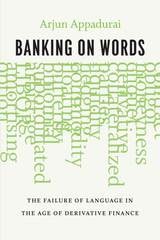
Banking on Words
The Failure of Language in the Age of Derivative FinanceArjun Appadurai
University of Chicago Press, 2015
Appadurai moves in four steps through his analysis. In the first, he highlights the importance of derivatives in contemporary finance, isolating them as the core technical innovation that markets have produced. In the second, he shows that derivatives are essentially written contracts about the future prices of assets—they are, crucially, a promise. Drawing on Mauss’s The Gift and Austin’s theories on linguistic performatives, Appadurai, in his third step, shows how the derivative exploits the linguistic power of the promise through the special form that money takes in finance as the most abstract form of commodity value. Finally, he pinpoints one crucial feature of derivatives (as seen in the housing market especially): that they can make promises that other promises will be broken. He then details how this feature spread contagiously through the market, snowballing into the systemic liquidity crisis that we are all too familiar with now.
With his characteristic clarity, Appadurai explains one of the most complicated—and yet absolutely central—aspects of our modern economy. He makes the critical link we have long needed to make: between the numerical force of money and the linguistic force of what we say we will do with it.

Beyond the Body Proper
Reading the Anthropology of Material LifeMargaret Lock and Judith Farquhar, eds.
Duke University Press, 2007
Beyond the Body Proper includes nine sections conceptually organized around themes such as everyday life, sex and gender, and science. Each section is preceded by interpretive commentary by the volume’s editors. Within the collection are articles and book excerpts focused on bodies using tools and participating in rituals, on bodies walking and eating, and on the female circumcision controversy, as well as pieces on medical classifications, spirit possession, the commodification of body parts, in vitro fertilization, and an artist/anatomist’s “plastination” of cadavers for display. Materialist, phenomenological, and feminist perspectives on embodiment appear along with writings on interpretations of pain and the changing meanings of sexual intercourse. Essays on these topics and many others challenge Eurocentric assumptions about the body as they speak to each other and to the most influential contemporary trends in the human sciences.
With selections by: Henry Abelove, Walter Benjamin, Janice Boddy, John Boswell, Judith Butler, Caroline Walker Bynum, Stuart Cosgrove, Michel de Certeau, Gilles Deleuze, Alice Domurat Dreger, Barbara Duden, Friedrich Engels, E. E. Evans-Pritchard, Judith Farquhar, Marcel Granet, Felix Guattari, Ian Hacking, Robert Hertz, Patricia Leyland Kaufert, Arthur Kleinman, Shigehisa Kuriyama, Jean Langford, Bruno Latour, Margaret Lock, Emily Martin, Karl Marx, Marcel Mauss, Maurice Merleau-Ponty, Nancy K. Miller, Lisa Jean Moore, John D. O’Neil, Aihwa Ong, Mariella Pandolfi, Susan Pedersen, Gregory M. Pflugfelder, Rayna Rapp, Nancy Scheper-Hughes, Kristofer Schipper, Matthew Schmidt, Peter Stallybrass, Michael Taussig, Charis Thompson, E.P. Thompson, Anna Lowenhaupt Tsing, Victor Turner, Terence Turner, Jose van Dijck, Keith Wailoo, Brad Weiss, Allon White

Bodies of Work
Civic Display and Labor in Industrial PittsburghEdward Slavishak
Duke University Press, 2008
Slavishak focuses on the workers whose bodies came to epitomize Pittsburgh, the men engaged in the arduous physical labor demanded by the city’s metals, glass, and coal industries. At the same time, he emphasizes how conceptions of Pittsburgh as quintessentially male limited representations of women in the industrial workplace. The threat of injury or violence loomed large for industrial workers at the turn of the twentieth century, and it recurs throughout Bodies of Work: in the marketing of artificial limbs, statistical assessments of the physical toll of industrial capitalism, clashes between labor and management, the introduction of workplace safety procedures, and the development of a statewide workmen’s compensation system.

CT Suite
The Work of Diagnosis in the Age of Noninvasive CuttingBarry F. Saunders
Duke University Press, 2008
Saunders’s analyses are informed by strands of cultural history and theory including art historical critiques of realist representation, Walter Benjamin’s concerns about violence in “mechanical reproduction,” and tropes of detective fiction such as intrigue, the case, and the culprit. Saunders analyzes the diagnostic “gaze” of medical personnel reading images at the viewbox, the two-dimensional images or slices of the human body rendered by the scanner, methods of archiving images, and the use of scans as pedagogical tools in clinical conferences. Bringing cloistered diagnostic practices into public view, he reveals the customs and the social and professional hierarchies that are formulated and negotiated around the weighty presence of the CT scanner. At the same time, by returning throughout to the nineteenth-century ideas of detection and scientific authority that inform contemporary medical diagnosis, Saunders highlights the specters of the past in what appears to be a preeminently modern machine.

Engaging Mbembe
Sindre Bandstad and Bjørn Enge Bertelsen, editors. Foreword by Arjun Appadurai.
Duke University Press, 2027

Fear of Small Numbers
An Essay on the Geography of AngerArjun Appadurai
Duke University Press, 2006
Fear of Small Numbers is Arjun Appadurai’s answer to that question. A leading theorist of globalization, Appadurai turns his attention to the complex dynamics fueling large-scale, culturally motivated violence, from the genocides that racked Eastern Europe, Rwanda, and India in the early 1990s to the contemporary “war on terror.” Providing a conceptually innovative framework for understanding sources of global violence, he describes how the nation-state has grown ambivalent about minorities at the same time that minorities, because of global communication technologies and migration flows, increasingly see themselves as parts of powerful global majorities. By exacerbating the inequalities produced by globalization, the volatile, slippery relationship between majorities and minorities foments the desire to eradicate cultural difference.
Appadurai analyzes the darker side of globalization: suicide bombings; anti-Americanism; the surplus of rage manifest in televised beheadings; the clash of global ideologies; and the difficulties that flexible, cellular organizations such as Al-Qaeda present to centralized, “vertebrate” structures such as national governments. Powerful, provocative, and timely, Fear of Small Numbers is a thoughtful invitation to rethink what violence is in an age of globalization.

Feeding Anorexia
Gender and Power at a Treatment CenterHelen Gremillion
Duke University Press, 2003
Feeding Anorexia is based on fourteen months of ethnographic research in a small inpatient unit located in a major teaching and research hospital in the western United States. Gremillion attended group, family, and individual therapy sessions and medical staff meetings; ate meals with patients; and took part in outings and recreational activities. She also conducted over one hundred interviews-with patients, parents, staff, and clinicians. Among the issues she explores are the relationship between calorie-counting and the management of consumer desire; why the "typical" anorexic patient is middle-class and white; the extent to which power differentials among clinicians, staff, and patients model "anorexic families"; and the potential of narrative therapy to constructively reframe some of the problematic assumptions underlying more mainstream treatments.

Globalization
Arjun Appadurai, ed.
Duke University Press, 2001
Seeking an alternative to the dead-end debate between those who see globalization as a phenomenon wholly without precedent and those who see it simply as modernization, imperialism, or global capitalism with a new face, the contributors seek to illuminate how space and time are transforming each other in special ways in the present era. They examine how this complex transformation involves changes in the situation of the nation, the state, and the city. While exploring distinct regions—China, Africa, South America, Europe—and representing different disciplines and genres—anthropology, literature, political science, sociology, music, cinema, photography—the contributors are concerned with both the political economy of location and the locations in which political economies are produced and transformed. A special strength of the collection is its concern with emergent styles of subjectivity, citizenship, and mobilization and with the transformations of state power through which market rationalities are distributed and embodied locally.
Contributors. Arjun Appadurai, Jean François Bayart, Jérôme Bindé, Néstor García Canclini, Leo Ching, Steven Feld, Ralf D. Hotchkiss, Wu Hung, Andreas Huyssen, Boubacar Touré Mandémory, Achille Mbembe, Philipe Rekacewicz, Saskia Sassen, Fatu Kande Senghor, Seteney Shami, Anna Tsing, Zhang Zhen

Globalization
Millennial Quartet II, Volume 12Arjun Appadurai, ed.
Duke University Press, 0
Seeking an alternative to the dead-end debate between those who see globalization as a phenomenon wholly without precedent and those who see it simply as modernization, imperialism, or global capitalism with a new face, the contributors seek to illuminate how space and time are transforming each other in special ways in the present era. They examine how this complex transformation involves changes in the situation of the nation, the state, and the city. While exploring distinct regions—China, Africa, South America, Europe—and representing different disciplines and genres—anthropology, literature, political science, sociology, music, cinema, photography—the contributors are concerned with both the political economy of location and the locations in which political economies are produced and transformed. A special strength of the collection is its concern with emergent styles of subjectivity, citizenship, and mobilization and with the transformations of state power through which market rationalities are distributed and embodied locally.
Contributors. Arjun Appadurai, Jérome Bindé, Néstor García Canclini, Leo Ching, Steven Feld, Ralf D. Hotchkiss, Wu Hung, Andreas Huyssen, Boubacar Touré Mandémory, Achille Mbembe, Saskia Sassen, Fatu Kande Senghor, Seteney Shami, Anna Tsing, Zhang Zhen

Modernity At Large
Cultural Dimensions of GlobalizationArjun Appadurai
University of Minnesota Press, 1996
Examines the role of imagination in the cultural development of our shrinking world.
The world is growing smaller. Every day we hear this idea expressed and witness its reality in our lives-through the people we meet, the products we buy, the foods we eat, and the movies we watch. In this bold look at the cultural effects of a shrinking world, leading cultural theorist Arjun Appadurai places these challenges and pleasures of contemporary life in a broad global perspective.
Offering a new framework for the cultural study of globalization, Modernity at Large shows how the imagination works as a social force in today's world, providing new resources for identity and energies for creating alternatives to the nation-state, whose era some see as coming to an end. Appadurai examines the current epoch of globalization, which is characterized by the twin forces of mass migration and electronic mediation, and provides fresh ways of looking at popular consumption patterns, debates about multiculturalism, and ethnic violence. He considers the way images-of lifestyles, popular culture, and self-representation-circulate internationally through the media and are often borrowed in surprising (to their originators) and inventive fashions.
Appadurai simultaneously explores and explodes boundaries-between how we imagine the world and how that imagination influences our self-understanding, between social institutions and their effects on the people who participate in them, between nations and peoples that seem to be ever more homogeneous and yet ever more filled with differences. Modernity at Large offers a path to move beyond traditional oppositions between culture and power, tradition and modernity, global and local, pointing out the vital role imagination plays in our construction of the world of today-and tomorrow.

The Afterlife of Images
Translating the Pathological Body between China and the WestAri Larissa Heinrich
Duke University Press, 2008
Combining literary studies, the history of science, and visual culture studies, Heinrich analyzes the rhetoric and iconography through which medical missionaries transmitted to the West an image of China as “sick” or “diseased.” He also examines the absorption of that image back into China through missionary activity, through the earliest translations of Western medical texts into Chinese, and even through the literature of Chinese nationalism. Heinrich argues that over time “scientific” Western representations of the Chinese body and culture accumulated a host of secondary meanings, taking on an afterlife with lasting consequences for conceptions of Chinese identity in China and beyond its borders.

The Republic of Therapy
Triage and Sovereignty in West Africa’s Time of AIDSVinh-Kim Nguyen
Duke University Press, 2010

Writing Religion
The Case for the Critical Study of ReligionEdited by Steven W. Ramey
University of Alabama Press, 2015
Section one of the volume, “Writing Discourses,” features essays by Jonathan Z. Smith, Bruce Lincoln, and Ann Pellegrini that illustrate how critical study enables the analysis of discourses in society and history. Section two, “Riting Social Formations,” includes pieces by Arjun Appadurai, Judith Plaskow, and Nathan Katz that reference both the power of rites to construct society and the act of riting as a form of disciplining that both prescribes and proscribes. The writings of Tomoko Masuzawa, Amy-Jill Levine, Aaron W. Hughes, and Martin S. Jaffee appear in section three, “Righting the Discipline.” They emphasize the correction of movements within the academic study of religion.
Steven W. Ramey frames the collection with a thoughtful introduction that explores the genesis, development, and diversity of critical analysis in the study of religion. An afterword by Russell McCutcheon reflects on the critical study of religion at the University of Alabama and rounds out this superb collection.
The mission of the Department of Religious Studies is to “avoid every tendency toward confusing the study of religion with the practice of religion.” Instruction about—rather than in—religion is foundational to the department’s larger goal of producing knowledge of the world and its many practices and systems of beliefs. Infused with this spirit, these fascinating essays, which read like good conversations with learned friends, offer significant examples of each scholar’s work. Writing Religion will be of value to graduate students, advanced undergraduates, and scholars interested in the study of religion from a critical perspective.