Results by title
6 books match the query 'Appearance'
Appearance, Discrimination and the Media
Portraying Facial Disfigurement Fairly in the NewsDiana Garrisi, Laima Janciute and Jacob Johanssen
University of Westminster Press, 2018
The portrayal of disfigurement in the UK media must change. This policy brief is based on recent research that found a general negative and sensationalised attitude towards disfigurement in the media.
Disfigurement is a condition that can affect anyone at any time in life regardless their social or demographic background due to accidents or health conditions or be congenital. In the UK, one in 111 people have facial disfigurements.
In order to improve the ways in which media portray disfigurement, this policy brief argues that media should move away from sensationalised coverage on disfigurement and focus instead on the lived experiences of individuals with this condition. It recommends strengthening diversity-oriented editorial practices and training as well as media literacy education. In addition, it addresses the lack of guidelines on the portrayal of disfigurement and urges regulatory bodies to be more efficient in handling complaints.

Chinatown Film Culture
The Appearance of Cinema in San Francisco’s Chinese NeighborhoodKim K. Fahlstedt
Rutgers University Press, 2020
On the Appearance of the World
A Future for Aesthetics in ArchitectureMark Foster Gage
University of Minnesota Press, 2024
How can architecture develop better aesthetic directions for the twenty-first-century built environment?
Our world, increasingly defined by efficient but unconsidered architecture and cities, seems to be getting uglier. In On the Appearance of the World, Mark Foster Gage asks why. He imagines a future scenario where architectural design and ideas from aesthetic philosophy align toward the production of a built world that is more humane, habitable, beautiful, and just.
Style and Time
Essays on the Politics of AppearanceAndrew Benjamin
Northwestern University Press, 2006
Nothing less than a rethinking of the conditions of Western art as it relates to politics, architecture, and time, this study of Walter Benjamin's modernity in temporal and spatial terms is a provocative and original work of philosophy in its own right—a work that suggests that the time has come to revise existing paradigms.
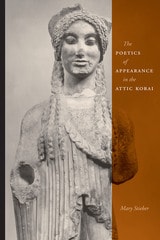
The Poetics of Appearance in the Attic Korai
By Mary Stieber
University of Texas Press, 2004
Some of the loveliest works of Archaic art were the Athenian korai—sculptures of beautiful young women presenting offerings to the goddess Athena that stood on the Acropolis. Sculpted in the sixth and early fifth centuries B.C., they served as votives until Persians sacked the citadel in 480/79 B.C. Subsequently, they were buried as a group and forgotten for nearly twenty-four centuries, until archaeologists excavated them in the 1880s. Today, they are among the treasures of the Acropolis Museum.
Mary Stieber takes a fresh look at the Attic korai in this book. Challenging the longstanding view that the sculptures are generic female images, she persuasively argues that they are instead highly individualized, mimetically realistic representations of Archaic young women, perhaps even portraits of real people. Marshalling a wide array of visual and literary evidence to support her claims, she shows that while the korai lack the naturalism that characterizes later Classical art, they display a wealth and realism of detail that makes it impossible to view them as generic, idealized images. This iconoclastic interpretation of the Attic korai adds a new dimension to our understanding of Archaic art and to the distinction between realism and naturalism in the art of all periods.
Worlds of Appearance
An Introduction to Aesthetics in PracticeWalead Beshty
University of Chicago Press, 2026
An accessible primer on aesthetics in art and everyday life, written by artist and scholar Walead Beshty.
In this general guide to the foundations of aesthetics, Walead Beshty introduces the complexities of aesthetics through succinct language and real-world examples, presenting an introductory theory of how the world becomes known to us through our senses and how that knowledge in turn builds our experience of everything around us.
Considering aesthetics on both a practical and a theoretical level, Worlds of Appearance asserts that art and aesthetics are inherently political, composing a fundamental form of communication and a means by which we can imagine the very nature of what can be experienced, sensed, and expressed. Aesthetics, argues Beshty, is a corporeal and material area of study, one that reveals how we perceive the world and how we develop technologies in response. With this book, he aims to fill a gap in existing writing about aesthetics, offering a clear explanation of how it acts as a dynamic force in our daily lives, how it functions on a concrete level, and how we can understand its possibilities.
Beginning with how we transform a flood of sensations into a coherent perception of the world, the book considers the basics of aesthetic production and reception, then moves on to look at specific examples of aesthetics in practice, with a focus on art, architecture, and performance. It concludes by laying out how aesthetic literacy is key to understanding the production of wide-ranging aspects of our lives, including digitization, mass media, systems of communications, and power relations.