Results by title
3 books match the query 'Appiah, Kwame Anthony'

"Race," Writing, and Difference
Edited by Henry Louis Gates Jr. and Kwame Anthony Appiah
University of Chicago Press, 1987
A classic of cultural criticism, "Race," Writing, and Difference provides a broad introduction to the idea of "race" as a meaningful category in the study of literature and the shaping of critical theory. This collection demonstrates the variety of critical approaches through which one may discuss the complexities of racial "otherness" in various modes of discourse. Now, fifteen years after their first publication, these essays have managed to escape the cliches associated with the race-class-gender trinity of '80s criticism, and remain a provocative overview of the complex interplay between race, writing, and difference.
[more]

Identities
Edited by Kwame Anthony Appiah and Henry Louis Gates Jr.
University of Chicago Press, 1995
The study of identity crosses all disciplinary borders to address such issues as the multiple interactions of race, class, and gender in feminist, lesbian, and gay studies, postcolonialism and globalization, and the interrelation of nationalism and ethnicity in ethnic and area studies. Identities will help disrupt the cliché-ridden discourse of identity by exploring the formation of identities and problem of subjectivity.
Leading scholars in literary criticism, anthropology, sociology, and philosophy explore such topics as "Gypsies" in the Western imagination, the mobilization of the West in Chinese television, the lesbian identity and the woman's gaze in fashion photography, and the regulation of black women's bodies in early 20th-century urban areas. This collection of twenty articles brings together the special issue of Critical Inquiry entitled "Identities" (Summer 1992), two other previously published essays, and five previously published critical responses and rejoinders, all of which is interrogated in two new essays by Michael Gorra and Judith Butler.
Contributors include Elizabeth Abel, Kwame Anthony Appiah, Akeel Bilgrami, Daniel Boyarin, Jonathan Boyarin, Judith Butler, Hazel V. Carby, Xiaomei Chen, Diana Fuss, Henry Louis Gates, Jr., Avery Gordon, Michael Gorra, Cheryl Herr, Saree S. Makdisi, Walter Benn Michaels, Christopher Newfield, Gananath Obeyesekere, Molly Anne Rothenberg, Gayatri Chakravorty Spivak, Sara Suleri, Katie Trumpener, and Joseph Valente.
[more]
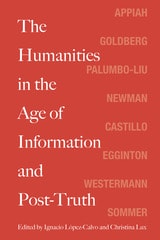
The Humanities in the Age of Information and Post-Truth
Edited by Ignacio López-Calvo and Christina Lux
Northwestern University Press, 2019
The essays in The Humanities in the Age of Information and Post-Truth represent a defense of the social function of the humanities in today's society. Edited by Ignacio López-Calvo and Christina Lux, the volume explains different ways in which the humanities and the arts, beyond their intrinsic and nonfunctional value, may be a valuable tool in our search for social justice, human empathy, freedom, and peace, all the while helping us answer many of the twenty-first century's big questions. Some essays explore the ways in which the humanities may help us imagine a different, more just world, and articulate politically effective mechanisms to achieve such goals. Others address the place of the humanities and the arts amid the ontological and epistemological uncertainties constantly produced in a fast-changing world.
While the reader may suspect that these types of lucubration are a desperate reaction to decreased public funding for the humanities worldwide, a decreased enrollment of students, or anxiety over the future of our profession, there is in this volume a coherent argument for the continued need, perhaps more now than ever, to invest in humanities education if we are to have informed and socially conscious citizens rather than just willing consumers and obedient workers. Furthermore, the essays prove that the humanities and the arts are, after all, not a luxury but an integral part of a complete scholarly education.
While the reader may suspect that these types of lucubration are a desperate reaction to decreased public funding for the humanities worldwide, a decreased enrollment of students, or anxiety over the future of our profession, there is in this volume a coherent argument for the continued need, perhaps more now than ever, to invest in humanities education if we are to have informed and socially conscious citizens rather than just willing consumers and obedient workers. Furthermore, the essays prove that the humanities and the arts are, after all, not a luxury but an integral part of a complete scholarly education.
[more]