Results by title
6 books match the query 'Apples'
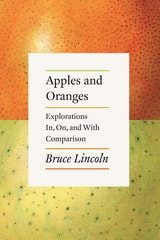
Apples and Oranges
Explorations In, On, and With ComparisonBruce Lincoln
University of Chicago Press, 2018
Comparison is an indispensable intellectual operation that plays a crucial role in the formation of knowledge. Yet comparison often leads us to forego attention to nuance, detail, and context, perhaps leaving us bereft of an ethical obligation to take things correspondingly as they are. Examining the practice of comparison across the study of history, language, religion, and culture, distinguished scholar of religion Bruce Lincoln argues in Apples and Oranges for a comparatism of a more modest sort.
Lincoln presents critiques of recent attempts at grand comparison, and enlists numerous theoretical examples of how a more modest, cautious, and discriminating form of comparison might work and what it can accomplish. He does this through studies of shamans, werewolves, human sacrifices, apocalyptic prophecies, sacred kings, and surveys of materials as diverse and wide-ranging as Beowulf, Herodotus’s account of the Scythians, the Native American Ghost Dance, and the Spanish Civil War.
Ultimately, Lincoln argues that concentrating one's focus on a relatively small number of items that the researcher can compare closely, offering equal attention to relations of similarity and difference, not only grants dignity to all parties considered, it yields more reliable and more interesting—if less grandiose—results. Giving equal attention to the social, historical, and political contexts and subtexts of religious and literary texts also allows scholars not just to assess their content, but also to understand the forces, problems, and circumstances that motivated and shaped them.
[more]
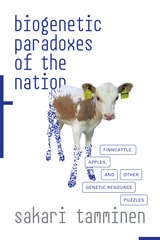
Biogenetic Paradoxes of the Nation
Finncattle, Apples, and Other Genetic-Resource PuzzlesSakari Tamminen
Duke University Press, 2019
In 1992, the Convention on Biological Diversity (CBD), signed by over 160 countries and hailed as the key symbol of a common vision for saving Earth's biodiversity, set forth three primary mandates: preserving biodiversity, using biodiversity components sustainably, and enabling economic benefit-sharing. The CBD—which gave signatory countries the ability to claim sovereignty over nonhuman genetic resources native to each nation—defined biodiversity through a politics of nationhood in ways that commodified genetic resources. In Biogenetic Paradoxes of the Nation Sakari Tamminen traces the ways in which the CBD's seemingly compatible yet ultimately paradox-ridden aims became manifest in efforts to create, conserve, and capitalize on distinct animal and plant species. In using Finland as a case study with which to understand the worldwide efforts to convert species into manifestations of national identity, Tamminen shows how the CBD's policies contribute less to biodiversity conservation than to smoothing the way for frictionless operation of biotechnologically assisted circuits of the global bioeconomy. Tamminen demonstrates how an intimate look at the high-level politics and technical processes of defining national genetic resources powerfully illuminates the limits of anthropocentric biopolitical theory.
[more]
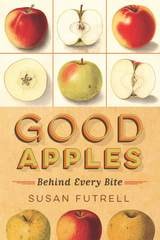
Good Apples
Behind Every BiteSusan Futrell
University of Iowa Press, 2017
Apples are so ordinary and so ubiquitous that we often take them for granted. Yet it is surprisingly challenging to grow and sell such a common fruit. In fact, producing diverse, tasty apples for the market requires almost as much ingenuity and interdependence as building and maintaining a vibrant democracy. Understanding the geographic, ecological, and economic forces shaping the choices of apple growers, apple pickers, and apple buyers illuminates what’s at stake in the way we organize our food system.
Good Apples is for anyone who wants to go beyond the kitchen and backyard into the orchards, packing sheds, and cold storage rooms; into the laboratories and experiment stations; and into the warehouses, stockrooms, and marketing meetings, to better understand how we as citizens and eaters can sustain the farms that provide food for our communities. Susan Futrell has spent years working in sustainable food distribution, including more than a decade with apple growers. She shows us why sustaining family orchards, like family farms, may be essential to the soul of our nation.
Good Apples is for anyone who wants to go beyond the kitchen and backyard into the orchards, packing sheds, and cold storage rooms; into the laboratories and experiment stations; and into the warehouses, stockrooms, and marketing meetings, to better understand how we as citizens and eaters can sustain the farms that provide food for our communities. Susan Futrell has spent years working in sustainable food distribution, including more than a decade with apple growers. She shows us why sustaining family orchards, like family farms, may be essential to the soul of our nation.
[more]
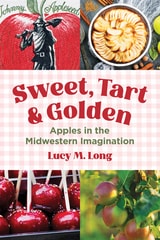
Sweet, Tart, and Golden
Apples in the Midwestern ImaginationLucy M. Long
University of Illinois Press, 2026
Whether Jonagolds or Ida Reds, the apple provides Midwesterners with both a versatile food and a powerful archetype of their culture and heritage. Lucy M. Long examines the ubiquitous fruit’s place in regional culture and its role in how people in the Midwest think of themselves and the wider world. Long guides readers to festivals and introduces them to orchard owners while tracing the history of how apples became a central part of Midwesterners’ landscape, leisure, tables, and way of life. Johnny Appleseed folklore, sustainability and the apple business, the meanings behind the Grand Rapids Applebutter Fest, a recipe for apple caramel cheesecake—Long reveals a quintessential American fruit in all its glory.
Lively and surprising, Sweet, Tart, and Golden blends food history with on-the-ground exploration to tell the multifaceted story of the apple.
Lively and surprising, Sweet, Tart, and Golden blends food history with on-the-ground exploration to tell the multifaceted story of the apple.
[more]
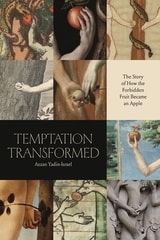
Temptation Transformed
The Story of How the Forbidden Fruit Became an AppleAzzan Yadin-Israel
University of Chicago Press, 2022
A "brisk and entertaining" (Wall Street Journal) journey into the mystery behind why the forbidden fruit became an apple, upending an explanation that stood for centuries.
How did the apple, unmentioned by the Bible, become the dominant symbol of temptation, sin, and the Fall? Temptation Transformed pursues this mystery across art and religious history, uncovering where, when, and why the forbidden fruit became an apple.
Azzan Yadin-Israel reveals that Eden’s fruit, once thought to be a fig or a grape, first appears as an apple in twelfth-century French art. He then traces this image back to its source in medieval storytelling. Though scholars often blame theologians for the apple, accounts of the Fall written in commonly spoken languages—French, German, and English—influenced a broader audience than cloistered Latin commentators. Azzan Yadin-Israel shows that, over time, the words for “fruit” in these languages narrowed until an apple in the Garden became self-evident. A wide-ranging study of early Christian thought, Renaissance art, and medieval languages, Temptation Transformed offers an eye-opening revisionist history of a central religious icon.
[more]
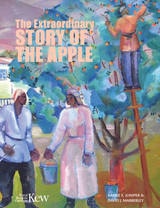
The Extraordinary Story of the Apple
David Mabberley and Barry Juniper
Royal Botanic Gardens, Kew, 2018
The story of apples begins in an unexpected place: with bears. While popular culture likes to link honey with these creatures, DNA evidence shows that it might be more accurate for Winnie the Pooh to be munching on an ancestor of Red Delicious. And while apples are modern America’s second favorite fruit (after “berries”), their origins lie in ancient China. These are just some of the remarkable details that arise from Barrie E. Juniper and David J. Mabberley’s The Extraordinary Story of the Apple. Written by two leading botanical experts, it’s a complete natural and cultural history of the apple.
Using DNA evidence, Juniper and Mabberley trace the fruit’s geographical journey through time and across countries. They show how the apple has long been one of the most important fruits in the temperate regions of the world, and that it has been beloved since the times of the Persians, Greeks, and Romans. Its reach grew thanks to its reputation as a highly nutritional food source as well as one that is remarkably convenient, as the apple can be stored throughout a harsh winter or easily transported over long distances. The authors also examine the apple’s global influence on human culture. After all, it’s the fruit that played a key role in the fall of Adam and Eve, the inspiration for Newton’s Law of Gravity, and the rise of a tech behemoth.
With a nod to this book’s roots with the Royal Botanic Gardens, Kew, chapters also cover types of apple and apple crops, grafting techniques over time, archaeological discoveries, use as a food and in cider making, as well as the latest research in apple biology. This fascinating book is illustrated throughout with color illustrations, paintings, photographs, and line drawings, and will make the ideal read for gardeners, growers, botanists, historians, archaeologists and zoologists alike. The next time you pluck an apple from a supermarket bushel, you’ll understand the millennia of human—and Ursidae—influences on that humble fruit.
[more]