Results by title
5 books match the query 'Applied'
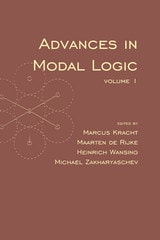
Advances in Modal Logic, Volume 1
Edited by Marcus Kracht, Maarten de Rijke, Heinrich Wansing, and Michael Zakhary
CSLI, 1998
Modal logic originated in philosophy as the logic of necessity and possibility. Nowadays it has reached a high level of mathematical sophistication and found many applications in a variety of disciplines, including theoretical and applied computer science, artificial intelligence, the foundations of mathematics, and natural language syntax and semantics.
This volume represents the proceedings of the first international workshop on Advances in Modal Logic, held in Berlin, Germany, October 8-10, 1996. It offers an up-to-date perspective on the field, with contributions covering its proof theory, its applications in knowledge representation, computing and mathematics, as well as its theoretical underpinnings.
"This collection is a useful resource for anyone working in modal logic. It contains both interesting surveys and cutting-edge technical results"
--Edwin D. Mares
The Bulletin of Symbolic Logic, March 2002
[more]

Fuzzy Logic Control in Energy Systems with design applications in MATLAB®/Simulink®
Ismail H. Altaş
The Institution of Engineering and Technology, 2017
Modern electrical power systems are facing complex challenges, arising from distributed generation and intermittent renewable energy. Fuzzy logic is one approach to meeting this challenge and providing reliability and power quality.
[more]

Fuzzy Logic Control in Energy Systems
With design examples in MATLAB®/Simulink®İsmail Hakkı Altaş
The Institution of Engineering and Technology, 2024
Fuzzy models have the capability of recognising, representing, and working with data that is vague or lacks certainty, making them suitable for managing electrical energy systems involving intermittent distributed generation and varying distributed loads.
[more]
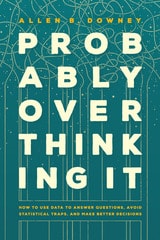
Probably Overthinking It
How to Use Data to Answer Questions, Avoid Statistical Traps, and Make Better DecisionsAllen B. Downey
University of Chicago Press, 2023
An essential guide to the ways data can improve decision making.
Statistics are everywhere: in news reports, at the doctor’s office, and in every sort of forecast, from the stock market to the weather. Blogger, teacher, and computer scientist Allen B. Downey knows well that people have an innate ability both to understand statistics and to be fooled by them. As he makes clear in this accessible introduction to statistical thinking, the stakes are big. Simple misunderstandings have led to incorrect medical prognoses, underestimated the likelihood of large earthquakes, hindered social justice efforts, and resulted in dubious policy decisions. There are right and wrong ways to look at numbers, and Downey will help you see which are which.
Probably Overthinking It uses real data to delve into real examples with real consequences, drawing on cases from health campaigns, political movements, chess rankings, and more. He lays out common pitfalls—like the base rate fallacy, length-biased sampling, and Simpson’s paradox—and shines a light on what we learn when we interpret data correctly, and what goes wrong when we don’t. Using data visualizations instead of equations, he builds understanding from the basics to help you recognize errors, whether in your own thinking or in media reports. Even if you have never studied statistics—or if you have and forgot everything you learned—this book will offer new insight into the methods and measurements that help us understand the world.
[more]
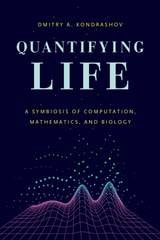
Quantifying Life
A Symbiosis of Computation, Mathematics, and BiologyDmitry A. Kondrashov
University of Chicago Press, 2016
Since the time of Isaac Newton, physicists have used mathematics to describe the behavior of matter of all sizes, from subatomic particles to galaxies. In the past three decades, as advances in molecular biology have produced an avalanche of data, computational and mathematical techniques have also become necessary tools in the arsenal of biologists. But while quantitative approaches are now providing fundamental insights into biological systems, the college curriculum for biologists has not caught up, and most biology majors are never exposed to the computational and probabilistic mathematical approaches that dominate in biological research.
With Quantifying Life, Dmitry A. Kondrashov offers an accessible introduction to the breadth of mathematical modeling used in biology today. Assuming only a foundation in high school mathematics, Quantifying Life takes an innovative computational approach to developing mathematical skills and intuition. Through lessons illustrated with copious examples, mathematical and programming exercises, literature discussion questions, and computational projects of various degrees of difficulty, students build and analyze models based on current research papers and learn to implement them in the R programming language. This interplay of mathematical ideas, systematically developed programming skills, and a broad selection of biological research topics makes Quantifying Life an invaluable guide for seasoned life scientists and the next generation of biologists alike.
With Quantifying Life, Dmitry A. Kondrashov offers an accessible introduction to the breadth of mathematical modeling used in biology today. Assuming only a foundation in high school mathematics, Quantifying Life takes an innovative computational approach to developing mathematical skills and intuition. Through lessons illustrated with copious examples, mathematical and programming exercises, literature discussion questions, and computational projects of various degrees of difficulty, students build and analyze models based on current research papers and learn to implement them in the R programming language. This interplay of mathematical ideas, systematically developed programming skills, and a broad selection of biological research topics makes Quantifying Life an invaluable guide for seasoned life scientists and the next generation of biologists alike.
[more]