Results by title
4 books match the query 'Apprenticeship'
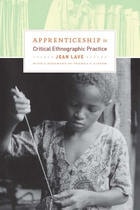
Apprenticeship in Critical Ethnographic Practice
Jean Lave
University of Chicago Press, 2011
In this extended meditation, Jean Lave interweaves analysis of the process of apprenticeship among the Vai and Gola tailors of Liberia with reflections on the evolution of her research on those tailors in the late 1970s. In so doing, she provides both a detailed account of her apprenticeship in the art of sustained fieldwork and an insightful overview of thirty years of changes in the empirical and theoretical facets of ethnographic practice. Examining the issues she confronted in her own work, Lave shows how the critical questions raised by ethnographic research erode conventional assumptions, altering the direction of the work that follows.
As ethnography takes on increasing significance to an ever widening field of thinkers on topics from education to ecology, this erudite but accessible book will be essential to anyone tackling the question of what it means to undertake critical and conceptually challenging fieldwork. Apprenticeship in Critical Ethnographic Practice explains how to seriously explore what it means to be human in a complex world—and why it is so important.
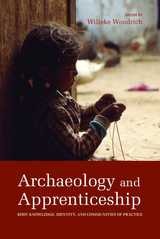
Archaeology and Apprenticeship
Body Knowledge, Identity, and Communities of PracticeEdited by Willeke Wendrich
University of Arizona Press, 2012
Apprenticeship is broadly defined as the transmission of culture through a formal or informal teacher–pupil relationship. This collection invites a wide discussion, citing case studies from all over the world and yet focuses the scholarship into a concise set of contributions. The chapters in this volume demonstrate how archaeology can benefit greatly from the understanding of the social dimensions of knowledge transfer. This book also examines apprenticeship in archaeology against a backdrop of sociological and cognitive psychology literature, to enrich the understanding of the relationship between material remains and enculturation.
Each of the authors in this collection looks specifically at how material remains can reveal several specific aspects of ancient cultures: What is the human potential for learning? How do people learn? Who is teaching? Why are they learning? What are the results of such learning? How do we recognize knowledge transfer in the archaeological record? These fundamental questions are featured in various forms in all chapters of the book. With case studies from the American Southwest, Alaska, Egypt, Ancient Greece, and Mesopotamia, this book will have broad appeal for scholars—particularly those concerned with cultural transmission and traditions of learning and education—all over the world.

Gilles Deleuze
An Apprenticeship in PhilosophyMichael Hardt
University of Minnesota Press, 1993
The key to understanding Deleuze's complete body of work.
"A coherent and systematic reading of a philosopher who has consistently courted the incoherent and systematic. What we must avoid are encounters with those who cultivate sad passions (the men of ressentiment in the Nietzschean formulation); and we must increase our power to compose new relationships with compatible bodies with whom we share a common notion. Hardt's exceptional book is one such joyful encounter." -Times Literary Supplement"An excellent book. The project of Gilles Deleuze is to situate Deleuze squarely in the camp of those who seek to deepen and transform our philsophical understanding and political situation. Hardt seems to me to be directly on target." -Substance"Both for its object and its method of study, here is a work that will mark the future of the field of Deleuzian studies." -Eric Alliez, Critique"Hardt's reading of Deleuze is complex and precise. He follows the intricacies of the argument and of the shifting positions with considerable skill, thus providing us with a study not only of the Deleuzian way of doing philosophy, but of Deleuzian reading-of the selectivity of its targets, of its agonistic approach to philosophy, through indirect attack on one main opponent. Reading Hardt reading Deleuze reading, we can understand, for instance, why Deleuze's exposition usually takes the form not of a dialectic but of a correlation, of a system of differences." -Radical Philosophy"How can we forget the dialectic? How an we affirm a constitutive ontology? Through its efforts to respond to these questions, Gilles Deleuze's philosophical apprenticeship presents the Bildungsroman of any contemporary philosophy that wants to break away from the destiny of modernity. Michael Hardt unravels the guiding thread of this philosophy of the future." -Antonio Negri"Hardt's interpretations are exceptionally well-grounded in the history of philosophical discourse, a discourse he exercises with discipline and rare insight. As the only major work on Deleuze in English, this book will undoubtedly set the standard for any future study of one of France's most important thinkers-and it is a very high standard, indeed." -Peggy Kamuf
Myself and Strangers
A Memoir of ApprenticeshipBy John Graves
University of Texas Press, 2005
In Myself and Strangers, John Graves, the highly regarded author of Goodbye to a River and other classic works, recalls the decade-long apprenticeship in which he found his voice as a writer. He recounts his wanderings from Texas to Mexico, New York, and Spain, where, like Hemingway, he hoped to find the material with which to write books that mattered. With characteristic honesty, Graves admits the false starts and dead ends that dogged much of his writing, along with the exhilaration he felt when the words finally flowed. He frankly describes both the pleasures and the restlessness of expatriate life in Europe after World War II—as well as his surprising discovery, when family obligations eventually called him home to Texas, that the years away had prepared him to embrace his native land as the fit subject matter for his writing. For anyone seeking the springs that fed John Graves' best-loved books, this memoir of apprenticeship will be genuinely rewarding.